
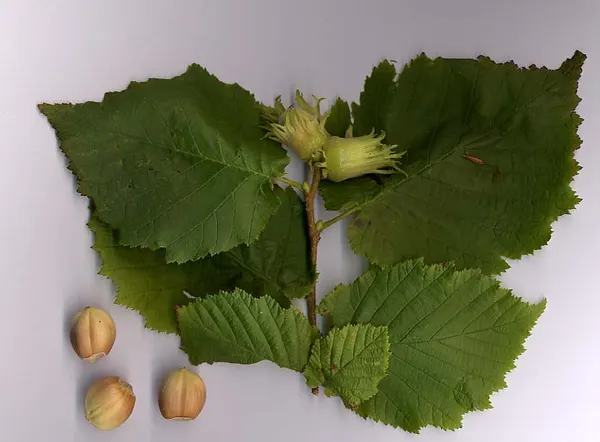
Hazelnut / filbert
Corylus avellana
Other names: Hazelnut / filbert, თხილი (tkhili), Hazel / hazelnut
Edible plantPhoto credit: Wikimedia Commons contributor
Safety information
Safety information
Toxicity: Nut: none known (tree-nut allergen). | None known (common food). Tree-nut allergy is the main concern (general knowledge).
Contraindications: Tree-nut allergy. | (General knowledge) tree-nut allergy.
Interactions: None documented. | None.
Evidence level
Reported in folk medicine sources; not clinically validated. Folk and historical sources have not been validated by clinical research.
Preparations
edible-raw/cooked · nut
Part used: nut
Traditional use: in sweets, sauces, churchkhela, gozinaki(Folk and historical sources have not been validated by clinical research.)
folk medicinal · leaf/bark
Part used: leaf/bark
Traditional use: minor astringent(Folk and historical sources have not been validated by clinical research.)
dietary (etiological belief) · nut
Part used: nut
Traditional use: etiological belief, NOT a remedy: eating too many fresh hazelnuts (and walnuts) in Aug-Sept blamed for outbreaks of saç'ereli (whitlow/panaritium) in children(Folk and historical sources have not been validated by clinical research.)
Associated conditions
Edibility
Edible parts: nuts raw or roasted | Nut, raw/roasted (staple food, especially in western Georgia).
Toxic lookalike warning
Hazelnuts in their leafy husks are distinctive; only eat confirmed hazel and avoid unknown wild nuts/seeds.
Nutritional notes
Rich in monounsaturated fat (oleic acid), vitamin E, manganese, copper, magnesium, folate and protein — a high-value functional nut central to Georgian confectionery. | Healthy fats, vitamin E, magnesium, protein (functional food).
Healing traditions
Related plants
Sources (3)
- Bussmann et al., A comparative ethnobotany ... Republic of Georgia, J Ethnobiol Ethnomed 2016;12:43
- Masalebi Saqartvelos Etnografiisatvis, 2020, N1 (2020)
- Bussmann et al., Unity in diversity — food plants of Sakartvelo, 2021
Sourcing & resources
Affiliate links — we may earn a small commission at no extra cost to you.