
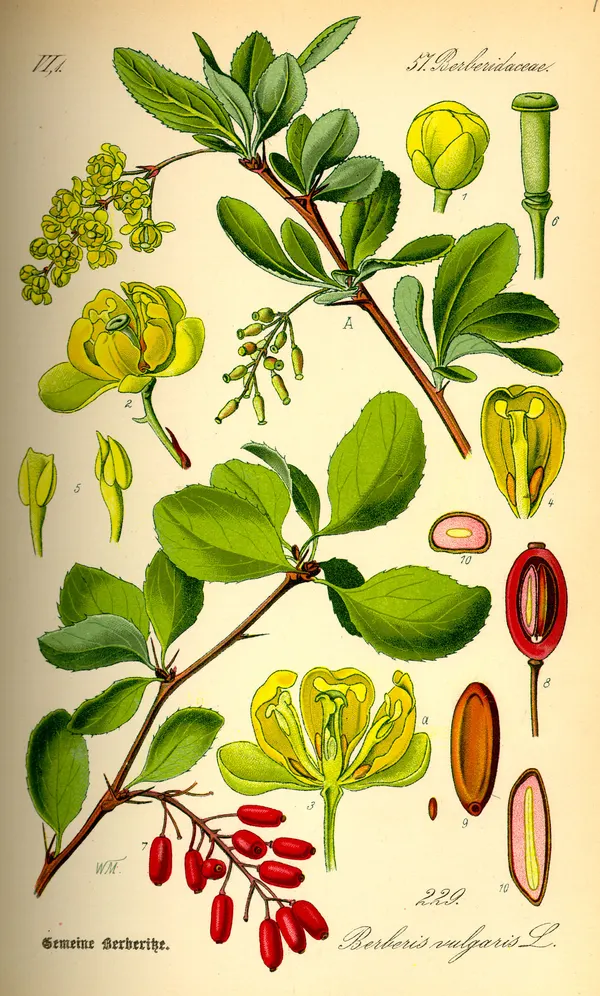
This plant carries serious safety risks. All information is for educational reference only.
Safety information
Toxicity: Berberine-containing. | Ripe berries are food-safe and pleasantly sour. The root/bark/unripe parts are high in berberine, which is contraindicated in pregnancy (berberine can cross the placenta and cause kernicterus risk in neonates) - so the book's 'good in pregnancy' advice is concerning if anything beyond ripe fruit is used. | Ripe berries: safe as food. Root/bark contains berberine and related isoquinoline alkaloids — higher-dose internal use can cause GI upset; isolated berberine has a defined interaction/contraindication profile.
Contraindications: Avoid during pregnancy. | Pregnancy/breastfeeding for berberine-rich parts (root/bark) and supplements; neonatal jaundice risk. | Berberine root preparations: pregnancy and breastfeeding (berberine crosses to the infant, can displace bilirubin → kernicterus risk in neonates; uterine effects) — avoid; neonates/infants.
Interactions: None specifically named (general berberine cautions). | Berberine inhibits CYP enzymes (interacts with many drugs, e.g. ciclosporin) and adds to antidiabetics/antihypertensives. (Safety gate.) | Berberine inhibits CYP3A4/CYP2D6 and P-glycoprotein → raises levels of many drugs (e.g. ciclosporin, midazolam); additive hypoglycaemic effect with antidiabetics and additive hypotensive effect; caution with anticoagulants.
Pregnancy & breastfeeding: Avoid during pregnancy. | Berberine-rich parts contraindicated; book's pregnancy recommendation is concerning. | Berberine root preparations contraindicated (kernicterus risk in neonates; uterine effects).
Evidence level
Supported by clinical trials in humans.
Preparations
This plant carries serious safety risks. All information is for educational reference only.
decoction · bark of root or stem
Part used: bark of root or stem
Traditional use: Traditionally used to correct liver function and promote bile flow (gallstones, gallbladder inflammation, jaundice from a congested liver) and as a bitter tonic with mild laxative effect.
How to prepare (traditional): Decoction: put 1 teaspoon of herb into 1 cup of cold water, bring to a boil, and simmer 10-15 minutes.
Dosage note (descriptive only): Drunk three times a day.
Reference only — not a dosage instruction
tincture · bark of root or stem
Part used: bark of root or stem
Traditional use: Hepatic / cholagogue bitter.
How to prepare (traditional): Tincture at 1:5 in 60% alcohol.
Dosage note (descriptive only): 1-2 ml three times a day.
Reference only — not a dosage instruction
Associated conditions
Edibility
Edible parts: berries are edible (not the medicinal root/stem bark) | Ripe berries (very sour; used as a spice/souring agent, dried). | ripe fruit (fresh/dried) as a sour spice
Toxic lookalike warning
Harvest from confirmed Berberis (spiny shrub, yellow wood, oblong red berries); avoid confusing with other red berries. | The spiny shrub and red oblong berries are fairly distinctive; still confirm species (3-spined thorns, yellow inner wood/bark, oblong red berries) and avoid unknown red berries.
Nutritional notes
Very high vitamin C; organic acids; berberine in non-fruit parts. | Very high vitamin C and organic acids in the fruit; anthocyanins; dried berries are a tart functional spice.
Healing traditions
Related plants
Sources (4)
- Hoffmann D., Medical Herbalism (2003) — David Hoffmann (2003)
- ნუნუ ღლიღვაშვილი-მარგიანი, "მედეადან დღემდე" (Nunu Ghlighvashvili-margiani, "From Medea to the present day")
- Bussmann et al., A comparative ethnobotany ... Republic of Georgia, J Ethnobiol Ethnomed 2016;12:43
- Bussmann et al., Unity in diversity — food plants of Sakartvelo, 2021