
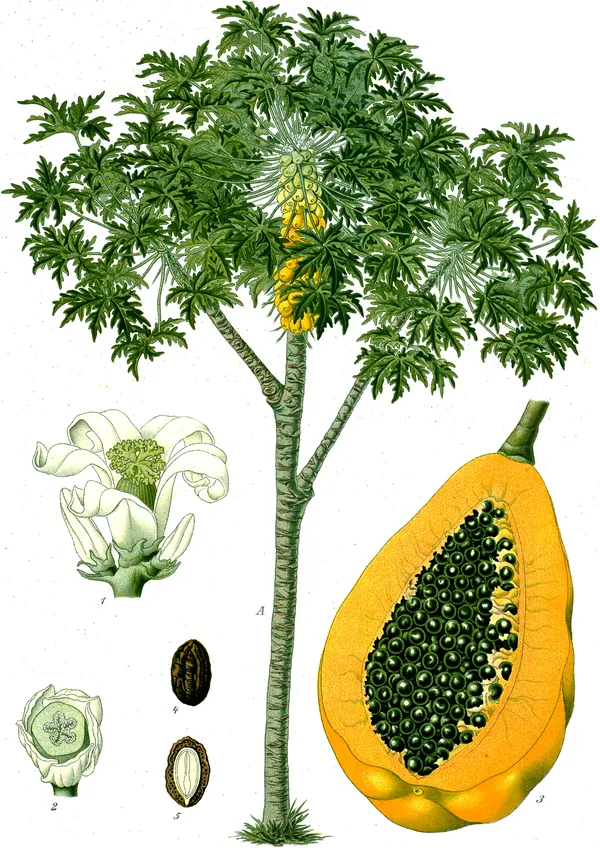
Papaya
Carica papaya
Edible plantPhoto credit: Franz Eugen Köhler, Köhler's Medizinal-Pflanzen
Safety information
Safety information
Toxicity: Ripe fruit safe as food. Papain (latex/unripe fruit) is irritant and a known allergen/sensitizer (contact dermatitis, occupational asthma, cross-reacts with latex allergy). Seeds contain benzyl isothiocyanate; high seed/latex intake has reproductive effects in animals.
Contraindications: Pregnancy — avoid unripe/green papaya, latex, and concentrated seed/leaf preparations (uterine contractions); latex/papain allergy; caution in bleeding disorders.
Interactions: Possible additive effect with anticoagulants/antiplatelets; leaf may interact with hypoglycemic/antihypertensive drugs; papain may enhance absorption of co-administered drugs.
Pregnancy & breastfeeding: Avoid unripe/green papaya, latex, and concentrated seed/leaf preparations in pregnancy (uterine contractions).
Evidence level
Supported by clinical trials in humans.
Preparations
ripe fruit fresh; green fruit cooked · ripe fruit
Part used: ripe fruit
Traditional use: food and digestive aid; leaf juice studied for dengue-associated low platelets; seeds folk anthelmintic and fertility regulation; latex/papain proteolytic/digestive; green fruit folk-reputed to affect pregnancy
Proposed mechanism: papain (digestive protease); latex/seed uterine/abortifacient effects; benzyl isothiocyanate in seeds
leaf juice/extract or decoction · leaves
Part used: leaves
Traditional use: dengue thrombocytopenia
seeds eaten/ground; latex (source of papain) · seeds
Part used: seeds
Traditional use: anthelmintic, fertility regulation
Dosage note (descriptive only): not for pregnancy
Associated conditions
Edibility
Edible parts: Ripe fruit, raw (flesh; seeds removed); green/unripe fruit cooked. Seeds edible in small culinary amounts but have reproductive activity at high intake — not for pregnancy.
Toxic lookalike warning
Do not confuse with North American pawpaw (Asimina triloba, toxic seeds/skin) or toxic 'papaya-like' ornamentals.
Nutritional notes
Ripe fruit rich in vitamin C, provitamin-A carotenoids (beta-carotene, lycopene), folate, potassium, fiber; contains papain (digestive protease).
Healing traditions
Related plants
Sources (2)
- Papaya consumption is unsafe in pregnancy — rat model, Br J Nutr, 2002
- Carica papaya L. Leaf systematic scoping review, Evid Based Complement Alternat Med, 2021
Sourcing & resources
Affiliate links — we may earn a small commission at no extra cost to you.