
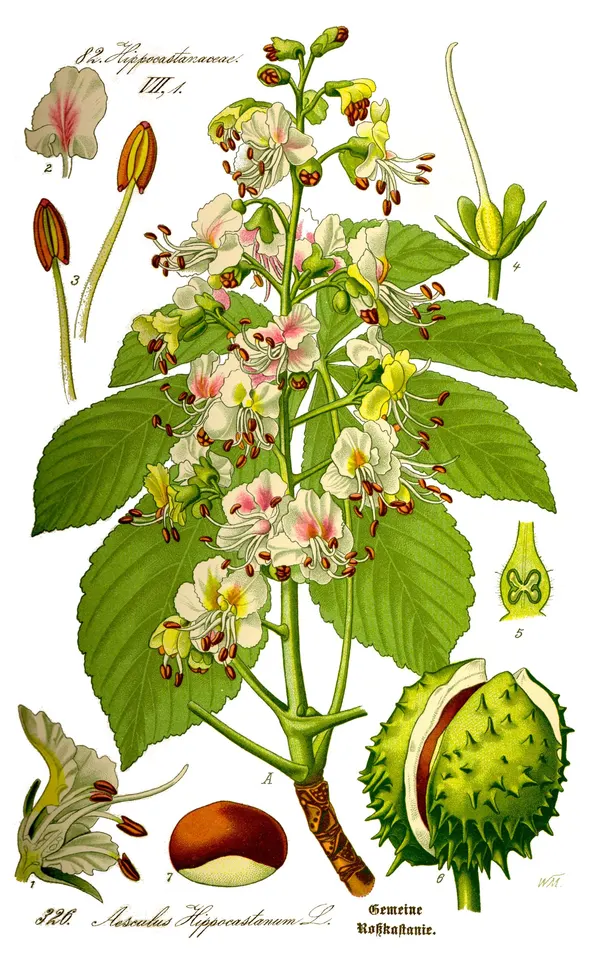
This plant carries serious safety risks. All information is for educational reference only.
Safety information
Toxicity: Serious if misused — raw seeds toxic; GI upset at normal dose; toxic at excess dose. | Seed contains coumarin derivatives; raw seed not for casual use. | Raw horse-chestnut seed contains esculin and saponins and is poisonous - raw ingestion causes GI toxicity and can be serious, especially in children. Only specially processed (aescin-standardised, esculin-removed) pharmaceutical extracts are considered safe internally; the book's home raw-seed tincture is not.
Contraindications: Not for children; do not apply to broken/ulcerated skin; best with professional advice. | Caution around anticoagulant therapy (theoretical). | Children; pregnancy/breastfeeding; bleeding disorders; kidney/liver impairment.
Interactions: May interact with blood-thinning drugs. | Coumarin derivatives may theoretically interact with anticoagulant medications. | Aescin may add to anticoagulants/antiplatelets; theoretical hypoglycaemia. (Safety gate.)
Pregnancy & breastfeeding: Contraindicated.
Evidence level
Supported by clinical trials in humans.
Preparations
This plant carries serious safety risks. All information is for educational reference only.
oil · seed
Part used: seed
Traditional use: Applied topically for rheumatism.
How to prepare (traditional): In France, an oil extracted from the seeds.
infusion · fruit and leaf
Part used: fruit and leaf
Traditional use: Traditionally used for venous problems such as varicose veins and haemorrhoids; commercial extracts are standardised to aescin.
How to prepare (traditional): Infusion: pour 1 cup of boiling water over 1-2 teaspoons of dried fruit and infuse 10-15 minutes.
Dosage note (descriptive only): Drunk three times a day, or used as a lotion externally.
Reference only — not a dosage instruction
tincture · fruit and leaf
Part used: fruit and leaf
Traditional use: Venous tone/circulatory support.
How to prepare (traditional): Tincture at 1:5 in 40% alcohol.
Dosage note (descriptive only): 1-4 ml three times a day.
Reference only — not a dosage instruction
lotion · seed
Part used: seed
Traditional use: Applied topically to varicose veins and hemorrhoids.
How to prepare (traditional): Made into a lotion (also available as gel or ointment). A decoction of the bark or leaf can also be used as an astringent lotion.
Dosage note (descriptive only): Apply twice daily to varicose veins.
Reference only — not a dosage instruction
other · seed
Part used: seed
Traditional use: Taken internally for venous problems such as varicose veins, leg ulcers, piles, and frostbite.
How to prepare (traditional): Tablets, which may have a higher aescin content than other preparations; also available as capsules for long-term use.
Dosage note (descriptive only): professional use only — not provided
Reference only — not a dosage instruction
Associated conditions
Nutritional notes
Not a food.
Healing traditions
Related plants
Sources (3)
- Chevallier A., Encyclopedia of Herbal Medicine (2016) — Andrew Chevallier (2016)
- Hoffmann D., Medical Herbalism (2003) — David Hoffmann (2003)
- ნუნუ ღლიღვაშვილი-მარგიანი, "მედეადან დღემდე" (Nunu Ghlighvashvili-margiani, "From Medea to the present day")