
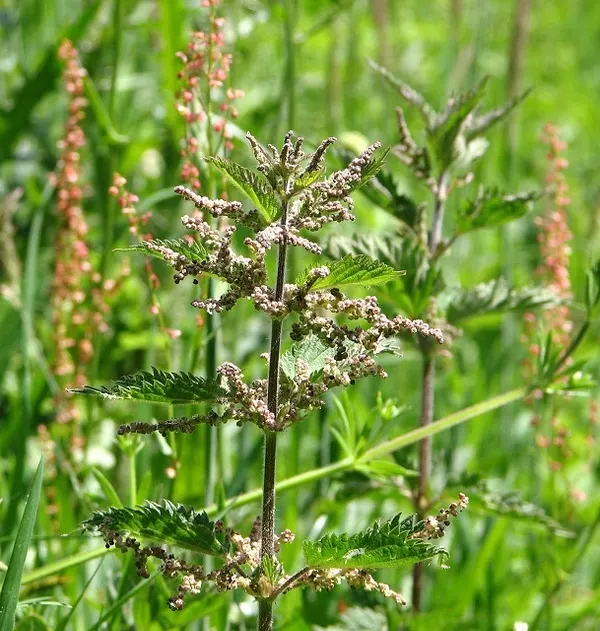
Stinging Nettle
Urtica dioica
Other names: Stinging Nettle, Nettle, Stinging nettle, ჭინჭარი (ch'inch'ari), ჭინჭარი, крапива (krapiva)
Edible plantPhoto credit: Evelyn Simak
Safety information
Safety information
Toxicity: Fresh plant stings (formic acid, histamine, serotonin, acetylcholine in trichomes) causing transient urticaria; cooking/drying destroys the sting. Mild GI effects possible with extracts. | Fresh plant stings (formic acid + histamine-type irritants); transient. A too-strong decoction reportedly caused severe burning. Autumn leaves gritty (cystoliths) and considered harmful - eat only young spring tops. | None known (fresh plant stings — neutralized by cooking/drying). | Fresh nettle causes urticaria (stinging) if applied topically. | Low when cooked/dried; raw plant stings (formic acid, histamine) causing transient skin urtication. | Low when cooked. Raw plant has stinging trichomes (formic acid, histamine, serotonin, acetylcholine) causing transient skin urtication; cooking/drying/crushing destroys the sting. | Fresh plant: mechanical sting (formic acid/histamine) — neutralised by cooking, drying or blanching. Otherwise low. | Mild. Fresh plant causes contact urticaria (stinging hairs); cooking/drying eliminates the sting.
Contraindications: Caution in fluid-retention conditions where increased urine output is undesirable; consult provider in renal/cardiac disease. | None specified by source. Modern: caution with diuretic/antihypertensive and anticoagulant drugs; avoid old/gritty leaves. | None notable. | None specifically named. | Pregnancy caution (book's own juice warning + uterotonic folk reputation); caution with fluid-restriction (diuretic folk use). | Caution in those on diuretics or with fluid-restriction conditions (kidney/heart); pregnancy — medicinal doses (galactagogue/uterine claims) should be discussed with a clinician (cooked food amounts not the concern). | Caution in fluid-restricted conditions (traditional diuretic claim); pregnancy caution for medicinal doses. | For EMA irrigation use, do not use where reduced fluid intake is advised (severe cardiac or renal disease); hypersensitivity. Adults/adolescents >12. Pregnancy caution widely repeated but not verified; medicinal use unstudied.
Interactions: Theoretical interaction with antihypertensives, diuretics, antidiabetics; possible additive effect with anticoagulants (vitamin K content of leaf may oppose warfarin) - consult provider. | None specified by source. | None specifically noted. | Internal use may theoretically decrease the efficacy of anticoagulant drugs (vitamin K content). | High vitamin-K content can oppose warfarin; theoretical additive effect with diuretics/antihypertensives. (Safety gate, not from Keti.) | May add to diuretics and antihypertensives; high vitamin K can oppose warfarin (additive vs opposing with anticoagulants/antiplatelets — monitor); diuretic effect may alter lithium clearance in theory. | Theoretical effects on blood glucose, blood pressure, anticoagulants (high leaf intake / supplements). | Possible additive effect with diuretics and antihypertensives (consistent with diuretic use); theoretical anticoagulant interaction via leaf vitamin K — not verified in a cited clinical source.
Pregnancy & breastfeeding: Not specifically addressed. | Caution; book is self-contradictory - do not rely on it. | Medicinal doses should be discussed with a clinician (galactagogue/uterine claims); cooked food amounts not a concern. | Pregnancy caution for medicinal doses. | Pregnancy caution widely repeated but not verified for a specific harm; medicinal use unstudied — avoid as precaution (cooked nettle as food green low-risk).
Evidence level
Supported by clinical trials in humans.
Preparations
decoction · root
Part used: root
Traditional use: For symptoms of enlarged prostate.
How to prepare (traditional): A decoction is made from the root.
Dosage note (descriptive only): For enlarged prostate, about 3/4 cup (150 ml) daily.
other · leaf
Part used: leaf
Traditional use: Nutritive, iron-rich tonic.
How to prepare (traditional): Leaves are cooked into a soup with carrots and onions, rich in iron.
Dosage note (descriptive only): Drink regularly.
capsule · leaf
Part used: leaf
Traditional use: For enlarged prostate and heavy periods.
How to prepare (traditional): Leaf is made into capsules.
Dosage note (descriptive only): For enlarged prostate, a 300 mg capsule 2-4 times a day; for heavy periods, a 100 mg capsule three times a day.
infusion · leaf
Part used: leaf
Traditional use: General tonic.
How to prepare (traditional): An infusion is made from the leaves.
Dosage note (descriptive only): Drink about 3/4 cup (200 ml) daily as a tonic.
tincture · root
Part used: root
Traditional use: For allergies and skin conditions.
How to prepare (traditional): A tincture is made from the root.
Dosage note (descriptive only): For hay fever, 1 tsp diluted with 1/2 cup (100 ml) water twice a day.
Associated conditions
Edibility
Edible parts: young leaves/tops, cooked (boiling/blanching removes the sting); not eaten raw | young tops cooked as greens/soup/pudding (cooking/drying destroys the sting); wear gloves | young aerial parts cooked as a nutritious vegetable/soup; cooking/drying removes the sting | young tops, cooked (cooking destroys the sting) | Young leaves/shoots, cooked (blanch first; cooking destroys the sting). | young leaves/shoots, always cooked (blanch first) | Young leaves/shoots, always cooked or blanched (never eaten raw fresh). | Young leaves/shoots, cooked or blanched (destroys sting); a traditional pot-herb.
Toxic lookalike warning
Before cooking, distinguish stinging nettle from superficially similar square-stemmed mints/dead-nettles (harmless) and avoid confusion with other unverified weeds; positively identify before harvest. | Before flowering, can be confused with harmless White Dead-Nettle (Lamium album, square hollow stem, no sting); confirm stinging hairs and opposite toothed heart-shaped leaves. | Young nettle can resemble white deadnettle and other square-stemmed mints — confirm the stinging hairs and serrated opposite leaves; harvest young tops only. | Superficially resembles white deadnettle (Lamium album, harmless) — verify before eating; avoid older/flowering nettle leaves (gritty cystoliths). | Before flowering, confirm the sting + square stem + opposite toothed leaves; avoid roadside/sprayed ground (nettle accumulates nitrate/heavy metals). | Before flowering, non-stinging dead-nettles (Lamium spp.) are harmless lookalikes, but foragers can confuse young nettle patches with other roadside herbs; confirm sting + opposite toothed leaves + square stem; never gather near sprayed/roadside ground (accumulates nitrate/heavy metals). | Young nettle confused with white dead-nettle (Lamium album) and hemp-nettle (Galeopsis) (both harmless); real risk is intermixed young ragwort or hemlock seedlings; distinguish from wood nettle; the sting itself confirms Urtica. Harvest only top young leaves; avoid plants gone to seed (gritty cystoliths may irritate kidneys/urinary tract). | Distinctive stinging hairs and opposite serrated leaves; non-stinging 'dead-nettles' (Lamium) are harmless lookalikes, but positively identify shoots before harvest.
Nutritional notes
Functional food - cooked leaves provide notable iron, calcium, vitamins A and C, vitamin K, protein. | Genuinely nutritious cooked green - iron, mineral salts, phosphates; high protein when dried. | Rich in iron, calcium, potassium, silica and vitamins — a notable wild superfood green. | Vitamin C and others, protein, dietary fiber, chlorophyll; iron-rich reputation; functional wild food. | Iron, vitamin C, provitamin-A, vitamin K, calcium; protein-dense for a leafy green. | High in vitamin C, provitamin-A carotenoids, vitamin K, iron, calcium, magnesium and protein; rich in chlorophyll and phenolics (chlorogenic and caffeic acid derivatives). Recognised functional spring food; among the more protein-dense wild greens. | Cooked leaves notably high in iron, calcium, magnesium, vitamin K, vitamin A (carotenoids), protein for a leafy green; one of the most nutrient-dense wild greens. | Cooked leaves nutrient-dense — iron, calcium, vitamins A, C, K, protein; classic functional spring green.
Healing traditions
Related plants
Sources (15)
- Grieve M., A Modern Herbal (1931) — Maud Grieve (1931)
- Chevallier A., Encyclopedia of Herbal Medicine (2016) — Andrew Chevallier (2016)
- Hoffmann D., Medical Herbalism (2003) — David Hoffmann (2003)
- ნუნუ ღლიღვაშვილი-მარგიანი, "მედეადან დღემდე" (Nunu Ghlighvashvili-margiani, "From Medea to the present day")
- Bussmann et al., A comparative ethnobotany ... Republic of Georgia, J Ethnobiol Ethnomed 2016;12:43
- EMA/HMPC Urticae folium (finalised EU herbal monograph)
- EMA/HMPC Urticae radix monograph (root)
- Bussmann et al., Unity in diversity — food plants and fungi of Sakartvelo, J Ethnobiol Ethnomed 2021;17:72
- Martkoplishvili & Kvavadze, Some popular medicinal plants and diseases of the Upper Palaeolithic in Western Georgia, J Ethnopharmacol 2015;166:42-52
- Dujmović 2026 (PMC13206582)
- Mavroeidis 2026 (PMC13210539)
- EMA/HMPC Urticae folium
- USDA FoodData Central (nettle)
- Urticae folium — HMPC summary, EMA/HMPC, 2011 (addendum 2022)
- EU herbal monograph on Urtica dioica L. / Urtica urens L., folium, EMA/HMPC, 2011
Sourcing & resources
Affiliate links — we may earn a small commission at no extra cost to you.