
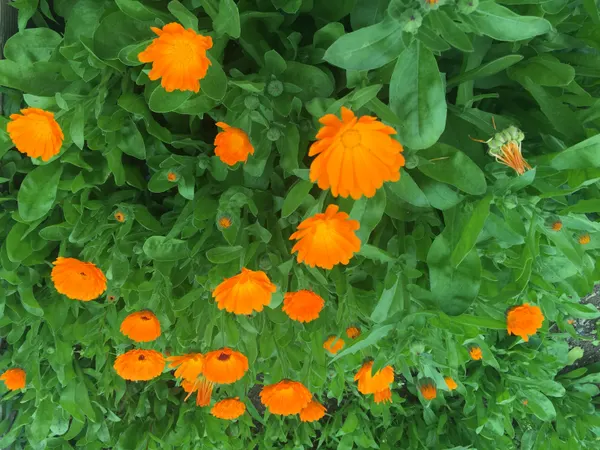
Calendula / Marigold
Calendula officinalis
Other names: Calendula / Marigold, Marigold (Pot Marigold), Calendula (Pot Marigold), Calendula, Calendula / pot marigold, Pot marigold / calendula, календула (kalendula); ноготки (nogotki), Calendula (pot marigold)
Edible plantPhoto credit: Betty Cai
Safety information
Safety information
Toxicity: Skin sensitisation reported (frequency unknown). | None known; non-toxic, also a culinary/edible flower. Modern: Asteraceae-family allergy possible. | None known (rare allergy; Asteraceae/ragweed-sensitive caution). | Possible allergen for Asteraceae-sensitive people; otherwise nontoxic in studies. | Low; rare Asteraceae allergy. | Low; possible Asteraceae contact allergy. | Mild. Skin sensitisation reported (frequency unknown).
Contraindications: Hypersensitivity to Asteraceae. EMA age limits: skin/wounds >6 years; mouth/throat >12 years. | None specified by source. | Ragweed-allergy cross-reactivity possible. | Emmenagogue — general pregnancy caution. | Asteraceae allergy; theoretical pregnancy caution (emmenagogue reputation) at high internal doses. | Asteraceae allergy; medicinal internal use not established for pregnancy (traditional emmenagogue reputation — avoid internal medicinal use in pregnancy). | Hypersensitivity to Asteraceae. Ages: skin/wounds >6 years; mouth/throat >12 years.
Interactions: None established on the public summary. | None specified by source. | None specifically noted. | None specifically reported. | Mild additive sedation/hypotension theoretical; minor. (Safety gate.) | Theoretical additive sedative effect and additive with antihypertensives/antidiabetics at high internal dose; minimal for topical use. | None established in EMA public summary.
Pregnancy & breastfeeding: Not specifically addressed. | Mild emmenagogue (caution). | Emmenagogue — general pregnancy caution. | Theoretical caution at high internal doses. | Avoid internal medicinal use (emmenagogue reputation). | Safety of internal use in pregnancy/lactation not established — avoid internal use as precaution (folk emmenagogue reputation not verified in a cited source).
Evidence level
Supported by clinical trials in humans.
Preparations
infusion · flower
Part used: flower
Traditional use: Traditionally used externally for inflamed skin, wounds, bruises, minor burns and scalds, and internally as an anti-inflammatory for gastric/duodenal ulcers and gallbladder complaints, and as a menstrual normaliser.
How to prepare (traditional): Infusion: pour 1 cup of boiling water over 1-2 teaspoons of flowers and infuse 10-15 minutes. Also applied externally as a lotion or ointment.
Dosage note (descriptive only): Drunk three times a day. Commission E: 1-2 g dried herb per cup (150 ml).
tincture · flower
Part used: flower
Traditional use: Anti-inflammatory vulnerary.
How to prepare (traditional): Tincture at 1:5 in 60% alcohol.
Dosage note (descriptive only): 1-4 ml three times a day.
other · flower
Part used: flower
Traditional use: For cuts and grazes.
How to prepare (traditional): Cream, easy to make.
Dosage note (descriptive only): Apply to cuts and grazes.
oil · flower
Part used: flower
Traditional use: For inflamed dry skin.
How to prepare (traditional): Infused oil, rubbed into the area.
Dosage note (descriptive only): For inflamed dry skin, rub into the area 2–3 times a day.
Associated conditions
Edibility
Edible parts: Petals edible as a culinary garnish/colorant (recognized edible flower), though not the medicinal use. | petals in broths/possets, to colour cheese/butter; leaves in salad | petals are edible (salad garnish, poor man's saffron) | petals are edible (culinary garnish/coloring) | Petals edible (colouring/garnish); not a staple food. | petals edible as a minor culinary garnish/colorant ('poor man's saffron'), not a staple | Petals edible (garnish/colorant), but monographed use is topical/oral-rinse, not food.
Toxic lookalike warning
Positively distinguish from inedible/ornamental marigolds (Tagetes spp.), a different genus. | Only true pot marigold (Calendula officinalis) is edible/medicinal; do not confuse with ornamental African/French marigolds (Tagetes) or with Marsh Marigold (Caltha palustris), acrid and toxic raw. | Distinguish from inedible ornamental Tagetes marigolds. | Confirm true Calendula (orange/yellow daisy flower, sticky aromatic foliage) before consuming any flower; avoid unknown daisy-type flowers. | Use true Calendula officinalis — ornamental Tagetes 'marigolds' are a different genus.
Nutritional notes
Petals minor culinary/colorant use. | Petals a traditional colouring/garnish (carotenoid pigments). | Carotenoid pigments. | Minor culinary use. | Carotenoids (lutein) in petals; negligible bulk nutrition. | Not a nutritional food; flowers contain triterpenoid saponins, carotenoids, flavonoids.
Healing traditions
Related plants
Sources (8)
- Grieve M., A Modern Herbal (1931) — Maud Grieve (1931)
- Chevallier A., Encyclopedia of Herbal Medicine (2016) — Andrew Chevallier (2016)
- Hoffmann D., Medical Herbalism (2003) — David Hoffmann (2003)
- ნუნუ ღლიღვაშვილი-მარგიანი, "მედეადან დღემდე" (Nunu Ghlighvashvili-margiani, "From Medea to the present day")
- Bussmann et al., A comparative ethnobotany ... Republic of Georgia, J Ethnobiol Ethnomed 2016;12:43
- EMA/HMPC Calendulae flos monograph & public summary
- Calendulae flos — HMPC summary, EMA/HMPC, 2018
- EU herbal monograph on Calendula officinalis L., flos (Rev.1), EMA/HMPC, 2018
Sourcing & resources
Affiliate links — we may earn a small commission at no extra cost to you.