
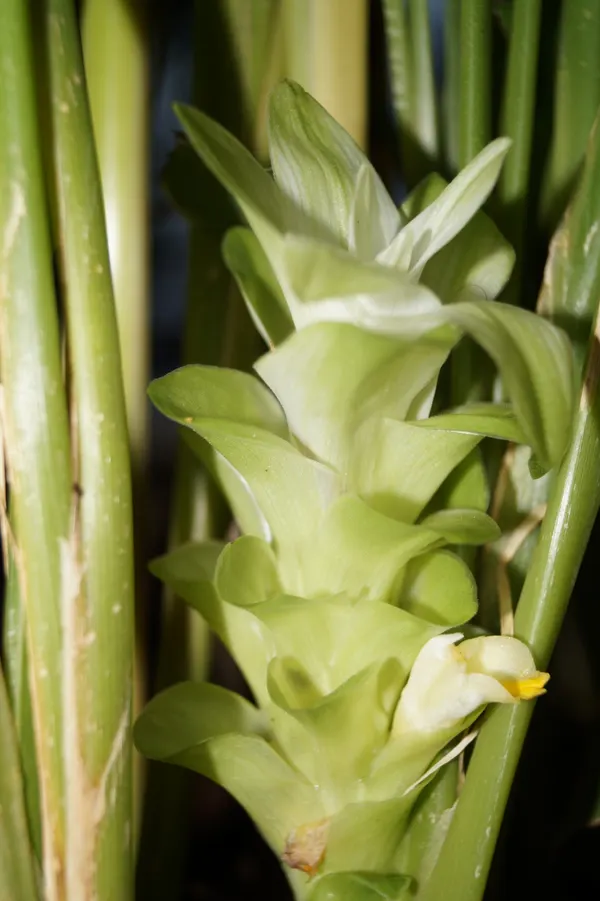
Turmeric
Curcuma longa
Other names: Turmeric, 姜黄 / 薑黃 jiānghuáng; 郁金 yùjīn; haldi, Haridra (हरिद्रा), Haldi (हल्दी)
Edible plantPhoto credit: SKsiddhartthan (Wikimedia Commons)
This plant carries serious safety risks. All information is for educational reference only.
Safety information
Toxicity: Culinary/extract amounts likely safe ~2-3 months; nausea, reflux, GI upset; topical curcumin can cause hives/itching. High-bioavailability curcumin formulations have caused liver injury (DILIN, Halegoua-DeMarzio 2023, PMID 36252717); some linked to piperine-enhanced products. | Mild — occasional skin rash. | Spice doses safe. High-dose supplements linked to drug-induced liver injury (DILIN case series; LiverTox), some products adulterated. | Culinary turmeric well tolerated. High-dose concentrated curcumin supplements (often with absorption enhancers such as piperine) linked to idiosyncratic acute liver injury - recognized cause of herb-induced liver injury in pharmacovigilance and LiverTox. | Low; GRAS as a spice. High-dose curcumin supplements: GI upset; rare hepatotoxicity case reports with high-dose/enhanced-absorption products.
Contraindications: Supplements possibly unsafe in pregnancy. Caution in liver disease, gallstones/bile-duct obstruction, or on hepatotoxic drugs. | Professional advice if on blood-thinning medication or with gallstones. | Liver disease (high-dose supplements); gallstones; pre-surgery (antiplatelet at high doses). | Pre-existing liver disease and high-dose supplement use; gallstones/biliary obstruction (cholagogue); pregnancy at medicinal/supplement doses (uterine-stimulant theory - culinary amounts fine); discontinue supplements before surgery. | Gallstones/bile-duct obstruction (stimulates bile); active hepatic disease (high-dose extracts); before surgery (bleeding risk); iron-deficiency (chelates iron). Caution in pregnancy at medicinal/supplement doses (culinary amounts acceptable).
Interactions: Consult provider; theoretical effects on drug-metabolizing enzymes; piperine co-formulation raises systemic exposure of curcumin and possibly co-administered drugs (CYP3A4/P-gp substrates). | Anticoagulants (additive); gallstone caution. | Possible additive antiplatelet; may affect drug metabolism at supplement doses. | Possible potentiation of anticoagulant/antiplatelet drugs; piperine (in combined products) inhibits drug metabolism/transport and can raise levels of co-administered drugs; possible additive antidiabetic effect. | Anticoagulants/antiplatelets (bleeding), antidiabetics (additive), piperine markedly increases absorption of curcumin and many co-administered drugs (CYP3A4/P-gp inhibition).
Pregnancy & breastfeeding: Supplements possibly unsafe in pregnancy. | Culinary amounts fine; caution at medicinal/supplement doses (uterine-stimulant theory). | Caution at medicinal/supplement doses; culinary amounts considered acceptable.
Evidence level
Supported by clinical trials in humans.
Preparations
This plant carries serious safety risks. All information is for educational reference only.
decoction · rhizome
Part used: rhizome
Traditional use: Traditionally used for gastritis and digestive complaints.
How to prepare (traditional): The rhizome is unearthed, broken into sections, boiled or steamed, then dried; a decoction is prepared from it.
Dosage note (descriptive only): For gastritis, the book suggests about 1/3 cup (75 ml) three times a day.
Reference only — not a dosage instruction
poultice · rhizome
Part used: rhizome
Traditional use: Traditionally applied to the skin for psoriasis and fungal infections.
How to prepare (traditional): A paste/poultice made by mixing the powder with a little water.
Dosage note (descriptive only): For psoriasis, the book suggests mixing 1 tsp with a little water and applying three times a day.
Reference only — not a dosage instruction
powder · rhizome
Part used: rhizome
Traditional use: Traditionally used for digestive complaints/gastritis.
How to prepare (traditional): Powder is described as the most common Ayurvedic preparation, taken with water.
Dosage note (descriptive only): For gastritis, the book suggests 1 tsp with water three times a day.
Reference only — not a dosage instruction
tincture · rhizome
Part used: rhizome
Traditional use: Traditionally used for inflammatory skin conditions such as eczema.
How to prepare (traditional): Tincture diluted in water.
Dosage note (descriptive only): For eczema, the book suggests 1 tsp diluted with 1/2 cup (100 ml) water three times a day.
Reference only — not a dosage instruction
Associated conditions
Edibility
Edible parts: rhizome as culinary spice (powder), raw or cooked | staple culinary spice (rhizome), cooked | Rhizome as cooked spice. | Rhizome is a staple culinary spice (powder/fresh); culinary amounts safe. Concentrated extracts are supplements, not food. | Rhizome widely eaten as culinary spice (cooked or fresh).
Toxic lookalike warning
Generally unmistakable as a sold spice. | Powdered turmeric has documented adulteration with lead chromate (pigment) and metanil yellow dye — a sourcing/contamination hazard rather than a botanical lookalike; buy whole rhizome or tested powder. | No significant lookalike for the powdered commercial spice, but fresh rhizomes can be confused with other Curcuma/Zingiberaceae species — source from reputable suppliers.
Nutritional notes
Functional-food spice; curcuminoids, manganese, iron; low intake amounts. | Antioxidant curcumin; functional-food role. | Curcuminoids (polyphenols), manganese, iron; functional anti-inflammatory spice (low bioavailability). | Functional spice; curcuminoids (curcumin, demethoxycurcumin), aromatic turmerone oils; culinary amounts contribute little macronutrient. | Curcuminoids (antioxidant polyphenols); functional-food role. Modest manganese/iron in spice quantities.
Healing traditions
Related plants
Sources (11)
- Chevallier A., Encyclopedia of Herbal Medicine (2016) — Andrew Chevallier (2016)
- NCCIH Turmeric fact sheet (Feng 2022 BMC, PMID 36261810; Zeng 2022 Front Immunol, PMID 35935936; Halegoua-DeMarzio 2023, PMID 36252717)
- NIH LiverTox Turmeric chapter (NBK548561)
- Curcuma longa / Turmeric (Wikipedia), English, accessed 2026, https://en.wikipedia.org/wiki/Turmeric
- Turmeric (NCCIH/NIH), English, https://www.nccih.nih.gov/health/turmeric
- Turmeric (LiverTox, NCBI Bookshelf NBK548561), English, https://www.ncbi.nlm.nih.gov/books/NBK548561/
- Wang et al., Turmeric: A Comprehensive Review of Its Botany, Traditional Uses, Phytochemistry, and Mechanisms as a Functional Food, Nutrients 2026, PMC13118882
- Zeng 2022, Front Immunol (PMID 35935936)
- Zeng 2021, Biosci Rep (PMID 34017975)
- Gupta 2013, AAPS J (PMID 23143785)
- Soleimani 2018, Phytother Res (PMID 29480523)