
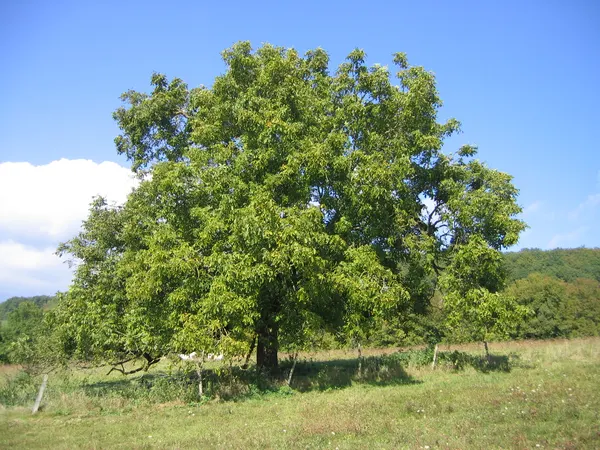
Walnut
Juglans regia
Other names: Walnut, კაკალი / ნიგოზი (kakali / nigozi); მწვანე კაკალი; წენგო; ტიხრები, ნიგოზი (nigozi), კაკალი (kakali)
Edible plantPhoto credit: Thesupermat (Wikimedia Commons)
Safety information
Safety information
Toxicity: Kernel edible/safe. Leaf/green husk contain juglone (an irritant/allelopathic naphthoquinone) — staining, mucosal irritant; flag husk/leaf preps. | Kernel food-safe (tree-nut allergen). Green husk/leaf juglone stains and is mildly irritant. | Kernel: none known (tree-nut allergen). Leaf/husk contains juglone and tannins — astringent; concentrated/prolonged internal use not advised; juglone cytotoxic in vitro. Green husk stains skin and can irritate. | None known (common food). Tree-nut allergy (general knowledge). (Green walnut hulls stain/irritate; not the seed.)
Contraindications: Tree-nut allergy. | Tree-nut allergy; the septa tincture is alcohol-based (avoid in pregnancy/alcohol issues). | Tree-nut allergy (kernel). Medicinal leaf/husk: pregnancy not established; avoid high-dose internal use. | (General knowledge) tree-nut allergy.
Interactions: None documented. | None major for the nut; minor. (Safety gate.) | Leaf preparations theoretical additive with antidiabetic drugs (folk 'sugar' use); high-tannin preparations may reduce absorption of co-taken drugs/minerals (iron). | None significant.
Pregnancy & breastfeeding: Septa tincture alcohol-based; avoid. | Medicinal leaf/husk not established.
Evidence level
Supported by clinical trials in humans.
Preparations
green-walnut + honey or spirit maceration · unripe green fruit
Part used: unripe green fruit
Traditional use: liver cleanser/anti-sclerotic, broad GI tonic(Folk and historical sources have not been validated by clinical research.)
leaf decoction · leaf
Part used: leaf
Traditional use: GI tract, eczema, lymph-node inflammation, 'expel salts' (100 leaves boiled)(Folk and historical sources have not been validated by clinical research.)
husk dye · husk
Part used: husk
Traditional use: brown hair dye(Folk and historical sources have not been validated by clinical research.)
Proposed mechanism: juglone
edible-raw/cooked · kernel
Part used: kernel
Traditional use: Georgian sauces/dishes (bazhe, satsivi, pkhali, churchkhela, gozinaki)
Proposed mechanism: cardiometabolic/lipid benefits (Western dietary trials)
preserve · unripe green nut
Part used: unripe green nut
Traditional use: green-walnut jam (kaklis muraba), tonic(Folk and historical sources have not been validated by clinical research.)
decoction/infusion · leaf/green husk
Part used: leaf/green husk
Traditional use: folk astringent, skin conditions, 'for blood sugar'
Proposed mechanism: leaf polyphenols
dietary (etiological belief) · nut
Part used: nut
Traditional use: same etiological folk belief as hazelnut: eating much fresh walnut in late summer blamed for children's saç'ereli (whitlow). Folk belief, not a remedy(Folk and historical sources have not been validated by clinical research.)
honey electuary / salve / oil · kernel / burnt husk
Part used: kernel / burnt husk
Traditional use: skin disease (qartsetskhli), folk virility (kacobis), headache (leaf infusion)(Folk and historical sources have not been validated by clinical research.)
Dosage note (descriptive only): texts warn against over-eating walnuts
kernel eaten · kernel
Part used: kernel
Traditional use: brain/heart/nerve and anti-anemia tonic (iron + cobalt), goitre (iodine), TB(Folk and historical sources have not been validated by clinical research.)
Proposed mechanism: iron, cobalt, iodine, omega-3 ALA
Dosage note (descriptive only): cap 2-3 kernels for overweight
septa-in-vodka tincture · internal septa
Part used: internal septa
Traditional use: high blood pressure(Folk and historical sources have not been validated by clinical research.)
Associated conditions
Edibility
Edible parts: Kernel raw/cooked; oil culinary. | Ripe kernel (raw/cooked); green walnut used for preserves (Georgian green-walnut jam). | kernels (raw/cooked); unripe green nuts cooked into preserve | Kernel, raw/cooked (staple in Georgian cuisine).
Toxic lookalike warning
Low. | Ripe walnuts are unambiguous in shell; foragers should not confuse green walnuts with other green drupes. | Cultivated walnut is unmistakable, but do not confuse with unrelated wild nuts/seeds; only eat confirmed walnut.
Nutritional notes
Rich in unsaturated fats (omega-3 ALA), protein, iron, cobalt, vitamin E, polyphenols; calorie-dense. | Rich in healthy unsaturated fats (notably omega-3 ALA — walnut is the richest common nut in ALA), protein, vitamin E (gamma-tocopherol), copper, manganese, magnesium, folate and polyphenols — high-value functional food central to the Georgian diet. | Omega-3 (ALA), polyphenols, protein (functional food).
Healing traditions
Related plants
Sources (6)
- ნუნუ ღლიღვაშვილი-მარგიანი, "მედეადან დღემდე" (Nunu Ghlighvashvili-margiani, "From Medea to the present day")
- Bussmann et al., A comparative ethnobotany ... Republic of Georgia, J Ethnobiol Ethnomed 2016;12:43
- Mtsire Karabadini, Part II (Surmanidze, 1990) — Ramaz Surmanidze (1990)
- Karabadini (Khelaia ed., 2009) — Nani Khelaia (ed.) (2009)
- Masalebi Saqartvelos Etnografiisatvis, 2020, N1 (2020)
- Bussmann et al., Unity in diversity — food plants of Sakartvelo, 2021
Sourcing & resources
Affiliate links — we may earn a small commission at no extra cost to you.