
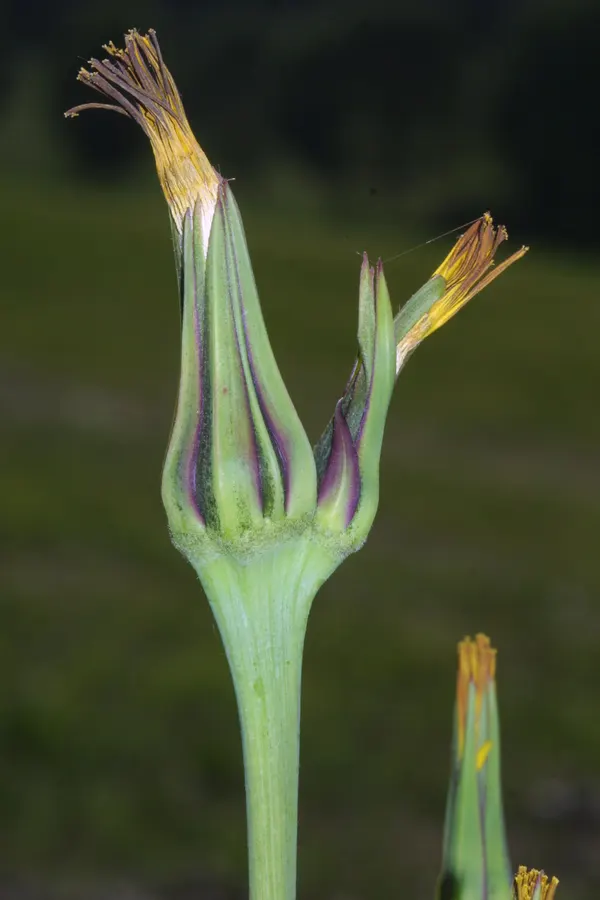
Salsify / goat's-beard
Tragopogon pratensis(?)
Other names: Salsify / goat's-beard
Edible plantSafety information
Safety information
Toxicity: None known as food. Milky latex harmless but bitter; older plants toughen.
Contraindications: None well established; Asteraceae allergy possible.
Interactions: None documented.
Evidence level
Reported in folk medicine sources; not clinically validated. Folk and historical sources have not been validated by clinical research.
Preparations
edible-raw · young shoot
Part used: young shoot
Traditional use: foraged vegetable(Folk and historical sources have not been validated by clinical research.)
cooked · root/shoots
Part used: root/shoots
Traditional use: oyster-like flavour root when cooked(Folk and historical sources have not been validated by clinical research.)
Edibility
Edible parts: young shoots/buds/leaves and root, raw (young) or cooked
Toxic lookalike warning
CRITICAL (root foraging): wild root-vegetables must be identified with certainty; confirm Tragopogon (grass-like leaves, large solitary yellow/purple flower closing by midday, big 'dandelion-clock' seed head, milky latex) — and as with all foraged roots, never confuse with toxic taprooted plants; do not dig unknown roots.
Nutritional notes
Root rich in inulin (prebiotic) and fibre, with potassium and some vitamin C; young greens add minerals — a functional root vegetable.
Healing traditions
Related plants
Sources (2)
- Bussmann et al., A comparative ethnobotany ... Republic of Georgia, J Ethnobiol Ethnomed 2016;12:43
- Bussmann et al., Unity in diversity — food plants of Sakartvelo, 2021
Sourcing & resources
Affiliate links — we may earn a small commission at no extra cost to you.