
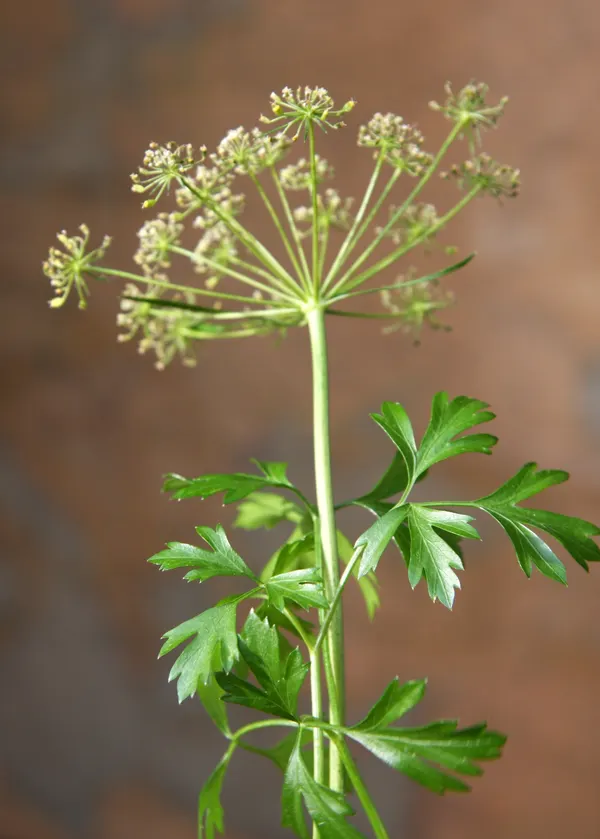
Parsley
Petroselinum crispum
Other names: Parsley
Edible plantPhoto credit: Jonathunder
This plant carries serious safety risks. All information is for educational reference only.
Safety information
Toxicity: Culinary leaf use safe. The concentrated seed oil/oleoresin (Apiol/myristicin) is toxic in quantity - large doses cause giddiness, deafness, fall in blood pressure, slowed pulse, paralysis and fatty degeneration of liver/kidney. Apiol misused as an abortifacient. | Leaf at culinary amounts safe. Parsley seed and concentrated seed oil contain apiole/myristicin — abortifacient and toxic in quantity (FLAGGED, no how-to). Leaf high in vitamin K (warfarin relevance) and contains furanocoumarins (phototoxic in large skin contact).
Contraindications: None specified for culinary use. Avoid Apiol/medicinal seed-oil doses in pregnancy (abortifacient/emmenagogue). | Pregnancy — avoid medicinal/seed amounts (uterine stimulant); warfarin users keep vitamin-K intake consistent.
Interactions: None specified by source. | High vitamin K antagonises warfarin; furanocoumarins (phototoxicity).
Pregnancy & breastfeeding: Avoid Apiol/medicinal seed-oil doses (abortifacient/emmenagogue). | Pregnancy — avoid medicinal/seed amounts (uterine stimulant).
Evidence level
Documented in systematic traditional medicine literature.
Preparations
This plant carries serious safety risks. All information is for educational reference only.
infusion · leaf and root
Part used: leaf and root
Traditional use: Traditionally used as a diuretic for water retention, as an emmenagogue, and as a carminative for flatulence and colic. (Fresh parsley is a rich source of vitamin C.)
How to prepare (traditional): Infusion: pour 1 cup of boiling water over 1-2 teaspoons of leaf or root and infuse, covered, 5-10 minutes.
Dosage note (descriptive only): Drunk three times a day. Commission E: 6 g herb daily.
Reference only — not a dosage instruction
tincture · leaf and root
Part used: leaf and root
Traditional use: Diuretic / carminative.
How to prepare (traditional): Tincture at 1:5 in 40% alcohol.
Dosage note (descriptive only): 1-2 ml three times a day.
Reference only — not a dosage instruction
Associated conditions
Edibility
Edible parts: leaves (raw/cooked, garnish), stems, and turnip-rooted Hamburg parsley (cooked like parsnip) | Leaf raw/cooked; root cooked.
Toxic lookalike warning
Plain-leaved parsley closely resembles Fool's Parsley (Aethusa cynapium, poisonous) - distinguished by Fool's Parsley's darker glossy leaves, unpleasant smell, and three long drooping bracts under each flower umbellule; can also be confused with hemlock. | CRITICAL (Apiaceae): flat-leaf parsley dangerously confused with poison hemlock (Conium maculatum) and fool's parsley (Aethusa cynapium) — both toxic Apiaceae; parsley smells of parsley and lacks a purple-spotted stem, poison hemlock has a smooth purple-blotched hollow stem and mousy smell, fool's parsley has a foul smell and long bracts under the umbel. Never forage flat-leaf parsley by sight alone.
Nutritional notes
Nutritious culinary herb (vitamins/minerals); root a vegetable. | Very high vitamin K, vitamin C, vitamin A (carotenoids), folate, iron; functional culinary green.
Healing traditions
Related plants
Sources (4)
- Grieve M., A Modern Herbal (1931) — Maud Grieve (1931)
- Apiaceae-misidentification literature
- USDA FoodData Central (parsley, raw)
- EMA/toxicology notes on parsley seed apiole