
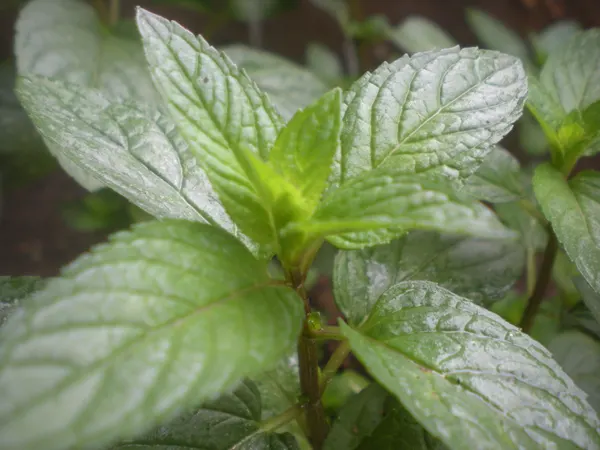
Peppermint
Mentha piperita
Other names: Peppermint, Peppermint / garden mint, პიტნა, Mint / Peppermint & Spearmint, мята перечная (myata perechnaya)
Edible plantPhoto credit: Own work
This plant carries serious safety risks. All information is for educational reference only.
Safety information
Toxicity: Oral: heartburn, perianal burning, menthol odor in urine/stool; rare allergic reactions, bradycardia, tremor; anaphylaxis reported. Inhalation: apnoea, broncho-/laryngospasm in susceptible/allergic patients and in infants. | Culinary mint mild. The text itself warns: large doses of mint cause poisoning (and recommends grated carrot as antidote). See also wild mint / pennyroyal entry — FLAG. | Low at normal doses; menthol/concentrated oil are potent. Modern caution: do not apply menthol/oil to the face/nose of infants and young children (risk of laryngospasm); high oral oil doses can be irritant. | Mild. | None known reported. | Leaf/tea low toxicity. Peppermint oil can cause heartburn/relax lower-oesophageal sphincter; concentrated menthol oil not for infants (apnoea risk). | Mild. Oral oil can cause heartburn, nausea, abdominal pain, dry mouth; rare allergy. Topical oil can irritate skin.
Contraindications: Oral GI use contraindicated in achlorhydria, liver disease, gallstones/bile-duct obstruction. Not for children <8 (IBS) or <2 generally; cold/cough preparations not for children 2-11; topical headache use not <18 (EMA). Do not apply near face/nostrils of infants/young children. | Large doses; reflux (relaxes sphincter). | None specified by source. Modern: caution with reflux/hiatus hernia and in infants. | Do not give to children under 5; essential oil not for children under 12 without advice. | None specifically reported. | GERD/hiatus hernia (oil); infants/young children (menthol — do not apply to face). | Do not apply to the face/nose of infants/young children — menthol can cause reflex apnea. Caution with GERD/hiatal hernia (oil may relax LES). Food amounts likely safe in pregnancy; medicinal amounts not well studied.
Interactions: Caution with drugs reduced by gastric pH changes; theoretical inhibition of some CYP enzymes (e.g., CYP3A4) at high doses. | None documented in source. | None specified by source. | None specifically noted. | None reported. | Peppermint oil may inhibit CYP3A4 at high doses (theoretical). | Peppermint oil may inhibit CYP3A4 → may raise levels of some drugs (certain statins, calcium-channel blockers, cyclosporine) — theoretical/possible.
Pregnancy & breastfeeding: Not specifically addressed; age restrictions apply. | Used for nausea of pregnancy (traditional). | Food amounts likely safe; medicinal amounts not well studied.
Evidence level
Supported by clinical trials in humans.
Preparations
This plant carries serious safety risks. All information is for educational reference only.
enteric capsules · leaves
Part used: leaves
Traditional use: irritable bowel syndrome
infusion · aerial parts
Part used: aerial parts
Traditional use: carminative/antispasmodic for flatulence, flatulent dyspepsia, intestinal colic; nausea, motion sickness, nausea of pregnancy; tension headaches
Proposed mechanism: stimulates bile and digestive juices
inhalation · aerial parts
Part used: aerial parts
Traditional use: nasal catarrh
edible raw/cooked (culinary) · leaf
Part used: leaf
Traditional use: culinary flavour(Folk and historical sources have not been validated by clinical research.)
Proposed mechanism: menthol
infusion (tea) · leaf
Part used: leaf
Traditional use: digestive/carminative
enteric-coated essential-oil capsules · essential oil
Part used: essential oil
Traditional use: IBS-type abdominal pain/bloating
Proposed mechanism: menthol blocks intestinal smooth-muscle L-type calcium channels (antispasmodic), activates TRPM8/TRPA1; modulation of visceral hypersensitivity proposed
Dosage note (descriptive only): IBS trials commonly used enteric-coated capsules ~180-225 mg two to three times daily; descriptive only
Reference only — not a dosage instruction
topical 10% oil in ethanol · essential oil
Part used: essential oil
Traditional use: tension headache
Proposed mechanism: cooling/TRPM8 activation
Dosage note (descriptive only): 10% oil-in-ethanol applied to forehead/temples (EMA); descriptive only
Reference only — not a dosage instruction
infusion (leaf tea) / inhalation · leaf
Part used: leaf
Traditional use: cough/cold symptoms, localized muscle pain and itching
Dosage note (descriptive only): descriptive only
Reference only — not a dosage instruction
infusion / juice / crushed leaf · leaf/aerial parts
Part used: leaf/aerial parts
Traditional use: speech disturbance (mint water in nose), nausea/vomiting (adults and children), digestion, urinary(Folk and historical sources have not been validated by clinical research.)
Dosage note (descriptive only): text warns large doses cause poisoning (grated carrot as antidote)
Reference only — not a dosage instruction
Peppermint Water and Spirit (B.P.), essential oil, infusion/tea, menthol crystals · herb/oil
Part used: herb/oil
Traditional use: flatulence, colic, dyspepsia, abdominal cramp, nausea; prevent griping from purgatives; colds/influenza (with elder flower); topical menthol for neuralgia, rheumatism, headache, toothache, sea-sickness
Proposed mechanism: antispasmodic, stimulant, stomachic, carminative; modern: carminative/antispasmodic recognized (digestive spasm, IBS)
Dosage note (descriptive only): menthol/concentrated oil potent (small doses)
Reference only — not a dosage instruction
infusion (tea) · leaves
Part used: leaves
Traditional use: digestive — relieves gas, bloating, colic, nausea, cramps, soothes colon; tension headaches/migraine; promotes sweating
Proposed mechanism: volatile oil strongly antibacterial; whole herb antispasmodic
Dosage note (descriptive only): not for children under 5
Reference only — not a dosage instruction
diluted essential oil / lotion · leaves
Part used: leaves
Traditional use: chest rub/inhalant
Dosage note (descriptive only): essential oil not for children under 12 without advice
Reference only — not a dosage instruction
enteric-coated oil capsules · aerial parts
Part used: aerial parts
Traditional use: irritable colon / ulcerative bowel conditions
Proposed mechanism: volatile oil mild anaesthetic to stomach wall
Dosage note (descriptive only): Commission E dosing
Reference only — not a dosage instruction
enteric-coated oil · oil
Part used: oil
Traditional use: IBS (medicinal)
Dosage note (descriptive only): GERD caution; not for infants (apnoea risk)
Reference only — not a dosage instruction
essential oil (enteric-coated capsules) · essential oil
Part used: essential oil
Traditional use: IBS symptoms and abdominal pain
Proposed mechanism: Gingerols not relevant; menthol; smooth-muscle relaxant
Dosage note (descriptive only): Recommended in 2021 ACG IBS guideline
Reference only — not a dosage instruction
infusion · leaves
Part used: leaves
Traditional use: indigestion, nausea, bloating, mild spasm, headache, mild calmative
Dosage note (descriptive only): Leaf evidence weaker than oil
Reference only — not a dosage instruction
Associated conditions
Edibility
Edible parts: leaf (culinary - tea, flavoring). Concentrated essential oil is NOT a food. | Leaf raw/cooked, tea. | culinary flavouring, tea, confectionery | common culinary herb (tea, cooking), fresh or dried | culinary herb/flavoring | Leaf raw/cooked. | Leaves (raw in salads/drinks, or as tea); culinary flavoring.
Toxic lookalike warning
Low (aromatic). | Distinguish from Pennyroyal (Mentha pulegium) whose concentrated oil is toxic/abortifacient, and from other square-stemmed labiates when foraging. | Mints are mint-family (square stems, mint smell) and not generally confused with toxic plants; foragers should not confuse non-aromatic square-stemmed plants (some Lamiaceae) — confirm the strong mint scent. Avoid pennyroyal (Mentha pulegium), a true mint whose oil (pulegone) is hepatotoxic/abortifacient — FLAGGED. | When foraging mints, do not mistake for pennyroyal (Mentha pulegium), whose oil is hepatotoxic and abortifacient — confirm by scent and positive ID.
Nutritional notes
Leaf used as flavoring/tea; negligible nutrition. | Flavouring; aids digestion; negligible nutritional value. | Culinary herb. | Culinary aromatic. | Menthol, rosmarinic acid, vitamin A; low-calorie functional culinary herb. | Leaf low-calorie; small amounts of vitamin A, manganese, antioxidants (rosmarinic acid); mainly a flavoring.
Healing traditions
Related plants
Sources (13)
- Grieve M., A Modern Herbal (1931) — Maud Grieve (1931)
- Chevallier A., Encyclopedia of Herbal Medicine (2016) — Andrew Chevallier (2016)
- Hoffmann D., Medical Herbalism (2003) — David Hoffmann (2003)
- Mtsire Karabadini, Part II (Surmanidze, 1990) — Ramaz Surmanidze (1990)
- Karabadini (Khelaia ed., 2009) — Nani Khelaia (ed.) (2009)
- EMA/HMPC Menthae piperitae aetheroleum monograph & public summary
- Linas 2026 Menthacarin phase IV trial (PMID 41405807, DOI 10.1007/s10354-025-01119-2)
- Pastras 2026 plant-derived IBS treatments review (PMID 41599795, DOI 10.3390/nu18020183)
- EMA/HMPC Menthae piperitae aetheroleum (peppermint oil)
- NCCIH peppermint information
- Peppermint Oil: Usefulness and Safety — NCCIH/NIH, 2025
- Ingrosso MR et al., Aliment Pharmacol Ther 2022;56(6):932-941 (PMID 35942669)
- Lacy BE et al., Am J Gastroenterol 2021;116(1):17-44 (PMID 33315591)