
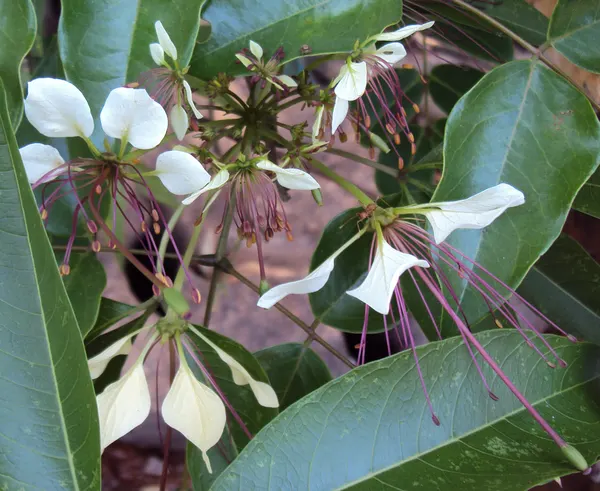
Varuna (three-leaved caper / garlic pear)
Crataeva nurvala
Edible plantPhoto credit: Vinayaraj
Safety information
Safety information
Toxicity: Low at studied doses.
Contraindications: Pregnancy (insufficient data — caution); on diuretics; obstructive uropathy (treat cause).
Interactions: Diuretics, lithium, antihypertensives (additive); few documented.
Pregnancy & breastfeeding: Pregnancy: insufficient data — caution.
Evidence level
Supported by clinical trials in humans.
Preparations
powder · stem bark
Part used: stem bark
in urinary/lithiasis formulas (Varunadi kashaya) · stem bark
Part used: stem bark
decoction · stem bark
Part used: stem bark
Traditional use: urinary calculi, dysuria, prostate/bladder complaints
Proposed mechanism: lupeol (triterpene), beta-sitosterol, saponins — antilithic (crystal/oxalate inhibition), anti-inflammatory, diuretic, bladder-tone-modulating
Associated conditions
Edibility
Edible parts: Young leaves/flowers of Crataeva pickled/eaten as a vegetable in some regions; medicinal part is the bark (not a food).
Toxic lookalike warning
Caper-relative leaves resemble other trifoliate plants; use only authenticated material.
Nutritional notes
Bark not a food; leaves a minor pickled vegetable.
Healing traditions
Related plants
Sources (3)
- Schoendorfer 2018, BMC Complement Altern Med (Urox RCT) (PMC5793427)
- Vidya 2004, J Ethnopharmacol (PMID 15339033)
- Varuna urolithic study 2011, Anc Sci Life (PMID 22131740)
Sourcing & resources
Affiliate links — we may earn a small commission at no extra cost to you.