
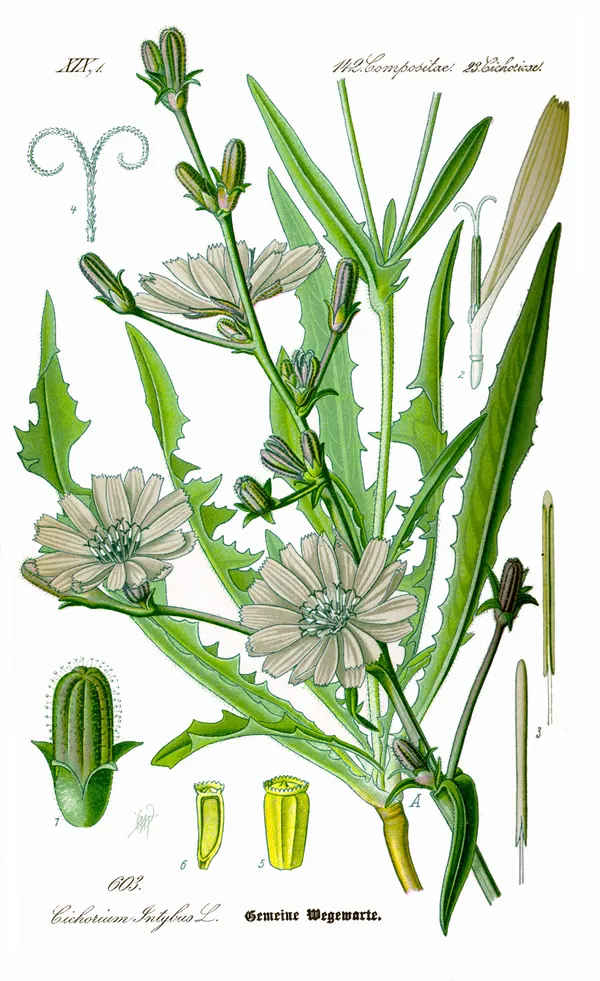
Chicory
Cichorium intybus
Other names: Chicory
Edible plantPhoto credit: Otto Wilhelm Thomé, Flora von Deutschland
Safety information
Safety information
Toxicity: Mild/contextual. Grieve warns habitual/excessive use causes venous passive congestion in digestive organs and may impair visual power; ill-suited to bloodless persons. Possible Asteraceae allergy (modern). | Low. | None known as food. Latex/sesquiterpene lactones can cause Asteraceae contact dermatitis; very high inulin intake causes bloating/flatulence. | Low; contact dermatitis possible (Asteraceae). High-dose inulin causes flatulence/bloating.
Contraindications: Per source, avoid excessive/habitual medicinal use. | Gallstone obstruction (choleretic - a blocked duct is an emergency); Asteraceae allergy; theoretical pregnancy caution (emmenagogue reputation) at high medicinal doses. | Bile-duct obstruction/gallstones (choleretic root); Asteraceae allergy; large root doses in pregnancy not established (mild uterine reputation). | Asteraceae allergy; gallstones (choleretic bitters); fructan intolerance / IBS (inulin).
Interactions: None specified by source. | Inulin may add to other prebiotics/hypoglycaemics; minor. (Safety gate.) | Theoretical additive hypoglycaemic effect (antidiabetics); mild diuretic additive; inulin can alter absorption of some minerals/drugs in large amounts. | None well established at food doses.
Pregnancy & breastfeeding: Theoretical caution at high medicinal doses. | Large root doses not established (mild uterine reputation).
Evidence level
Supported by laboratory or animal studies; not yet confirmed in humans.
Preparations
decoction, infusion, roasted-ground root (coffee additive), syrup, blanched salad, cooked young roots/heads, poultice · root/leaves
Part used: root/leaves
Traditional use: jaundice, liver enlargement, gout, rheumatism, gravel; child's laxative (syrup); poultice for swellings/inflamed eyes
Proposed mechanism: tonic, laxative, diuretic (resembles Dandelion); laxative effect plausible from inulin
Dosage note (descriptive only): avoid excessive/habitual medicinal use (Grieve)
fresh-leaf juice · leaf
Part used: leaf
Traditional use: anemia (1 month), eyesight (with carrot/parsley/celery)(Folk and historical sources have not been validated by clinical research.)
Proposed mechanism: inulin
Dosage note (descriptive only): blended, strained, briefly boiled
root decoction · root
Part used: root
Traditional use: liver pain, anemia, constipation, kidneys, urinary inflammation, expel gallstones(Folk and historical sources have not been validated by clinical research.)
edible-raw/cooked · young leaf
Part used: young leaf
Traditional use: bitter spring green(Folk and historical sources have not been validated by clinical research.)
roasted root · root
Part used: root
Traditional use: caffeine-free 'coffee'(Folk and historical sources have not been validated by clinical research.)
decoction · root
Part used: root
Traditional use: folk digestive/'liver' bitter, mild diuretic/laxative
Proposed mechanism: inulin prebiotic; sesquiterpene-lactone bitters, choleretic, hypoglycaemic
roasted · root
Part used: root
Traditional use: coffee substitute/extract(Folk and historical sources have not been validated by clinical research.)
raw/cooked · leaf
Part used: leaf
Traditional use: bitter green(Folk and historical sources have not been validated by clinical research.)
Associated conditions
Edibility
Edible parts: blanched leaves (raw salad), young heads (cooked like Sea Kale), young roots (boiled) | Young leaves (bitter salad/cooked green), root (roasted coffee substitute). | young leaves raw/cooked (bitter); root cooked/roasted | Root cooked/roasted; leaves raw (bitter) or cooked.
Toxic lookalike warning
Wild rosette resembles dandelion and other composites; identify by tall (2-3 ft) twiggy stems and bright blue flowers before harvesting wild plants. | Chicory rosettes resemble other blue-flowered composites and dandelion relatives; confirm the stiff branched stem and sky-blue ligulate flowers before gathering. | The blue-flowered tall stems are distinctive in flower, but young basal rosettes resemble dandelion and other composites; confirm chicory (milky latex, clasping stem leaves, sky-blue ray flowers) and avoid unknown rosette greens. | Blue-flowered chicory hard to confuse in flower, but rosette leaves resemble other Asteraceae rosettes including ragwort (Jacobaea vulgaris, PA-hepatotoxic) and sow thistle; confirm characteristic sky-blue ligulate flowers and milky latex.
Nutritional notes
Root contains inulin and sugar (coffee-substitute/prebiotic value); a bitter principle. | Root rich in inulin (prebiotic); leaves provide vitamin A, K, folate. | Root very rich in inulin (prebiotic fibre); leaves provide provitamin-A, vitamin K, folate, potassium and bitters — a functional bitter green and prebiotic root. | Root one of the richest dietary sources of inulin (commercial inulin/oligofructose feedstock), a prebiotic soluble fibre; leaves provide vitamin K, folate, vitamin A.
Healing traditions
Related plants
Sources (6)
- Grieve M., A Modern Herbal (1931) — Maud Grieve (1931)
- ნუნუ ღლიღვაშვილი-მარგიანი, "მედეადან დღემდე" (Nunu Ghlighvashvili-margiani, "From Medea to the present day")
- Bussmann et al., A comparative ethnobotany ... Republic of Georgia, J Ethnobiol Ethnomed 2016;12:43
- Bussmann et al., Unity in diversity — food plants of Sakartvelo, 2021
- EMA/HMPC and food-composition literature on Cichorium intybus inulin
- USDA FoodData Central (chicory greens; chicory root)
Sourcing & resources
Affiliate links — we may earn a small commission at no extra cost to you.