
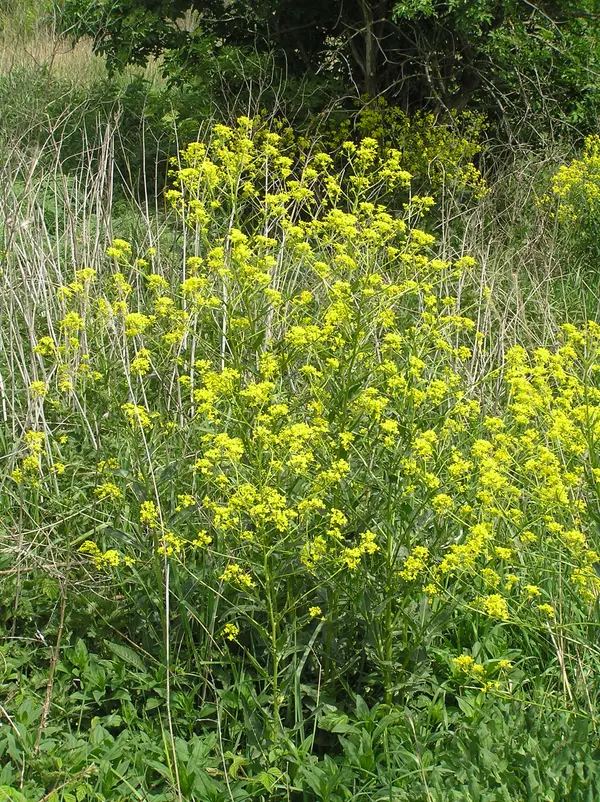
Wild rocket / hedge mustard greens
Bunias orientalis(?)
Other names: various local greens names (svberbiga = Bunias orientalis), Wild rocket / hedge mustard greens
Edible plantPhoto credit: Petr Filippov
Safety information
Safety information
Toxicity: Low as a food green. Brassicaceae contain glucosinolates (goitrogenic in very large raw amounts) — moderate intake is fine; older/strong plants are very pungent.
Contraindications: Thyroid disease (avoid very large raw quantities — goitrogens); otherwise none well established.
Interactions: High vitamin-K leaf may affect warfarin in quantity; otherwise minimal.
Evidence level
Supported by laboratory or animal studies; not yet confirmed in humans.
Preparations
cooked · young leaf/stalk
Part used: young leaf/stalk
Traditional use: cooked green(Folk and historical sources have not been validated by clinical research.)
edible-raw · young leaf/peeled stalk
Part used: young leaf/peeled stalk
Traditional use: foraged spring nibble (notably Bunias orientalis 'sverbiga')(Folk and historical sources have not been validated by clinical research.)
Proposed mechanism: glucosinolate phytochemistry
Edibility
Edible parts: young leaves and peeled young stalks raw/cooked
Toxic lookalike warning
Wild Brassicaceae are generally non-toxic, but young rosettes can resemble other roadside plants; confirm the mustard family (4-petal cross flowers, peppery taste, characteristic seed pods) and avoid unknown rosette greens — and never gather rosettes near where toxic plants grow.
Nutritional notes
Vitamin C, provitamin-A, vitamin K, folate and glucosinolate-derived isothiocyanates; peppery low-calorie greens.
Healing traditions
Related plants
Sources (2)
- Bussmann et al., A comparative ethnobotany ... Republic of Georgia, J Ethnobiol Ethnomed 2016;12:43
- Bussmann et al., Unity in diversity — food plants of Sakartvelo, 2021
Sourcing & resources
Affiliate links — we may earn a small commission at no extra cost to you.