
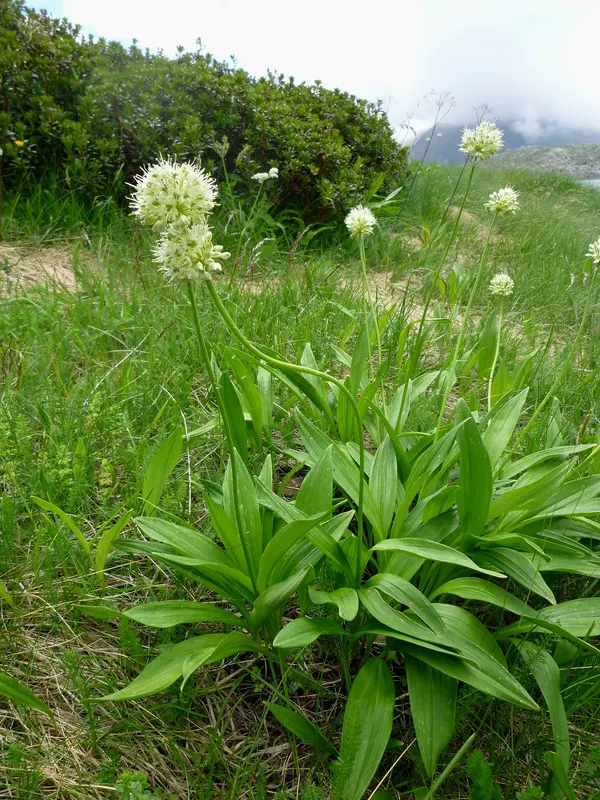
Bear's garlic relatives / wild leek
Allium victorialis
Other names: Bear's garlic relatives / wild leek
Edible plantPhoto credit: Isidre blanc
Safety information
Safety information
Toxicity: None known as food in normal amounts.
Contraindications: As for other wild garlic — large amounts may aggravate reflux; theoretical antiplatelet caution before surgery.
Interactions: Organosulfur compounds may add to antiplatelet/anticoagulant drugs; monitor at high intake.
Evidence level
Supported by laboratory or animal studies; not yet confirmed in humans.
Preparations
edible-raw · young leaf
Part used: young leaf
Traditional use: salads(Folk and historical sources have not been validated by clinical research.)
cooked · leaf/bulb
Part used: leaf/bulb
Traditional use: cooked greens(Folk and historical sources have not been validated by clinical research.)
pickled/salted · leaf
Part used: leaf
Traditional use: salted/pickled for the year(Folk and historical sources have not been validated by clinical research.)
Proposed mechanism: organosulfur/saponin, antioxidant
Edibility
Edible parts: young leaves raw or cooked; bulbs cooked
Toxic lookalike warning
CRITICAL: as with all wild-garlic greens, confirm the strong garlic/onion smell of a freshly crushed leaf and do not confuse with lily-of-the-valley (Convallaria), autumn crocus (Colchicum, fatal) or false hellebore (Veratrum, also fatal), whose young leaves can grow in the same meadows and do not smell of garlic.
Nutritional notes
Vitamin C, organosulfur compounds, manganese; low-calorie aromatic green.
Healing traditions
Related plants
Sources (2)
- Bussmann et al., A comparative ethnobotany ... Republic of Georgia, J Ethnobiol Ethnomed 2016;12:43
- Bussmann et al., Unity in diversity — food plants of Sakartvelo, 2021
Sourcing & resources
Affiliate links — we may earn a small commission at no extra cost to you.