
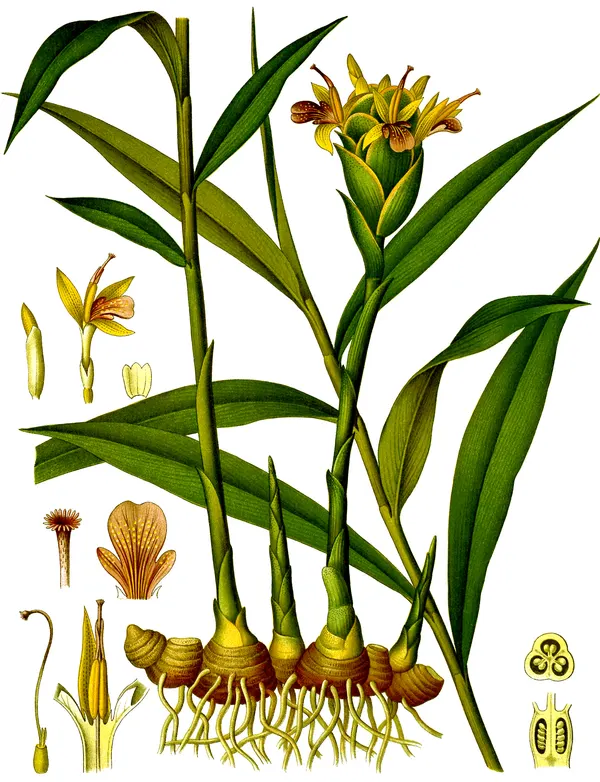
Ginger
Zingiber officinale
Other names: Ginger, ჯანჯაფილი, 生姜 shēngjiāng; 干姜 / 乾薑 gānjiāng; 炮姜 páojiāng, Ardraka (आर्द्रक, fresh), Shunthi (शुण्ठी, dried), Adrak
Edible plantPhoto credit: Franz Eugen Köhler, Köhler's Medizinal-Pflanzen
Safety information
Safety information
Toxicity: Mild - abdominal discomfort, heartburn, diarrhea, mouth/throat irritation. | None known at culinary scale. | Very low as food/spice. Modern: high doses may cause heartburn/GI upset; mild antiplatelet effect possible. Grieve warns commercial Essence of Ginger was often adulterated. | None known at culinary doses. | None known reported at culinary/normal doses. | Mild — heartburn, GI discomfort, mouth/throat irritation. | Low for culinary/food amounts. Higher supplement doses may cause mild GI upset, heartburn, or diarrhea. | Low; mild heartburn, GI discomfort at high doses.
Contraindications: Generally well tolerated. Supplements during pregnancy may be safe but consult a provider; limited breastfeeding data. | Caution with bleeding disorders / high doses. | None specified by source. Modern: large medicinal doses with anticoagulants; gallstones. | Avoid medicinal doses with peptic ulcers; in pregnancy and with anticoagulants keep to ≤2 g dried (≈4 g fresh) per day; essential oil professional-only internally. | Per Commission E, not recommended for morning sickness of pregnancy (though traditional use exists; TCM advises ≤2 g dried ginger daily in pregnancy). | Generally well tolerated; consult provider in pregnancy for supplement doses. | Generally safe in pregnancy at culinary/low supplement doses (used for morning sickness), but high doses and concentrated extracts not well characterized in pregnancy - caution and professional advice advised; caution with gallstones (cholagogue effect) and bleeding disorders. | Bleeding disorders/before surgery (antiplatelet, high doses); gallstones (cholagogue); high medicinal doses in pregnancy debated (culinary amounts acceptable; consult clinician).
Interactions: Talk to provider if on medication; theoretical additive effect with anticoagulants/antiplatelets at high supplement doses (described inconsistently). | May potentiate anticoagulants (modern note, not in source). | None specified by source. Modern: possible additive bleeding risk with anticoagulants in high doses. | Anticoagulants (dose-limit; mild antiplatelet effect). | May influence bleeding times (inhibits thromboxane synthase, prostacyclin agonist); large doses (12–14 g) may enhance anticoagulant drugs. | Theoretical additive antiplatelet/anticoagulant at high supplement doses. | Theoretical additive antiplatelet/anticoagulant effect (warfarin, aspirin, antiplatelet herbs); possible additive effect with antidiabetic and antihypertensive drugs at high doses. | Anticoagulants/antiplatelets (possible additive bleeding at high doses), antidiabetics, antihypertensives.
Pregnancy & breastfeeding: Supplements may be safe but consult provider; limited breastfeeding data. | High-dose medicinal use should follow medical advice (emmenagogue) (modern). | Excellent and safe for pregnancy nausea within the ≤2 g/day limit. | Per Commission E, not recommended for morning sickness; TCM advises ≤2 g dried ginger daily in pregnancy. | Consult provider in pregnancy for supplement doses (may help pregnancy nausea). | Safe at culinary/low doses (used for morning sickness); caution at high doses/concentrated extracts. | High medicinal doses debated; culinary amounts considered acceptable; consult clinician.
Evidence level
Supported by clinical trials in humans.
Preparations
infusion · rhizome
Part used: rhizome
Traditional use: For nausea and digestive complaints.
How to prepare (traditional): An infusion is made from the rhizome.
Dosage note (descriptive only): For nausea, drink 3/4 cup (150 ml) three times a day.
capsule · rhizome
Part used: rhizome
Traditional use: For morning sickness.
How to prepare (traditional): The rhizome is made into capsules.
Dosage note (descriptive only): For morning sickness, a 75 mg capsule every hour.
tincture · rhizome
Part used: rhizome
Traditional use: To improve digestion.
How to prepare (traditional): A tincture is made from the rhizome.
Dosage note (descriptive only): To improve digestion, 30 drops with water twice a day.
oil · rhizome
Part used: rhizome
Traditional use: Applied externally for arthritic aches and pains.
How to prepare (traditional): The essential oil is diluted, 5 drops in 20 drops carrier oil, and applied.
Dosage note (descriptive only): For arthritic aches and pains, apply the diluted oil externally.
Associated conditions
Edibility
Edible parts: rhizome, raw or cooked, widely used as food/spice | Rhizome, spice/food. | rhizome fresh/dried/preserved/candied (spice, tea, baking), cooked and raw | everyday culinary spice/food (rhizome), fresh or dried | culinary spice/food (rhizome), fresh or dried | Rhizome raw/cooked. | Rhizome eaten fresh, dried, pickled, candied, and as a near-universal culinary spice; ginger tea common. | Rhizome widely eaten fresh/dried/cooked; staple culinary spice.
Toxic lookalike warning
Do not confuse with unrelated rhizomes; wild ginger (Asarum spp.) is a DIFFERENT plant containing aristolochic-acid-type/nephrotoxic and carcinogenic compounds and must not be substituted. | Low (imported spice). | Cultivated tropical crop - no significant wild look-alike for the rhizome. | Culinary ginger unmistakable whole; do not substitute wild ginger (Asarum spp.), which contains nephrotoxic/carcinogenic aristolochic-acid–type compounds. | No serious toxic-lookalike for the cultivated rhizome; do not confuse with unrelated rhizomes; only food-grade Z. officinale. | Fresh ginger can be confused with other rhizomes (galangal, turmeric, or rarely unrelated toxic roots) when foraging or buying loose roots; source identified ginger.
Nutritional notes
Functional-food role; gingerols/shogaols (pungent bioactives); culinary spice, low calorie. | Aromatic spice; volatile oil and resins (gingerols/shogaols). | Functional spice; warming, anti-nausea. | Culinary aromatic; antioxidant/antimicrobial food-preservative role. | Gingerols/shogaols (pungent bioactives); low calorie functional spice. | Functional spice/food; gingerols (fresh), shogaols (dried/heated), aromatic sesquiterpenes (zingiberene). Low macronutrient at culinary amounts. | Culinary spice; gingerols/shogaols are bioactive; minor minerals.
Healing traditions
Related plants
Sources (16)
- Grieve M., A Modern Herbal (1931) — Maud Grieve (1931)
- Chevallier A., Encyclopedia of Herbal Medicine (2016) — Andrew Chevallier (2016)
- Hoffmann D., Medical Herbalism (2003) — David Hoffmann (2003)
- Mtsire Karabadini, Part II (Surmanidze, 1990) — Ramaz Surmanidze (1990)
- Karabadini (Khelaia ed., 2009) — Nani Khelaia (ed.) (2009)
- NCCIH Ginger fact sheet (Toth 2018 Phytomedicine, PMID 30466995; Hu 2022, PMID 31937153; Negi 2021, PMID 33842121)
- EMA/HMPC Zingiberis rhizoma monograph
- Zingiber officinale (Wikipedia), English, accessed 2026, https://en.wikipedia.org/wiki/Ginger
- Ginger (NCCIH/NIH), English, https://www.nccih.nih.gov/health/ginger
- Ginger (LactMed, NCBI Bookshelf NBK501772), English, https://www.ncbi.nlm.nih.gov/books/NBK501772/
- Tahergorabi et al., Treatment of Nausea and Vomiting With Zingiber officinale in Pregnancy: An Umbrella Review of Systematic Reviews, Phytother Res 2026, PMID 42322087
- Paudel et al., Pharmacological properties of ginger: what do meta-analyses say? A systematic review, Front Pharmacol 2025, PMC12343617
- Li 2024, Int J Food Sci Nutr (PMID 38072785)
- Viljoen 2014, Nutr J (PMID 24642205)
- Tóth 2018, Phytomedicine (PMID 30466995)
- Crichton 2019, J Acad Nutr Diet (PMID 31519467)
Sourcing & resources
Affiliate links — we may earn a small commission at no extra cost to you.