
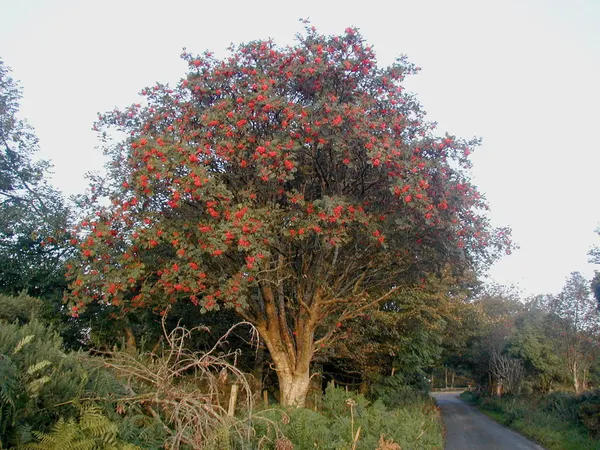
Rowan (mountain ash)
Sorbus aucuparia
Other names: рябина (ryabina), Rowan (mountain ash)
Edible plantPhoto credit: Eeno11
Safety information
Safety information
Toxicity: Mild. Raw berries contain parasorbic acid, which irritates gastric mucosa and can cause nausea/vomiting/diarrhea if eaten raw in quantity. Parasorbic acid degraded by freezing, cooking, or drying. Seeds contain trace cyanogenic compounds — do not eat crushed seeds in quantity.
Contraindications: Avoid large raw intake; caution with sensitive GI; pregnancy/children — use only as processed food, no medicinal dosing established.
Interactions: None well established; sorbitol gives osmotic/laxative effect that could add to other laxatives.
Pregnancy & breastfeeding: Use only as processed food; no medicinal dosing established.
Evidence level
Reported in folk medicine sources; not clinically validated. Folk and historical sources have not been validated by clinical research.
Preparations
compote/jelly/syrup · ripe fruit
Part used: ripe fruit
Traditional use: vitamin source and mild remedy; folk laxative, diuretic, cholagogue, poor appetite/upset stomach(Folk and historical sources have not been validated by clinical research.)
Proposed mechanism: Vitamin C, sorbitol (osmotic laxative), tannins, parasorbic acid
gargle (juice) · fruit
Part used: fruit
Traditional use: hoarseness(Folk and historical sources have not been validated by clinical research.)
Associated conditions
Edibility
Edible parts: Berries, cooked/processed only (compote, jelly, jam, syrup).
Toxic lookalike warning
Do not eat raw berries in quantity (parasorbic acid → GI upset); always debitter by frost/cooking/drying. Do not confuse with red berries of toxic ornamentals; ID the pinnate-leaved rowan correctly.
Nutritional notes
Vitamin C, sorbitol, tannins, carotenoids, organic acids; bitter and astringent.
Healing traditions
Related plants
Sources (1)
- Sorbus aucuparia — Wikipedia (cited to Pahlow, Aichele), 2025
Sourcing & resources
Affiliate links — we may earn a small commission at no extra cost to you.