
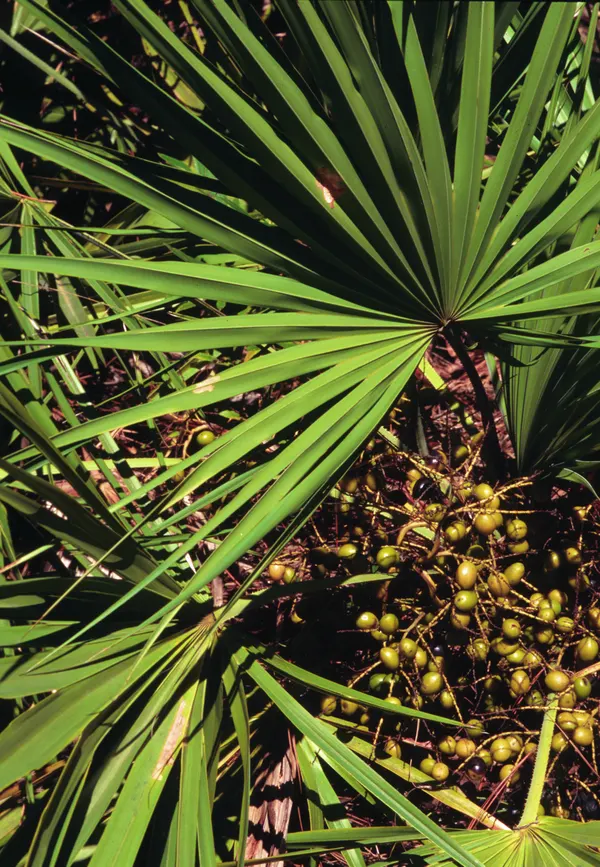
Saw Palmetto
Serenoa repens
Other names: Saw Palmetto
Edible plantPhoto credit: Ted Bodner, Southern Weed Science Society, United States
Safety information
Safety information
Toxicity: Well tolerated up to ~3 years; infrequent mild GI symptoms, dizziness, headache. Does not distort PSA readings. | None known reported.
Contraindications: Possibly unsafe in pregnancy/breastfeeding (hormonal activity). | None specifically reported.
Interactions: No specific interaction established; consult provider (theoretical additive effect with antiplatelets/hormonal drugs). | None specifically reported.
Pregnancy & breastfeeding: Possibly unsafe in pregnancy/breastfeeding (hormonal activity).
Evidence level
Supported by clinical trials in humans.
Preparations
decoction · fruit (berry)
Part used: fruit (berry)
Traditional use: Traditionally and clinically used to tone the male reproductive system and relieve symptoms of benign prostatic hyperplasia (BPH), especially urinary difficulty.
How to prepare (traditional): Decoction: put 2-4 teaspoons of berries in 1 cup of water, bring to a boil and simmer gently 5 minutes. (The active lipophilic fraction for prostate use is better delivered by lipophilic extracts.)
Dosage note (descriptive only): Drunk three times a day. Commission E: 1-2 g berries or 320 mg lipophilic extract daily.
tincture · fruit (berry)
Part used: fruit (berry)
Traditional use: Prostate remedy.
How to prepare (traditional): Tincture at 1:5 in 60% alcohol.
Dosage note (descriptive only): 1-2 ml three times a day.
infusion · fruit
Part used: fruit
Traditional use: Traditionally a diuretic and remedy for enlarged prostate and lower urinary tract symptoms.
How to prepare (traditional): Infusion of the berries; also used in a combined remedy with horsetail and licorice (2 tsp saw palmetto, 2 tsp horsetail, 1 tsp licorice in about 200 ml water).
Dosage note (descriptive only): For enlarged prostate, take about 150 ml daily; for the combined tonic, take about 100 ml twice a day.
tincture · fruit
Part used: fruit
Traditional use: Traditionally a long-term tonic for debility and general failure to thrive (anabolic action).
How to prepare (traditional): Tincture of the berries taken with water.
Dosage note (descriptive only): Take 1 tsp with water daily as a long-term tonic.
Associated conditions
Edibility
Edible parts: Berries historically eaten by Indigenous peoples but not a Western food; bitter. | berries historically eaten by indigenous peoples
Nutritional notes
Not a notable food. | Fatty-acid/sterol-rich fruit.
Healing traditions
Related plants
- Bhringraj (false daisy)Eclipta prostrataClinical
- Varuna (three-leaved caper / garlic pear)Crataeva nurvalaClinical
- Asian cornelian cherry / shan zhu yu (山茱萸)Cornus officinalisClinical
- PeppermintMentha piperitaClinical
- RosemarySalvia rosmarinusClinical
- Baikal Skullcap (Huang Qin)Scutellaria baicalensisClinical
Sources (2)
- Hoffmann D., Medical Herbalism (2003) — David Hoffmann (2003)
- NCCIH Saw Palmetto fact sheet
Sourcing & resources
Affiliate links — we may earn a small commission at no extra cost to you.