
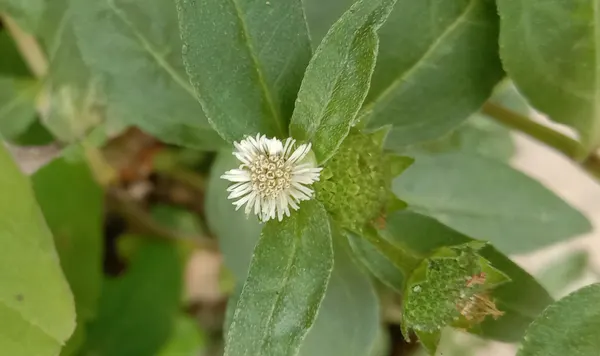
Safety information
Safety information
Toxicity: Low at studied doses; topically generally well tolerated.
Contraindications: Pregnancy (insufficient data — caution); cold/kapha GI states (traditional caution).
Interactions: Theoretical additive with hepatically cleared drugs; possible additive with hair/hormone treatments.
Pregnancy & breastfeeding: Pregnancy: insufficient data — caution.
Evidence level
Supported by clinical trials in humans.
Preparations
medicated oil (Bhringraj taila) · whole plant
Part used: whole plant
powder · whole plant
Part used: whole plant
fresh juice · whole plant
Part used: whole plant
Traditional use: hair growth/greying, liver health, rejuvenation
Proposed mechanism: coumestans (wedelolactone, demethylwedelolactone), triterpene saponins, flavonoids — hepatoprotective, antioxidant, hair-follicle-stimulating, anti-inflammatory
Associated conditions
Edibility
Edible parts: Leaves eaten as a cooked potherb in some regions.
Toxic lookalike warning
Small daisy-family herbs easily confused; some Asteraceae contain hepatotoxic pyrrolizidine alkaloids — only correctly identified Eclipta should be used.
Nutritional notes
Leaves used as a minor cooked green.
Healing traditions
Related plants
Sources (2)
- Li 2026, Front Pharmacol (PMID 42093889)
- Van Anh 2025, Pharmaceuticals (PMID 41304898)
Sourcing & resources
Affiliate links — we may earn a small commission at no extra cost to you.