
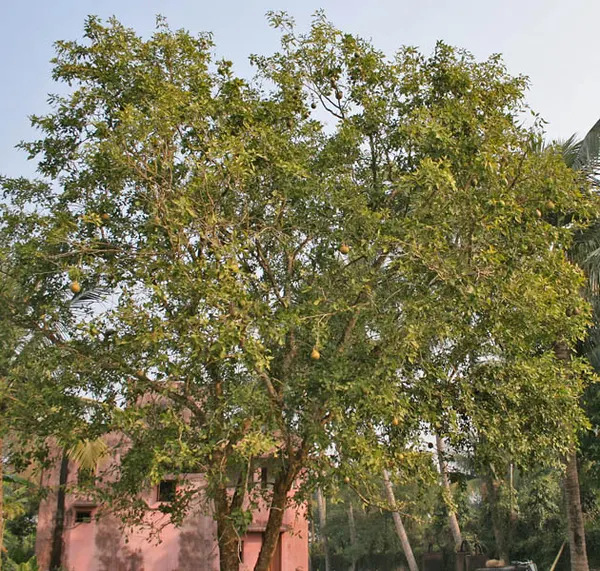
Bael
Aegle marmelos
Other names: Bilva (बिल्व), Bael, Bengal quince, wood apple, Bael
Edible plantPhoto credit: J.M.Garg
Safety information
Safety information
Toxicity: Low for ripe fruit (food); high doses of unripe fruit/leaf may cause GI effects; some reports of constipation with excess unripe fruit.
Contraindications: Pregnancy (insufficient data for medicinal preparations; leaf traditionally cautioned); diabetes (may lower glucose — monitor).
Interactions: Antidiabetics (additive), thyroid (leaf — theoretical), absorption of co-administered drugs (mucilage/tannins).
Pregnancy & breastfeeding: Insufficient data for medicinal preparations; leaf traditionally cautioned.
Evidence level
Supported by clinical trials in humans.
Preparations
fruit pulp/decoction · fruit (esp. unripe)
Part used: fruit (esp. unripe)
Traditional use: antidiarrheal/antidysenteric (unripe fruit), digestive, antimicrobial; ripe fruit laxative/nutritive
Proposed mechanism: Unripe fruit rich in tannins and mucilage (antidiarrheal, astringent, antimicrobial); marmelosin (coumarin) and others antidiabetic/antimicrobial (preclinical)
Dosage note (descriptive only): Ripe fruit eaten/juiced freely as food; unripe-fruit powder/decoction in gram-scale; robust human dosing data limited
Associated conditions
Edibility
Edible parts: Ripe fruit pulp eaten fresh or as sherbet/jam; widely consumed.
Toxic lookalike warning
Hard-shelled fruit superficially resembles other 'wood apples' (e.g., Limonia acidissima) and unrelated hard fruits — use correctly identified Bael.
Nutritional notes
Ripe fruit provides carbohydrates, fiber, vitamin C, carotenoids, minerals; nutritive functional fruit. Bioactives: marmelosin, tannins.
Healing traditions
Related plants
Sources (4)
- Sharma 2022, Int J Mol Sci (PMID 36142805)
- Venthodika 2021, Phytother Res (PMID 33159390)
- Manandhar 2018, J Integr Med (PMID 29709412)
- Maity 2009, Indian J Exp Biol (PMID 20099458)
Sourcing & resources
Affiliate links — we may earn a small commission at no extra cost to you.