
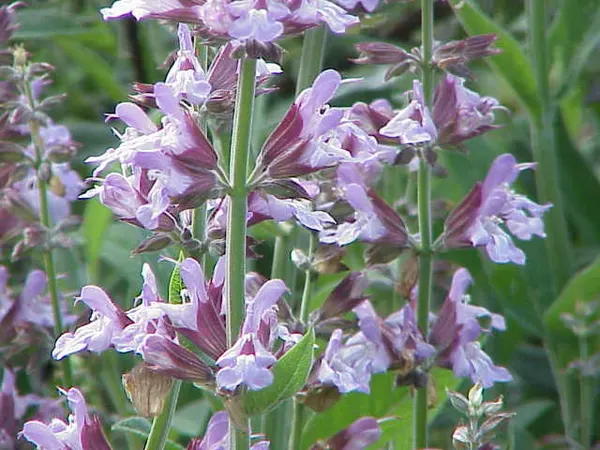
This plant carries serious safety risks. All information is for educational reference only.
Safety information
Toxicity: Leaf infusions/extracts generally well tolerated. Thujone-containing essential oil and high-dose/prolonged use can cause tachycardia, heat sensation, vertigo, and (in excess) seizures - alcoholic extracts and oil carry maximum thujone limits. | Leaf as culinary herb/tea is safe in normal amounts. The volatile oil contains thujone; Grieve calls the oil a violent epileptiform convulsant and notes prolonged smelling causes intoxication/giddiness. Excessive/prolonged high-dose oil or strong-tea use is unsafe. | Mild — contains thujone (avoid medicinal doses long-term). | Adverse reactions likely only with overdose (>15 g leaf/dose) or prolonged use — thujone can cause tachycardia, hot flashes, convulsions, dizziness. | Sage contains thujone; high or prolonged doses of the essential-oil-rich plant can be neurotoxic/convulsant. | Mild for culinary/tea use. Essential oil and high-dose/prolonged extracts are a concern due to thujone (Dalmatian sage oil high in α/β-thujone); GABA-A antagonist/neurotoxin → convulsions at high doses.
Contraindications: Avoid medicinal/high doses and the essential oil in pregnancy and breastfeeding (thujone; sage may also reduce milk supply - traditionally used to wean). Epilepsy: avoid thujone-rich preparations. EMA: mostly adults/adolescents. | None specified by source. Modern: avoid concentrated sage oil and prolonged high-dose use in pregnancy/breastfeeding and epilepsy (thujone). | Avoid medicinal doses in pregnancy, breastfeeding, or epilepsy. | Stimulates the uterus — avoid during pregnancy; avoid prolonged high-dose use. | Pregnancy and breastfeeding (thujone; and sage is anti-galactagogue - the book itself uses it to stop milk); epilepsy; high-dose/long-term internal use. | PREGNANCY and lactation — avoid medicinal/high doses (thujone; traditional emmenagogue; may reduce milk supply). Avoid in epilepsy/seizure disorders. Not for prolonged high-dose use.
Interactions: Theoretical additive effects with anticonvulsants, sedatives, antidiabetic/blood-pressure drugs; possible interaction at high doses - consult provider. | None specified by source. | None specifically noted. | None specifically named (thujone additive with other thujone herbs implied). | May lower seizure threshold; additive sedation; may lower blood glucose. (Safety gate.) | Theoretical additive sedation with CNS depressants; possible additive hypoglycemia; may interact with anticonvulsants (lowers seizure threshold) and anticoagulants (vitamin K / coumarin-type effects).
Pregnancy & breastfeeding: Avoid medicinal/high doses and essential oil in pregnancy and breastfeeding (thujone; galactifuge). | Avoid concentrated oil and prolonged high-dose use (modern). | Avoid medicinal doses in pregnancy. | Avoid during pregnancy (uterine stimulant). | Contraindicated (thujone; anti-galactagogue). | Avoid medicinal/high doses (thujone; traditional emmenagogue; may reduce milk supply).
Evidence level
Supported by clinical trials in humans.
Preparations
This plant carries serious safety risks. All information is for educational reference only.
infusion · leaf
Part used: leaf
Traditional use: Traditionally used as a gargle/mouthwash for inflammations of the mouth, throat and tonsils (gingivitis, stomatitis, laryngitis), as a carminative for dyspepsia, and to reduce sweating and milk production.
How to prepare (traditional): Infusion: pour 1 cup of boiling water over 1-2 teaspoons of leaf and infuse, covered, 10 minutes. Mouthwash/gargle: place 2 teaspoons of leaf in about 0.5 L of water, bring to a boil, stand covered 15 minutes, and gargle deeply with the hot infusion several times a day.
Dosage note (descriptive only): Drunk three times a day. Commission E: 4-6 g dried herb daily; for gargles 2.5 g herb or 2-3 drops essential oil in 100 ml water.
Reference only — not a dosage instruction
tincture · leaf
Part used: leaf
Traditional use: As a digestive tonic.
How to prepare (traditional): Tincture of the leaves taken with water.
Dosage note (descriptive only): Take 40 drops with water twice a day.
Reference only — not a dosage instruction
other · leaf
Part used: leaf
Traditional use: First-aid remedy rubbed on stings and bites.
How to prepare (traditional): Fresh leaves rubbed directly on the skin.
Associated conditions
Edibility
Edible parts: leaves as a culinary herb (fresh/dried), cooked. Culinary amounts safe; concern is concentrated/high-dose medicinal use and the oil. | leaves widely cooked (stuffings, sauces, cheese) and as tea | common culinary herb (leaves) | culinary herb (moderate amounts) | Culinary herb in small amounts (leaves); not a bulk food (thujone). | Leaves, culinary herb (cooked/dried); culinary amounts GRAS.
Toxic lookalike warning
Ornamental/wild Salvia and unrelated grey-leaved plants can be confused; use culinary S. officinalis, identified by its sage aroma. | Do not confuse garden sage with ornamental/wild Salvia species; 'white sage' smudge and hallucinogenic Salvia divinorum are entirely different plants — S. officinalis is not psychoactive.
Nutritional notes
Culinary herb; negligible quantities (vitamin K, volatile oils). | Culinary herb; volatile oil (thujone, cineol, borneol), tannin, resin. | Culinary herb. | Culinary aromatic. | Leaves rich in vitamin K and antioxidants (rosmarinic acid); culinary quantities only.
Healing traditions
Related plants
Sources (9)
- Grieve M., A Modern Herbal (1931) — Maud Grieve (1931)
- Chevallier A., Encyclopedia of Herbal Medicine (2016) — Andrew Chevallier (2016)
- Hoffmann D., Medical Herbalism (2003) — David Hoffmann (2003)
- ნუნუ ღლიღვაშვილი-მარგიანი, "მედეადან დღემდე" (Nunu Ghlighvashvili-margiani, "From Medea to the present day")
- EMA/HMPC Salviae officinalis folium monograph & public summary
- NIH LactMed record for sage (galactifuge/weaning note)
- Sage — Drugs.com (Wolters Kluwer) professional monograph, 2026
- Lopresti AL, Drugs R&D 2017;17(1):53-64 (PMC5318325)
- Thujone — Wikipedia, 2026