
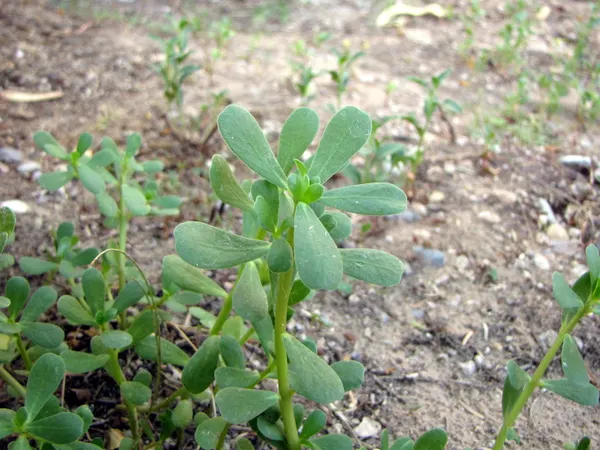
Purslane
Portulaca oleracea
Other names: Purslane, ბირკა
Edible plantPhoto credit: ZooFari
Safety information
Safety information
Toxicity: None known as food. Contains oxalates (like spinach/sorrel) — moderate intake; caution for oxalate-stone-prone people. | Contains soluble oxalates (succulent leaves) — moderate raw amounts fine; cooking reduces oxalate. High-oxalate caution for stone-formers.
Contraindications: Kidney stones (oxalate) — limit large raw intake; otherwise none well established. | Calcium-oxalate kidney-stone history.
Interactions: Oxalate may bind minerals; high intake theoretical additive with diuretics; none clinically significant at food amounts. | Theoretical additive blood-pressure lowering (per meta-analysis).
Evidence level
Supported by clinical trials in humans.
Preparations
cooked · leaf/stem
Part used: leaf/stem
Traditional use: sautéed/in stews and pkhali(Folk and historical sources have not been validated by clinical research.)
pickled · leaf/stem
Part used: leaf/stem
Traditional use: preserve(Folk and historical sources have not been validated by clinical research.)
folk medicinal · whole aerial part
Part used: whole aerial part
Traditional use: cooling, mildly diuretic, 'stomach-soothing'
Proposed mechanism: high omega-3 ALA, antioxidant, mucilage
edible-raw · leaf/stem
Part used: leaf/stem
Traditional use: salad(Folk and historical sources have not been validated by clinical research.)
cooked · leaf/stem
Part used: leaf/stem
Traditional use: stews, sautéed; pickled(Folk and historical sources have not been validated by clinical research.)
Proposed mechanism: cooking reduces oxalate
edible-raw · leaf/stem
Part used: leaf/stem
Traditional use: salad(Folk and historical sources have not been validated by clinical research.)
Associated conditions
Edibility
Edible parts: leaves/stems raw or cooked | Leaves/stems raw or cooked.
Toxic lookalike warning
Purslane (fleshy paddle-shaped leaves, smooth reddish prostrate stems, no milky sap) can be confused with prostrate spurges (Euphorbia spp.), which are toxic and exude milky latex when broken — the milky-sap test distinguishes them; never eat a prostrate 'succulent' that bleeds white latex. | Dangerously confused with petty/hairy spurge (Euphorbia spp., e.g. E. maculata/prostrata), a prostrate weed of same habitats that exudes toxic, irritant white latex when broken — purslane has fleshy hairless stems with NO milky sap, spurge bleeds white latex. Always snap a stem: milky sap = reject.
Nutritional notes
Among the richest leafy plants in omega-3 alpha-linolenic acid (ALA); good vitamin C, vitamin A precursors, magnesium, potassium, and mucilage — a recognised functional green. | One of the richest leafy-plant sources of alpha-linolenic acid (omega-3 ALA); also vitamin C, vitamin E, magnesium, potassium, beta-carotene, glutathione. Functional-food role for omega-3 and BP.
Healing traditions
Related plants
Sources (5)
- Bussmann et al., A comparative ethnobotany ... Republic of Georgia, J Ethnobiol Ethnomed 2016;12:43
- Bussmann et al., Unity in diversity — food plants of Sakartvelo, 2021
- Vajdi 2025 J Res Med Sci purslane-and-blood-pressure systematic review/meta-analysis (PMC12646340)
- Zherkova 2025 Plants (Basel) purslane oxalate/ascorbic-acid assessment (PMC12656633)
- USDA FoodData Central (purslane, raw)
Sourcing & resources
Affiliate links — we may earn a small commission at no extra cost to you.