
Safety information
Safety information
Toxicity: Low; very high vitamin-C/tannin content may cause GI upset, loose stools in excess; tannins can reduce iron absorption. | Very low; widely eaten as food. Excess may loosen stool.
Contraindications: Bleeding disorders/before surgery (antiplatelet effect); caution in those with very low blood sugar/pressure on medication. | Caution in active diarrhoea; theoretical bleeding-risk caution (antiplatelet tendency in preclinical work). Pregnancy: culinary amounts generally regarded as food.
Interactions: Anticoagulants/antiplatelets (additive bleeding), antidiabetics, antihypertensives, lipid drugs (additive). | May potentiate antidiabetic and antiplatelet/anticoagulant drugs (preclinical/theoretical); high vitamin C content.
Pregnancy & breastfeeding: Culinary amounts generally regarded as food.
Evidence level
Supported by clinical trials in humans.
Preparations
fresh fruit/preserves · fruit
Part used: fruit
Traditional use: antioxidant tonic
fresh/dried fruit, powder, decoction, pill, juice · fruit
Part used: fruit
Traditional use: cooling 'bile/heat-clearing' rejuvenative tonic; heat (Tripa) disorders, digestion, vitamin-C restorative
Proposed mechanism: Very high vitamin C, tannins (emblicanin A/B), gallic/ellagic acid — antioxidant, geroprotective, immunomodulatory (mostly preclinical/small studies)
powder/juice · fruit
Part used: fruit
Traditional use: Rasayana antioxidant tonic; digestive, metabolic (lipid/glucose), hair/skin, immune support
Proposed mechanism: Very high vitamin C, hydrolysable tannins (emblicanin A/B), gallic/ellagic acid, flavonoids — antioxidant, lipid-lowering, anti-inflammatory, mild antiplatelet
Dosage note (descriptive only): Trials used Amla fruit powder/extract ~500 mg-1 g/day; fresh fruit eaten directly as food
Associated conditions
Edibility
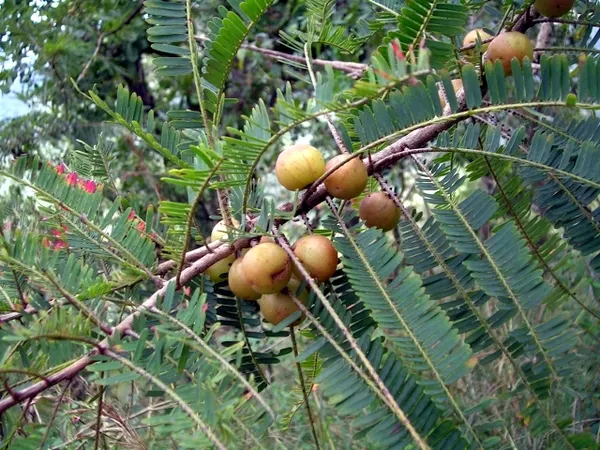
Edible parts: Fruit eaten raw, juiced, pickled, candied; common food. | Fruit eaten raw, cooked, pickled, juiced.
Toxic lookalike warning
Small round green fruits can resemble other wild berries/drupes; buy identified Amla, do not forage unknown green 'gooseberries.' | Fresh amla can be confused with unrelated small green wild fruits; in dried form with other market drupes — confirm identity botanically before use.
Nutritional notes
Exceptionally high vitamin C and polyphenols/tannins; strong functional-food/antioxidant role. Source of dietary fiber. | Very high vitamin C, tannins (emblicanin A/B), gallic/ellagic acid; recognized functional food.
Healing traditions
Related plants
Sources (5)
- Garang et al. 2025, Front Pharmacol (PMID 40963683)
- Setayesh 2023, Diabetes Metab Syndr (PMID 36934568)
- Hashem-Dabaghian 2018, J Cardiovasc Thorac Res (PMID 30386531)
- Thilakchand 2013, Food Funct (PMID 23978895)
- Lewis et al. 2026, J Ayurveda Integr Med (PMID 42172813)
Sourcing & resources
Affiliate links — we may earn a small commission at no extra cost to you.