
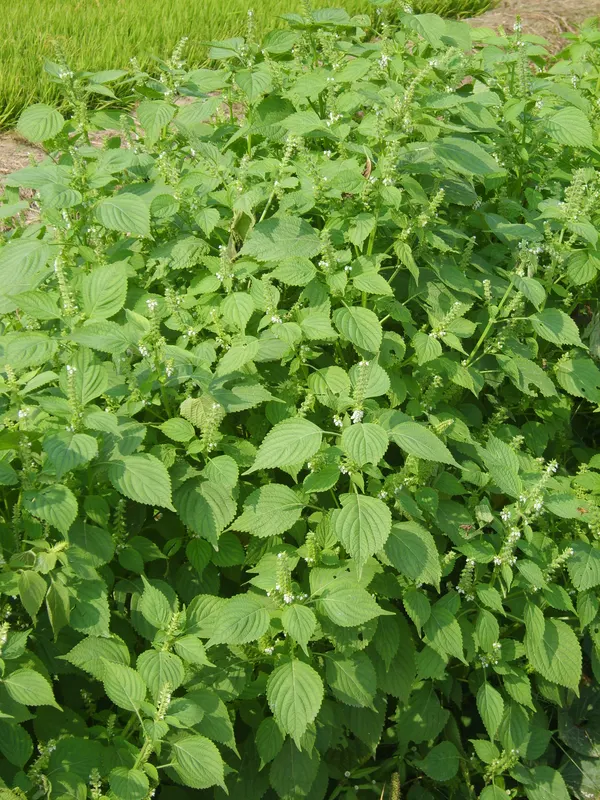
Zi su / perilla
Perilla frutescens
Other names: 紫苏 / 紫蘇 zǐsū; 苏叶 sūyè; 苏梗 sūgěng; 苏子 sūzǐ; shiso; kkaennip, Zi su / perilla
Edible plantPhoto credit: Dalgial
Safety information
Safety information
Toxicity: Low for culinary leaf/seed amounts. Perilla ketone and related compounds are pulmonary toxins in grazing livestock (perilla mint poisoning in cattle) - livestock/forage hazard, not a documented hazard of normal human culinary use; do not consume large amounts of mature/flowering plant material.
Contraindications: Pregnancy at medicinal doses not well characterized; otherwise few for culinary use.
Interactions: Not well characterized.
Pregnancy & breastfeeding: Medicinal doses not well characterized.
Evidence level
Supported by laboratory or animal studies; not yet confirmed in humans.
Preparations
infusion/decoction · leaf
Part used: leaf
Traditional use: releasing the exterior, dispersing cold, warming the middle, moving qi (early colds, fish/crab-poisoning antidote, digestive); seed descends qi and resolves phlegm/cough
Proposed mechanism: rosmarinic acid, perillaldehyde, luteolin, alpha-linolenic acid (seed)
edible leaf · leaf
Part used: leaf
Traditional use: raw/wrapped/pickled culinary(Folk and historical sources have not been validated by clinical research.)
seed oil · seed
Part used: seed
Traditional use: edible oil (omega-3 ALA)(Folk and historical sources have not been validated by clinical research.)
Associated conditions
Edibility
Edible parts: Leaves are a staple culinary herb (Korean/Japanese), eaten raw, wrapped, or pickled; seeds pressed for edible oil (high omega-3 ALA) and used as seasoning.
Toxic lookalike warning
Use food-grade culinary perilla; avoid consuming large quantities of mature flowering plant (livestock-toxic ketones).
Nutritional notes
Functional food; seed oil notably high in alpha-linolenic acid (omega-3); leaves provide rosmarinic acid, carotenoids, minerals.
Healing traditions
Related plants
Sources (2)
- Perilla frutescens (Wikipedia), English, accessed 2026, https://en.wikipedia.org/wiki/Perilla_frutescens
- Perilla - Drugs.com natural database, English, https://www.drugs.com/npp/perilla.html
Sourcing & resources
Affiliate links — we may earn a small commission at no extra cost to you.