
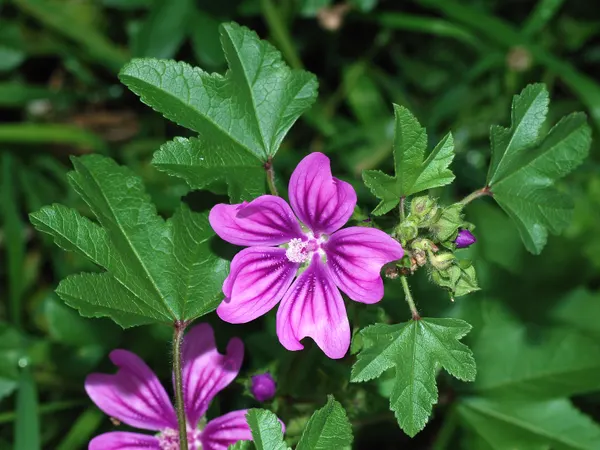
Common mallow
Malva sylvestris(?)
Other names: Common mallow, ბალბა
Edible plantPhoto credit: Alvesgaspar
Safety information
Safety information
Toxicity: None known as food. High-nitrate soils (heavily fertilised/contaminated ground) can let mallow accumulate nitrates — avoid such sites. | Low. Heavy consumption of some Malva spp. linked to seborrhoea/photosensitivity-type effects in livestock literature — not established in normal human food use.
Contraindications: None well established; demulcent mucilage may slow absorption of co-taken oral drugs (separate dosing by ~1-2 h). | None well established at food doses.
Interactions: Mucilage may delay/reduce absorption of other oral medicines taken at the same time. | Mucilage may slow absorption of oral drugs taken simultaneously (general demulcent caution).
Evidence level
Supported by laboratory or animal studies; not yet confirmed in humans.
Preparations
poultice · leaf/flower
Part used: leaf/flower
Traditional use: irritated skin/gut(Folk and historical sources have not been validated by clinical research.)
cooked · young leaf
Part used: young leaf
Traditional use: mucilaginous soups/stews(Folk and historical sources have not been validated by clinical research.)
infusion · flower
Part used: flower
Traditional use: demulcent for cough/sore throat
Proposed mechanism: mucilage demulcent
cooked · young leaf/shoot
Part used: young leaf/shoot
Traditional use: classic Georgian wild pkhali/soup green, fillings(Folk and historical sources have not been validated by clinical research.)
infusion · leaf/flower
Part used: leaf/flower
Traditional use: demulcent tea for sore throat, cough
Proposed mechanism: mucilage emollient/anti-inflammatory
raw · young leaf
Part used: young leaf
Traditional use: salad(Folk and historical sources have not been validated by clinical research.)
Associated conditions
Edibility
Edible parts: young leaves/shoots cooked (also raw in small amounts); flowers edible | Leaves raw/cooked, immature fruits, flowers.
Toxic lookalike warning
Rounded, lobed mallow leaves can be confused with young leaves of other roadside herbs (and superficially with some Geranium/Alcea); confirm palmate veining, notched/heart petals and disc-shaped 'cheese' fruits; avoid lookalikes from unknown plants. | Rounded, lobed mallow leaves confused with young common/creeping buttercup (Ranunculus spp., irritant protoanemonin) and with ground ivy; mallow leaves softly downy with palmate veins and lack the acrid bite of buttercup. Avoid any plant with an acrid/burning taste.
Nutritional notes
Mucilage (soluble fibre), vitamins A and C, calcium, magnesium, iron; valued soft leafy green and a gentle source of fibre. | Mucilage (soluble fibre), vitamin A, vitamin C; demulcent functional role.
Healing traditions
Related plants
Sources (4)
- Bussmann et al., A comparative ethnobotany ... Republic of Georgia, J Ethnobiol Ethnomed 2016;12:43
- Bussmann et al., Unity in diversity — food plants of Sakartvelo, 2021
- EMA/HMPC Althaeae radix (marshmallow root, same mucilage class)
- ethnobotanical food references for Malva sylvestris
Sourcing & resources
Affiliate links — we may earn a small commission at no extra cost to you.