
Safety information
Safety information
Toxicity: None known as food; very acidic raw. | None known at food doses; mild. Very high vitamin-C/acid load makes raw juice intensely sour, potentially upsetting in quantity. | Very low — the berry is a common food. Seeds/oil well tolerated.
Contraindications: None well established; concentrated oil internal use not characterised for pregnancy. | No well-established ones at food amounts. Concentrated oils/extracts not studied in pregnancy/lactation — precautionary avoidance only. Theoretical antiplatelet/bleeding caution — not verified. | No major ones at food doses; theoretical bleeding caution from antiplatelet activity in preclinical work.
Interactions: Theoretical additive with anticoagulants/antiplatelets (vitamin K and unsaturated-fat content); monitor with high-dose oil. | Not well established. Theoretical additive effects with anticoagulants/antiplatelets — not verified. | Possible additive effect with antiplatelet/anticoagulant drugs (theoretical/preclinical).
Pregnancy & breastfeeding: Concentrated oil internal use not characterised. | Concentrated oils/extracts not studied — precautionary avoidance only (not verified in a cited source).
Evidence level
Supported by clinical trials in humans.
Preparations
edible-cooked (juice/syrup) · berry
Part used: berry
Traditional use: vitamin-rich tonic juice/syrup, preserves(Folk and historical sources have not been validated by clinical research.)
oil · seed/fruit
Part used: seed/fruit
Traditional use: topical for burns/skin and internal tonic
Proposed mechanism: skin/mucosal healing
juice/syrup · fruit
Part used: fruit
Traditional use: vitamin tonic, infections
Proposed mechanism: High vitamin C, vitamin E, carotenoids, sterols
oil · pulp/seed
Part used: pulp/seed
Traditional use: topical/oral for burns, wounds, radiation skin injury, mucosal irritation
Proposed mechanism: Carotenoids, tocopherols/tocotrienols, phytosterols, palmitoleic acid (omega-7) in pulp oil, linoleic/α-linolenic in seed oil — plausibly supporting epithelial/mucosal repair
juice/decoction/syrup/paste/oil · fruit, seed
Part used: fruit, seed
Traditional use: cough, phlegm, lung and digestive complaints, 'blood' disorders; food and medicine
Proposed mechanism: Flavonoids (isorhamnetin, quercetin, kaempferol glycosides), carotenoids, tocopherols, vitamin C, phytosterols; seed/pulp oils with palmitoleic acid (omega-7) — mucosal-protective, antioxidant, anti-inflammatory, lipid/metabolic effects (mostly preclinical)
Associated conditions
Edibility
Edible parts: berries (usually cooked/juiced due to acidity) | Berries (raw, very sour; usually cooked into juice/jam/syrup); leaves dried for tea. | Berries eaten raw, juiced, cooked; seed oil used.
Toxic lookalike warning
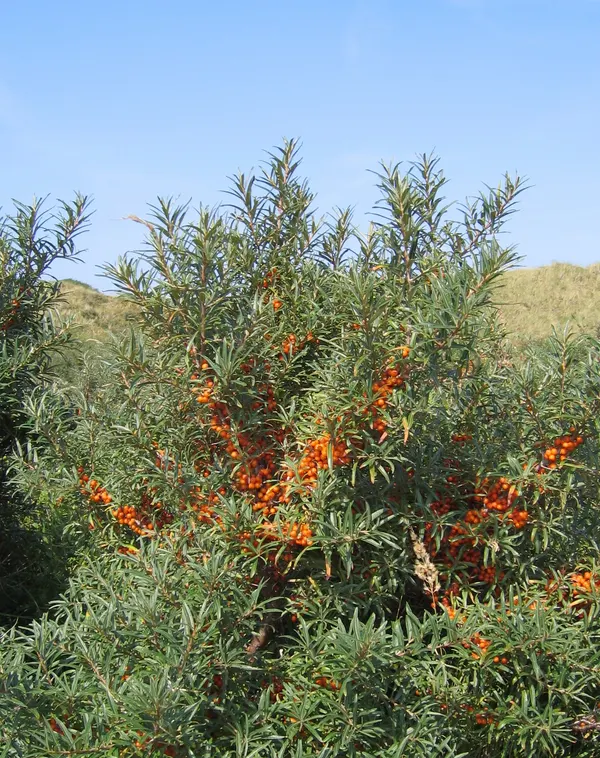
Dense orange berries clustered tightly on thorny shrubs are fairly distinctive; confirm sea buckthorn (silvery narrow willow-like leaves, sharp thorns) and avoid unknown orange/red berries. | Bright orange berries on spiny branches resemble other orange-berried ornamental shrubs; identify by silvery lanceolate leaves and thorns; never eat unidentified orange berries. | Bright orange sea-buckthorn berries grow on thorny shrubs and can be confused with other orange/red wild berries (some toxic, e.g. certain Solanum or honeysuckle berries); confirm species and note the characteristic thorns before harvest.
Nutritional notes
Exceptionally high vitamin C, carotenoids, vitamin E, and unusual omega-7 (palmitoleic) plus omega-3/6 fatty acids in the seed/pulp oil — a recognised nutrient-dense functional food. | Exceptionally vitamin-C rich (~400 mg/100 g fruit), plus vitamin E, vitamin K, carotenoids (beta-carotene, zeaxanthin, lycopene), phytosterols (β-sitosterol); functional-food/nutraceutical role. | Exceptionally high vitamin C, carotenoids, vitamin E, flavonoids, and omega-3/6/7 fatty acids (seed/pulp oil); strong functional-food profile.
Healing traditions
Related plants
Sources (4)
- Bussmann et al., A comparative ethnobotany ... Republic of Georgia, J Ethnobiol Ethnomed 2016;12:43
- Hippophae rhamnoides — Wikipedia (cites Bal 2011; Andersson 2009), 2026
- Liu et al. 2026, Front Pharmacol (PMID 41868122)
- Dong et al. 2025, Front Pharmacol (PMID 41064454)
Sourcing & resources
Affiliate links — we may earn a small commission at no extra cost to you.