
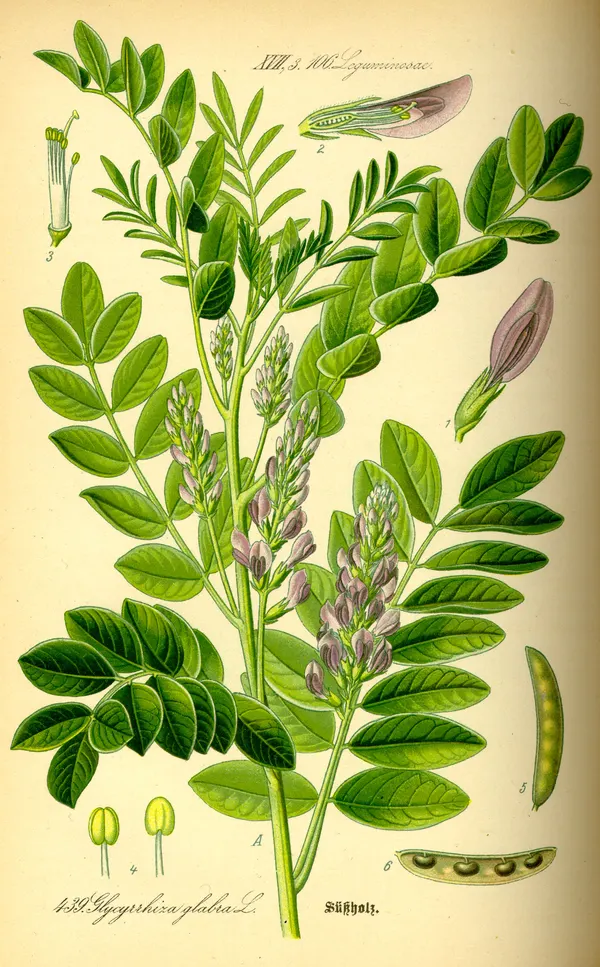
Liquorice / Licorice
Glycyrrhiza glabra(?)
Other names: Liquorice / Licorice, Licorice, ძირტკბილა (dzirt'k'bila — 'sweet-root'), Liquorice, солодка (solodka), лакрица (lakritsa), Yashtimadhu (यष्टिमधु), Mulethi (मुलेठी)
Edible plantPhoto credit: Otto Wilhelm Thomé, Flora von Deutschland
This plant carries serious safety risks. All information is for educational reference only.
Safety information
Toxicity: Excessive or prolonged intake causes pseudohyperaldosteronism: hypertension, fluid retention/oedema, hypokalaemia (muscle weakness, arrhythmias), headache; severe cases caused hospitalisation and deaths (including from licorice confectionery and teas). | Glycyrrhizin in excess causes pseudoaldosteronism — hypertension, low potassium, oedema; flag prolonged/high use. | Serious if overused — excess raises blood pressure and causes fluid/potassium disturbance. | Chronic use can cause hypokalemia, headache, spastic numbness, hypertension, weak limbs, dizziness, edema (mineralocorticoid-type effect). | Glycyrrhizin causes pseudoaldosteronism with excess/prolonged use — sodium/water retention, potassium loss, hypertension, oedema, and arrhythmia; documented hospitalisations and deaths from heavy liquorice intake. Effect dose- and duration-dependent. | SERIOUS with glycyrrhizin. Glycyrrhizic acid causes pseudoaldosteronism → sodium/water retention, hypertension, hypokalemia, edema, irregular heartbeat, and cardiac arrest with large or prolonged intake. Even small amounts can harm high-salt consumers and those with heart/kidney disease. DGL avoids this. | SERIOUS with excess/chronic intake — glycyrrhizin/glycyrrhetinic acid inhibits renal 11β-HSD2 causing pseudohyperaldosteronism: hypertension, hypokalemia, fluid retention, and in severe cases arrhythmia, muscle weakness, even cardiac arrest. Dose- and duration-dependent.
Contraindications: Hypertension, cardiac/kidney/liver disease, hypokalaemia, and pregnancy (heavy glycyrrhizin intake linked to preterm birth, effects on offspring cognition/HPA axis). Avoid in those on the interacting drugs. | Hypertension, heart/kidney disease, pregnancy, hypokalaemia. | Avoid high/long-term doses with high blood pressure or in pregnancy; prolonged use needs supervision. | Avoid prolonged use with thiazide/loop diuretics and cardiac glycosides; not for patients on hypotensives, corticoids, diuretics, or MAO inhibitors; do not combine with spironolactone or amiloride; avoid in hypertension/heart/kidney disease and pregnancy. | Hypertension, heart disease, kidney disease, low potassium, and pregnancy (associated with preterm birth in heavy-consumption studies) — avoid; do not use long-term or in large amounts. | Hypertension; heart disease; kidney disease; low potassium; pregnancy (heavy intake linked to preterm delivery — unsafe); caution in breastfeeding (insufficient data). | Hypertension, heart disease, kidney disease, hypokalemia, edema, pregnancy (linked to preterm birth/effects — avoid).
Interactions: Potentiates potassium loss with thiazide/loop diuretics, corticosteroids, stimulant laxatives; hypokalaemia increases toxicity of cardiac glycosides (digoxin) and risk with QT-prolonging/antiarrhythmic drugs; may oppose antihypertensives. | Diuretics, digoxin, corticosteroids, antihypertensives. | Caution with antihypertensives, diuretics, digoxin (potassium loss). | Potentiates potassium loss → increases cardiac-glycoside toxicity; interacts with diuretics, antihypertensives, corticosteroids, MAOIs, potassium-sparing diuretics. | Potentiates potassium loss with thiazide/loop diuretics and stimulant laxatives → risk with digoxin (hypokalaemia raises toxicity); opposes antihypertensives; affects corticosteroid metabolism; theoretical effect on CYP3A4 and on drugs needing potassium balance. | Corticosteroids (potentiation); diuretics and other potassium-lowering drugs (additive hypokalemia); digoxin (hypokalemia raises toxicity risk); antihypertensives (opposed). | Diuretics (potentiate K+ loss), digoxin (hypokalemia → toxicity), corticosteroids (potentiation), antihypertensives (antagonism), warfarin; many drug interactions.
Pregnancy & breastfeeding: Avoid in pregnancy (heavy glycyrrhizin intake linked to preterm birth and offspring HPA/cognitive effects). | Pregnancy contraindicated. | Avoid high doses in pregnancy. | Avoid in pregnancy. | Avoid (associated with preterm birth in heavy-consumption studies). | Heavy intake linked to preterm delivery — unsafe; avoid. | Avoid — linked to preterm birth/effects.
Evidence level
Supported by clinical trials in humans.
Preparations
This plant carries serious safety risks. All information is for educational reference only.
decoction · root
Part used: root
Traditional use: Traditionally used as a demulcent expectorant for bronchial catarrh, bronchitis and coughs, and for gastritis and peptic ulcers; also liver support (hepatitis, cirrhosis).
How to prepare (traditional): Decoction: put half a teaspoon to 1 teaspoon of root in 1 cup of water, bring to a boil and simmer 10-15 minutes. (Traditional note: for flavouring/sweetening, do not boil more than about 5 minutes to avoid the acrid resin.)
Dosage note (descriptive only): Drunk three times a day. Commission E: 5-15 g root daily (200-600 mg glycyrrhizin).
Reference only — not a dosage instruction
tincture · root
Part used: root
Traditional use: Traditionally taken for gastritis.
How to prepare (traditional): Tincture of the root added to water.
Dosage note (descriptive only): professional use only — not provided
Reference only — not a dosage instruction
other · root
Part used: root
Traditional use: Traditionally chewed for indigestion.
How to prepare (traditional): Dried juice stick, chewed.
Dosage note (descriptive only): professional use only — not provided
Reference only — not a dosage instruction
powder · root
Part used: root
Traditional use: Traditionally rubbed onto canker sores.
How to prepare (traditional): Powder gently rubbed onto the affected area.
Dosage note (descriptive only): professional use only — not provided
Reference only — not a dosage instruction
Associated conditions
Edibility
Edible parts: Root used as a flavoring (licorice confectionery, beverages). Hazard is dose/duration of glycyrrhizin, not lookalike confusion - confectionery and licorice tea can deliver toxic glycyrrhizin loads. | Root used as flavouring; not for sustained high intake. | root used as a confectionery/flavouring; root sticks chewed | root used as flavoring/confection (licorice) | root used as a flavoring/sweetener in small amounts; not a bulk food | Root is the source of licorice flavoring in candy/foods and is 'generally considered safe as a food ingredient' — but glycyrrhizin accumulates with heavy/chronic intake. Not a foraged-root food; positive ID required. | Root used as a flavoring (confectionery, teas). As food carries same dose-dependent hazard: regular/large consumption of real-licorice products can cause hypertension and hypokalemia.
Toxic lookalike warning
Confirm Glycyrrhiza (pinnate leaves, pea-family flowers, sweet root) before harvesting any wild root; never dig unknown roots (Caucasus has toxic taprooted plants). | Positive ID required for any wild root. | Distinguish from anise-flavored candy that contains no real licorice.
Nutritional notes
Flavoring; relevant issue is glycyrrhizin load, not nutrition. | Sweet flavouring (glycyrrhizin ~50× sweeter than sugar). | Flavoring; not a significant food. | Sweetener/flavoring; not a nutritional food. | Not a nutritional food; active is glycyrrhizin (~50x sweeter than sugar) plus flavonoids. (Many US 'licorice' candies use anise oil, not real licorice.) | Flavoring only; bioactive glycyrrhizin.
Healing traditions
Related plants
Sources (13)
- Chevallier A., Encyclopedia of Herbal Medicine (2016) — Andrew Chevallier (2016)
- Hoffmann D., Medical Herbalism (2003) — David Hoffmann (2003)
- Bussmann et al., A comparative ethnobotany ... Republic of Georgia, J Ethnobiol Ethnomed 2016;12:43
- Mtsire Karabadini, Part II (Surmanidze, 1990) — Ramaz Surmanidze (1990)
- Karabadini (Khelaia ed., 2009) — Nani Khelaia (ed.) (2009)
- EMA/HMPC Liquiritiae radix monograph & public summary
- EFSA/EU and national food-safety guidance on glycyrrhizin intake limits
- Licorice Root: Usefulness and Safety — NCCIH/NIH, 2025
- Geijerstam et al., Am J Clin Nutr 2024 (PMID 38246526)
- Penninkilampi et al., J Hum Hypertens 2017 (PMID 28660884)
- Nazari 2017, Phytother Res (PMID 28833680)
- Ceccuzzi 2023, Nutrients (PMID 37764649)
- van Uum 2005, Neth J Med (PMID 15869038)