
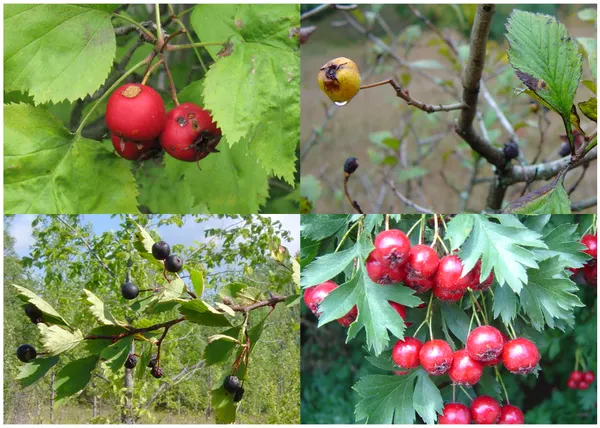
Hawthorn
Crataegus(?)
Other names: Hawthorn, კუნელი (k'uneli)
Edible plantPhoto credit: Nadiatalent (Wikimedia Commons)
Safety information
Safety information
Toxicity: Low. | Low for fruit/flower; seeds (like many Rosaceae pips) contain cyanogenic compounds — do not crush/eat the seeds.
Contraindications: Serious cardiac disease must be physician-managed - self-treating angina/arrhythmia with a folk tincture is dangerous (a true cardiac event is an emergency). | Cardiac patients should not self-treat heart disease with hawthorn instead of medical care; pregnancy not established for medicinal doses.
Interactions: May potentiate digoxin, antihypertensives, nitrates and beta-blockers - clinically relevant; monitor. (Safety gate.) | IMPORTANT: may potentiate cardiac glycosides (digoxin), antihypertensives, beta-blockers, nitrates, and PDE5 inhibitors — additive cardiovascular/hypotensive effects; medical supervision needed.
Pregnancy & breastfeeding: Not noted. | Not established for medicinal doses.
Evidence level
Supported by clinical trials in humans.
Preparations
fruit eaten · fruit
Part used: fruit
Traditional use: anemia (ცირცელი fruit)(Folk and historical sources have not been validated by clinical research.)
infusion/decoction · flower/fruit
Part used: flower/fruit
Traditional use: folk 'heart' tonic — heart and circulation, calming/sleep, blood pressure(Folk and historical sources have not been validated by clinical research.)
edible-cooked/syrup · fruit
Part used: fruit
Traditional use: haws eaten, preserves/leather(Folk and historical sources have not been validated by clinical research.)
standardized extract (WS 1442) · leaf-and-flower
Part used: leaf-and-flower
Traditional use: chronic heart failure NYHA I-II (Western trials/meta-analyses)
infusion · flower/fruit
Part used: flower/fruit
flower/fruit tincture (drops) · flower/fruit
Part used: flower/fruit
Traditional use: heart tonic - angina/stenocardia, ischaemic heart disease, arrhythmia, palpitations, high blood pressure, insomnia(Folk and historical sources have not been validated by clinical research.)
Proposed mechanism: flavonoids
Dosage note (descriptive only): 10 drops every 15-20 min then 3x/day (angina)
Associated conditions
Edibility
Edible parts: Ripe hawthorn fruit (mealy, eaten fresh/processed); stone discarded. | fruit flesh cooked (avoid/strain seeds); flowers/leaves for tea
Toxic lookalike warning
Ensure fruit is from Crataegus (haws, single/few hard stones, thorny shrub) and not confused with other red shrub berries. | Red haws are distinctive (thorny shrub, single-stone or few-stone haws, lobed leaves), but confirm the species and never crush/swallow the stones; avoid unknown red shrubby berries.
Nutritional notes
Fruit provides flavonoids, vitamin C, pectin. | Polyphenols (oligomeric procyanidins, flavonoids), vitamin C, pectin in fruit.
Healing traditions
Related plants
Sources (3)
- ნუნუ ღლიღვაშვილი-მარგიანი, "მედეადან დღემდე" (Nunu Ghlighvashvili-margiani, "From Medea to the present day")
- Bussmann et al., A comparative ethnobotany ... Republic of Georgia, J Ethnobiol Ethnomed 2016;12:43
- Bussmann et al., Unity in diversity — food plants of Sakartvelo, 2021
Sourcing & resources
Affiliate links — we may earn a small commission at no extra cost to you.