
This plant carries serious safety risks. All information is for educational reference only.
Safety information
Toxicity: Generally well tolerated; mild dizziness, headache, GI upset, palpitations reported infrequently. | None known. | Low — usually no adverse effects at normal doses; reportedly toxic in high doses. Rare mild events (dizziness, headache, nausea, palpitations, GI, rash); one hypersensitivity/renal case report with a related species.
Contraindications: Self-treatment of heart disease is inappropriate - cardiac symptoms must be medically evaluated. Limited pregnancy/breastfeeding data. EMA traditional-use products: adults only. | Seek professional advice if on heart or blood-pressure medication. | Allergy to Rosaceae. Avoid in pregnancy/lactation absent human data (animal data reassuring).
Interactions: Theoretical additive effects with cardiac glycosides (digoxin), antihypertensives, nitrates, other cardiovascular drugs - consult a physician; do not combine without supervision. | May interact with cardiac/BP drugs (additive) — professional advice. | May modestly increase serum digoxin levels (generally minor but flagged). Possible antiplatelet/vasodilatory activity → theoretical additive effect with anticoagulants/antiplatelets and antihypertensives/nitrates (AHA 2016).
Pregnancy & breastfeeding: Limited pregnancy/breastfeeding data. | Avoid in pregnancy/lactation absent human data (animal data reassuring).
Evidence level
Supported by clinical trials in humans.
Preparations
This plant carries serious safety risks. All information is for educational reference only.
berries cooked into jelly/cordial · fruit
Part used: fruit
Traditional use: food
decoction/infusion/tablets · flowering tops/berries
Part used: flowering tops/berries
Traditional use: heart tonic
tincture/infusion · flowering tops, berries
Part used: flowering tops, berries
Traditional use: 'heart and nerve' herb
standardized dry extract (capsule/tablet) / tincture / infusion (tea) · leaf with flower
Part used: leaf with flower
Traditional use: symptoms of temporary nervous cardiac complaints; supportive in mild chronic heart failure (NYHA I-II); mild hypertension
Proposed mechanism: oligomeric proanthocyanidins and flavonoids (vitexin, hyperoside) positive inotropic and mild vasodilatory, increase coronary flow, antioxidant; proposed cAMP-independent inotropy and endothelial NO effects - preclinical/mechanistic
Dosage note (descriptive only): heart-failure trials used standardized leaf-with-flower extract (e.g., WS 1442) ~160-900 mg/day in divided doses; descriptive only - cardiac use requires medical supervision
Reference only — not a dosage instruction
tincture · flowering tops/berries
Part used: flowering tops/berries
Traditional use: heart and circulation tonic — angina, coronary artery disease, mild CHF, irregular heartbeat, BP normalization
Proposed mechanism: bioflavonoids/proanthocyanins dilate coronary arteries, improve heart blood flow, strongly antioxidant
Dosage note (descriptive only): professional advice if on heart/BP medication
Reference only — not a dosage instruction
standardized dry extract · leaves and flowers
Part used: leaves and flowers
Traditional use: mild chronic heart failure (NYHA I-II) adjunct, palpitations, mild heart weakness, BP complaints, insomnia, nervous agitation
Proposed mechanism: Oligomeric proanthocyanidins and flavonoids — positive inotropic, vasodilatory (endothelial NO), mild ACE-inhibitory/antioxidant
Dosage note (descriptive only): Trials (WS 1442) commonly a few hundred mg/day in divided doses; benefit as adjunct in NYHA I-II only
Reference only — not a dosage instruction
Associated conditions
Edibility
Edible parts: ripe berries edible cooked (jellies, cordials, haw ketchup); flesh mealy | berries traditionally eaten (jellies); young leaves edible | Ripe berries (raw or cooked; jams/drinks).
Toxic lookalike warning
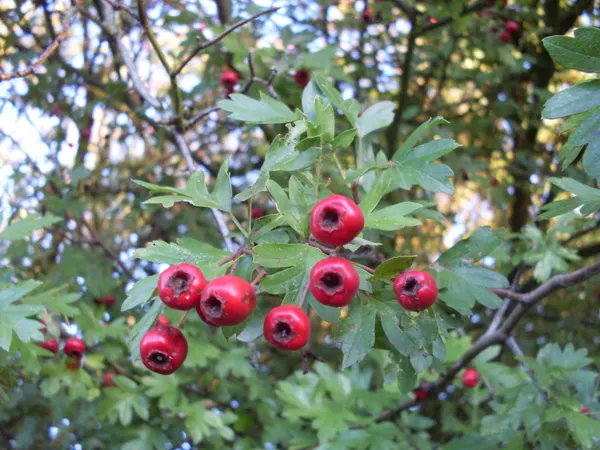
Hawthorn seeds/kernels, like other rose-family pips (apple, cherry), contain cyanogenic compounds and should not be crushed/eaten; red haws should be positively distinguished from unrelated toxic red berries before foraging. | Hawthorn berries can be confused with other red autumn berries, some toxic (Cotoneaster, Pyracantha, holly); confirm thorns, lobed leaves and single/double stones. | Hawthorn seeds/kernels (like other Rosaceae) contain cyanogenic compounds — do not crush/eat kernels in quantity; positively ID Rosaceae flowers/lobed leaves/thorns and avoid confusing with other red-berried shrubs.
Nutritional notes
Berries: vitamin C, anthocyanins, pectin/fiber; minor food use. | Berry antioxidants. | Berries contain flavonoids, oligomeric proanthocyanidins, vitamin C, pectin; antioxidant.
Healing traditions
Related plants
Sources (6)
- Chevallier A., Encyclopedia of Herbal Medicine (2016) — Andrew Chevallier (2016)
- EMA/HMPC Crataegi folium cum flore monograph & public summary
- Szikora 2025 hawthorn-BP meta-analysis (PMID 40732315, DOI 10.3390/ph18071027)
- Zeng 2024 hawthorn fruit RCT (PMID 39583031, DOI 10.1177/15593258241303136)
- Hawthorn — Drugs.com (Wolters Kluwer) professional monograph, 2025
- Pittler MH et al., Cochrane Database Syst Rev 2008;CD005312 (PMID 18254076)