
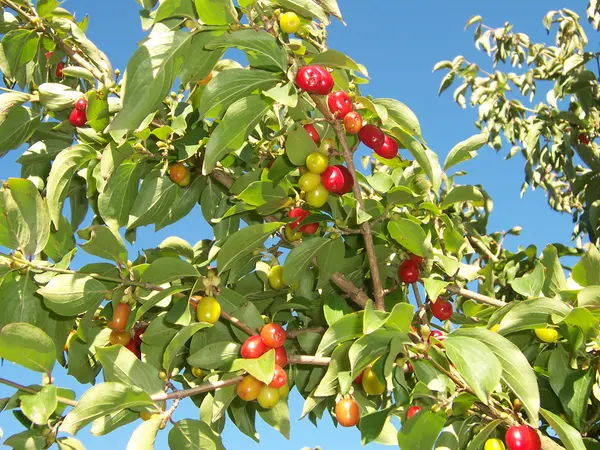
Cornelian cherry
Cornus mas
Other names: Cornelian cherry, შინდი (shindi)
Edible plantPhoto credit: B.navez (Wikimedia Commons)
Safety information
Safety information
Toxicity: None known for ripe fruit; unripe fruit very astringent. Do not drip plant juices into the eye (irritation/infection risk - safety gate). | None known for ripe fruit in food amounts. Unripe fruit is strongly astringent and can cause GI upset.
Contraindications: None well established for food amounts. | No well-established medicinal contraindications; concentrated extracts not characterised for pregnancy. Diabetics using large medicinal amounts should monitor (preclinical hypoglycaemic signals).
Interactions: Preclinical hypoglycaemic signals -> theoretical additive with antidiabetics. (Safety gate.) | None well documented; preclinical hypoglycaemic/hypolipidaemic signals suggest theoretical additive effect with antidiabetic and lipid-lowering drugs — monitor.
Pregnancy & breastfeeding: Not noted. | Concentrated extracts not characterised for pregnancy; food fruit fine.
Evidence level
Supported by clinical trials in humans.
Preparations
eaten fresh · fruit
Part used: fruit
Traditional use: bronchial asthma, heart-area pain (before meals)(Folk and historical sources have not been validated by clinical research.)
leaf juice · leaf
Part used: leaf
Traditional use: watering eyes (dripped in eye - do not do)(Folk and historical sources have not been validated by clinical research.)
leaf decoction · leaf
Part used: leaf
Traditional use: ear noise(Folk and historical sources have not been validated by clinical research.)
edible-raw · ripe fruit
Part used: ripe fruit
Traditional use: eaten fresh(Folk and historical sources have not been validated by clinical research.)
cooked · fruit
Part used: fruit
Traditional use: jam, lavashana/fruit leather, tklapi, sauces (tkemali-style), souring agent(Folk and historical sources have not been validated by clinical research.)
decoction/infusion · fruit/leaves
Part used: fruit/leaves
Traditional use: folk astringent/antidiarrheal, stomach complaints, fevers, tonic(Folk and historical sources have not been validated by clinical research.)
extract · fruit
Part used: fruit
Traditional use: glycaemic and lipid parameters (small RCTs)
Associated conditions
Edibility
Edible parts: Ripe fruit raw/cooked (jam, tklapi, sauces); single stone discarded. | ripe fruit raw or cooked; single hard stone discarded
Toxic lookalike warning
Harvest only confirmed Cornus mas (opposite leaves, early yellow flowers, oblong single-stone red drupe); avoid unknown red roadside berries. | Ripe red drupes can superficially resemble other small red berries; harvest only from confirmed Cornus mas (opposite leaves, early-spring yellow flowers before leaf-out, oblong red single-stone fruit); avoid unknown red roadside berries.
Nutritional notes
Very high vitamin C; anthocyanins, iron, malic acid, pectin. | Very high vitamin C; rich in anthocyanins and other polyphenols; notable iron and organic acids (malic acid); good pectin. Among the more vitamin-C-dense Caucasian wild fruits.
Healing traditions
Related plants
Sources (5)
- ნუნუ ღლიღვაშვილი-მარგიანი, "მედეადან დღემდე" (Nunu Ghlighvashvili-margiani, "From Medea to the present day")
- Bussmann et al., A comparative ethnobotany ... Republic of Georgia, J Ethnobiol Ethnomed 2016;12:43
- Bussmann et al., Unity in diversity — food plants of Sakartvelo, 2021
- Dinda et al., Cornus mas L. (cornelian cherry), J Ethnopharmacol 2016;193:670-690 (PMID 27705748)
- Demir & Kalyoncu, Some nutritional, pomological and physical properties of cornelian cherry, J Food Eng 2003;60:335-341
Sourcing & resources
Affiliate links — we may earn a small commission at no extra cost to you.