
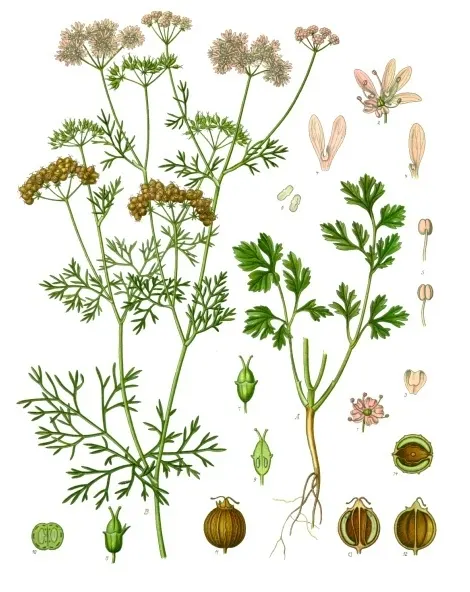
Coriander
Coriandrum sativum
Other names: Coriander, ქინძი (kindzi); ქინძის თესლი; ცერეცო; კამა, Coriander / cilantro, ქინძი, Coriander / Cilantro
Edible plantPhoto credit: Franz Eugen Köhler, Köhler's Medizinal-Pflanzen
This plant carries serious safety risks. All information is for educational reference only.
Safety information
Toxicity: Culinary safe. The text itself warns that large doses can cause brain ischaemia and depression (CNS depression) — flag over-dose. | Low (culinary). | Low at culinary amounts. (Genetic variation makes cilantro taste soapy to some — not toxicity.)
Contraindications: Large doses. | None significant for food amounts; rare allergy. | None well established at food doses; rare allergy.
Interactions: None documented. | Theoretical mild hypoglycaemic/hypotensive additive at high intake. (Safety gate.) | Theoretical additive glucose/BP lowering at high intake.
Pregnancy & breastfeeding: Not noted (culinary).
Evidence level
Supported by laboratory or animal studies; not yet confirmed in humans.
Preparations
This plant carries serious safety risks. All information is for educational reference only.
edible raw (leaf) or cooked · leaf
Part used: leaf
Traditional use: culinary herb; folk carminative/digestive(Folk and historical sources have not been validated by clinical research.)
spice (whole/ground) · seed
Part used: seed
Traditional use: culinary spice(Folk and historical sources have not been validated by clinical research.)
Proposed mechanism: linalool
crushed seed in water / herb poultice · seed/herb
Part used: seed/herb
Traditional use: styptic — bloody urine and nosebleed (seed packed in nostrils); wind/colic, eye pain(Folk and historical sources have not been validated by clinical research.)
Dosage note (descriptive only): text warns large doses cause brain ischaemia and depression (CNS depression)
Reference only — not a dosage instruction
seed powder · seed
Part used: seed
Traditional use: insomnia(Folk and historical sources have not been validated by clinical research.)
Dosage note (descriptive only): 3-4 g, 3-4x/day
Reference only — not a dosage instruction
seed tincture (spirit) · seed
Part used: seed
Traditional use: low mood affecting libido(Folk and historical sources have not been validated by clinical research.)
seed/leaf in cooking · seed/leaf
Part used: seed/leaf
Traditional use: digestion, colic; dill-fennel group as calmative and for lactation(Folk and historical sources have not been validated by clinical research.)
cooked · root
Part used: root
Traditional use: Thai cuisine(Folk and historical sources have not been validated by clinical research.)
Associated conditions
Edibility
Edible parts: Leaf and seed, culinary. | Leaves (raw, a Georgian staple herb) and seeds (spice). | Leaf raw/cooked, seed spice, root.
Toxic lookalike warning
Umbellifer family contains deadly look-alikes (hemlock Conium, fool's parsley) when wild — but cultivated coriander is distinctive by smell. | Coriander/dill belong to the Apiaceae, a family containing deadly poisonous lookalikes (hemlock Conium, water-hemlock Cicuta, fool's parsley Aethusa) - only gather/use cultivated coriander and dill; never substitute wild umbellifers without expert ID. | Apiaceae: cilantro leaves resemble flat-leaf parsley and, more dangerously, young poison hemlock (Conium) and fool's parsley (Aethusa) — confirm the distinctive coriander/cilantro smell and absence of a purple-spotted stem before foraging any carrot-family herb.
Nutritional notes
Leaves provide vitamin K, A, C; seeds provide minerals and aromatic oils. | Leaf: vitamin K, vitamin A, vitamin C, antioxidants; seed: fibre, manganese, essential oil (linalool). Functional culinary herb/spice.
Healing traditions
Related plants
Sources (5)
- ნუნუ ღლიღვაშვილი-მარგიანი, "მედეადან დღემდე" (Nunu Ghlighvashvili-margiani, "From Medea to the present day")
- Mtsire Karabadini, Part II (Surmanidze, 1990) — Ramaz Surmanidze (1990)
- Karabadini (Khelaia ed., 2009) — Nani Khelaia (ed.) (2009)
- USDA FoodData Central (coriander leaf; coriander seed)
- Apiaceae-misidentification literature