
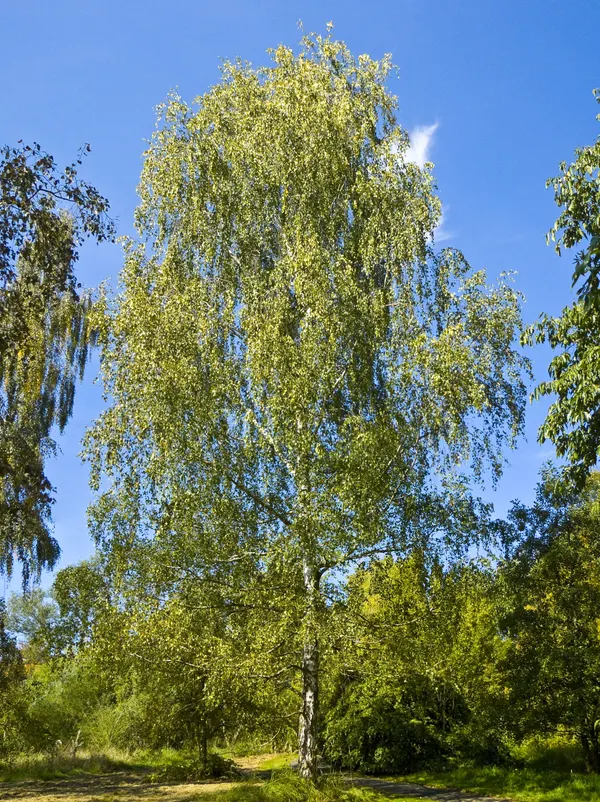
Birch
Betula(?)
Other names: Birch, არყის ხე (arqis khe)
Edible plantPhoto credit: Willow (Wikimedia Commons)
Safety information
Safety information
Toxicity: Low; birch pollen-allergic people may react (oral allergy). | Low (general knowledge).
Contraindications: Serious kidney disease/oedema from heart/kidney failure (do not self-treat with diuretics); birch allergy. | (General knowledge) birch-pollen allergy cross-reactivity.
Interactions: Additive with diuretics; lithium/electrolyte caution. (Safety gate.) | None well established.
Pregnancy & breastfeeding: Not noted.
Evidence level
Reported in folk medicine sources; not clinically validated. Folk and historical sources have not been validated by clinical research.
Preparations
salt-water decoction wash · leaves
Part used: leaves
Traditional use: leaves boiled in salt water; decoction used to treat sirsveli (ringworm/dermatophytosis), recorded for affected livestock(Folk and historical sources have not been validated by clinical research.)
Proposed mechanism: Birch leaf is a traditional skin/diuretic herb (general knowledge)
leaf/bud infusion · leaf/bud
Part used: leaf/bud
Traditional use: diuretic for mild kidney pathology, body cleanser, urinary tract, cholagogue/liver lists(Folk and historical sources have not been validated by clinical research.)
Dosage note (descriptive only): pinch of baking soda to dissolve bud resins
Associated conditions
Edibility
Edible parts: Birch sap is a traditional drink (not in this book); leaves are medicinal tea, not a food. | Birch sap is a traditional drink (general knowledge) — not the use here.
Nutritional notes
Sap: trace sugars/minerals (general).
Healing traditions
Related plants
- Varuna (three-leaved caper / garlic pear)Crataeva nurvalaClinical
- Asian cornelian cherry / shan zhu yu (山茱萸)Cornus officinalisClinical
- Horse ChestnutAesculus hippocastanumClinical
- GarlicAllium sativumClinical
- Astragalus (Huang Qi)Astragalus membranaceusClinical
- Calendula / MarigoldCalendula officinalisClinical
Sources (2)
- ნუნუ ღლიღვაშვილი-მარგიანი, "მედეადან დღემდე" (Nunu Ghlighvashvili-margiani, "From Medea to the present day")
- Masalebi Saqartvelos Etnografiisatvis, 2020, N1 (2020)
Sourcing & resources
Affiliate links — we may earn a small commission at no extra cost to you.