
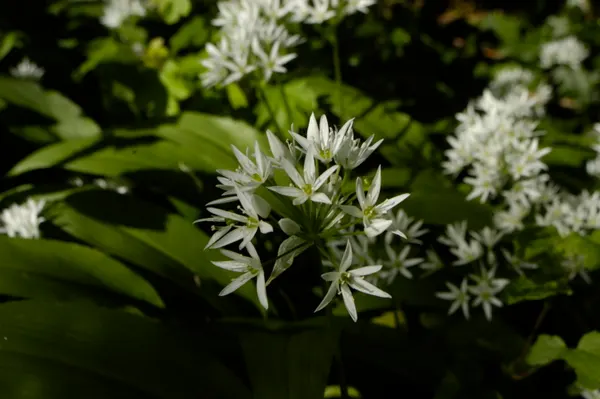
Wild garlic / ramsons
Allium ursinum
Other names: Wild garlic / ramsons, ღანძილი, Wild garlic / Ramsons
Edible plantPhoto credit: R. de Salis (Rodolph)
This plant carries serious safety risks. All information is for educational reference only.
Safety information
Toxicity: None known as food in normal amounts. | Low when correctly identified. The hazard is misidentification, not the plant itself.
Contraindications: Large culinary/medicinal amounts may aggravate reflux; theoretical caution before surgery (antiplatelet effect); caution in active bleeding/clotting disorders at high intake. | Same cautions as garlic at high intake (GI upset, antiplatelet effect).
Interactions: Garlic-like organosulfur compounds may add to antiplatelet/anticoagulant drugs (warfarin, aspirin, clopidogrel) and theoretically to antihypertensives/antidiabetics; monitor at high intake. | Theoretical additive antiplatelet/anticoagulant effect at high intake.
Evidence level
Supported by laboratory or animal studies; not yet confirmed in humans.
Preparations
This plant carries serious safety risks. All information is for educational reference only.
edible-raw · young leaf
Part used: young leaf
Traditional use: salads(Folk and historical sources have not been validated by clinical research.)
cooked · leaf/bulb
Part used: leaf/bulb
Traditional use: fillings, pkhali(Folk and historical sources have not been validated by clinical research.)
pickled/salted · leaf
Part used: leaf
Traditional use: classic Caucasian preserve for storage(Folk and historical sources have not been validated by clinical research.)
folk medicinal · leaf/bulb
Part used: leaf/bulb
Traditional use: 'blood cleansing', digestion, blood pressure, spring tonic
Proposed mechanism: organosulfur (allicin-type) antiplatelet, mild hypotensive/lipid
edible-raw · leaf
Part used: leaf
Traditional use: pesto, salad(Folk and historical sources have not been validated by clinical research.)
cooked · leaf
Part used: leaf
Traditional use: soups, sautéed(Folk and historical sources have not been validated by clinical research.)
Associated conditions
Edibility
Edible parts: young leaves raw or cooked; bulbs cooked | Leaves raw or cooked.
Toxic lookalike warning
CRITICAL: leaves confused every spring with DEADLY lookalikes — lily-of-the-valley (Convallaria majalis), autumn crocus (Colchicum autumnale, colchicine, no antidote, frequently fatal) and lords-and-ladies (Arum). Reliable test: strong garlic/onion smell of a freshly crushed leaf; toxic lookalikes do NOT smell of garlic (handling garlic first can mask the test). If in doubt, do not eat. Fatal poisonings occur in the Caucasus/Europe every spring. | CRITICAL: Allium ursinum leaves repeatedly confused, with fatal results, with lily-of-the-valley (Convallaria majalis — cardiac glycosides) and autumn crocus / meadow saffron (Colchicum autumnale — colchicine, often lethal); young Lords-and-Ladies (Arum maculatum) also a risk. Reliable field check: crushed wild-garlic leaves smell strongly of garlic; toxic lookalikes do not — but verify each leaf.
Nutritional notes
Rich in vitamin C and organosulfur compounds; provides manganese, folate; low-calorie aromatic green. | Rich in organosulfur compounds (alliin/allicin-type), vitamin C, manganese; low calorie functional green.
Healing traditions
Related plants
Sources (4)
- Bussmann et al., A comparative ethnobotany ... Republic of Georgia, J Ethnobiol Ethnomed 2016;12:43
- Bussmann et al., Unity in diversity — food plants of Sakartvelo, 2021
- M-Hamvas 2025 Plants (Basel) histological separation of A. ursinum vs Convallaria/Colchicum (PMC12348878)
- Ivanović 2022 Metabolites metabolomic adulterant detection in A. ursinum (PMC9501555)