
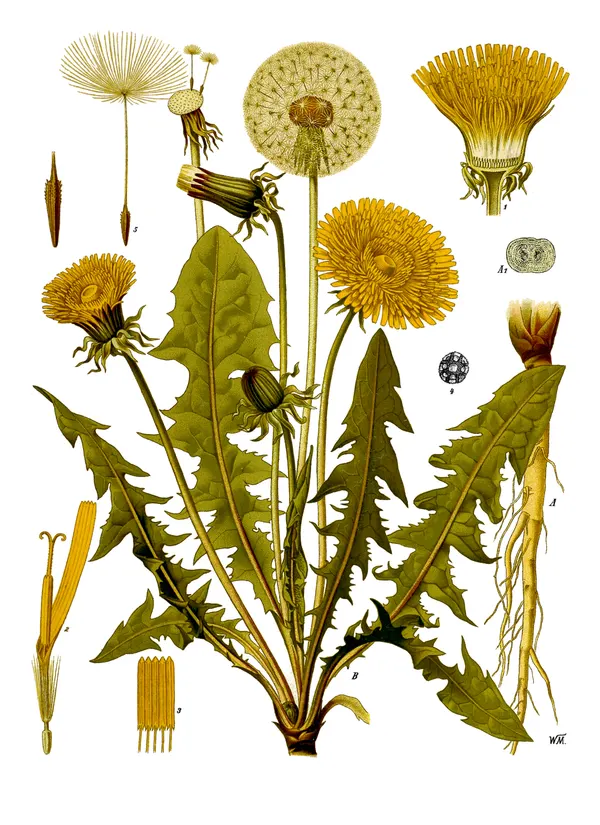
Dandelion
Taraxacum officinale
Other names: Dandelion, ბაბუაწვერა (babuats'vera), Common dandelion, ბაბუაცვერა
Edible plantPhoto credit: Walther Otto Müller
Safety information
Safety information
Toxicity: Generally low. Possible GI upset, hyperacidity; contact dermatitis from latex in some people; Asteraceae allergy possible. | None known per source. Latex may cause contact dermatitis in sensitive people (modern note). | None known. | Theoretical allergic reactions in Asteraceae-sensitive people; rare contact dermatitis from the stem latex. | Low as food/tea; the milky latex is irritant and should never be put in the eye. | None known as food. Latex may irritate sensitive skin. | Generally low. Latex in stems/leaves can cause contact dermatitis in sensitive people; Asteraceae-allergy cross-reactivity.
Contraindications: Bile-duct obstruction, gallbladder empyema, ileus (traditional contraindications for bitter/choleretic herbs); active gallstones - consult provider. | None specified by source. Modern caution: bile-duct obstruction/gallstones. | None notable. | None specifically named. | Bile-duct obstruction / gallstone blockage (choleretic action can worsen an obstructed duct); caution with 'gallstone flushing' claims - a moving stone is a medical emergency. | Bile-duct obstruction/gallstones (choleretic action — avoid medicinal root); Asteraceae allergy; theoretical caution with diuretic effect in those on fluid-restriction. | Bile-duct obstruction, gallstones, active gallbladder disease (bitter/choleretic action); Asteraceae allergy.
Interactions: Theoretical additive effect with diuretics (potassium/fluid balance), with lithium (via diuresis), and possible effects on drug-metabolizing enzymes - consult provider. | None specified by source. Modern: theoretical diuretic/lithium and blood-sugar effects. | None specifically noted. | None specifically reported. | Diuretic - theoretical additive with diuretics/lithium; possible additive with antidiabetics. (Safety gate.) | May add to diuretics (and alter lithium); theoretical effect on drugs sharing the same transporters/CYPs; possible additive with antidiabetics; high vitamin-K leaf may affect warfarin. | Theoretical additive effect with diuretics; possible interaction with drugs requiring stable potassium; limited human data.
Pregnancy & breastfeeding: Not specifically addressed. | Not noted.
Evidence level
Supported by laboratory or animal studies; not yet confirmed in humans.
Preparations
other · leaf
Part used: leaf
Traditional use: Traditional cleansing tonic food.
How to prepare (traditional): Fresh leaves are eaten raw in a tonic salad.
Dosage note (descriptive only): Eat regularly for its cleansing benefits.
tincture · root
Part used: root
Traditional use: Detoxifying remedy for eczema.
How to prepare (traditional): A tincture is made from the root.
Dosage note (descriptive only): For eczema, 1/2 tsp diluted with 1/2 cup (100 ml) water three times a day.
decoction · root
Part used: root
Traditional use: Detoxifying remedy for acne.
How to prepare (traditional): The root is made into a decoction.
Dosage note (descriptive only): For acne, about 1/3 cup (75 ml) three times a day.
infusion · leaf
Part used: leaf
Traditional use: Diuretic for fluid retention/swollen ankles.
How to prepare (traditional): An infusion is made from the leaves.
Dosage note (descriptive only): For swollen ankles, 2 cups (500 ml) daily.
Associated conditions
Edibility
Edible parts: young leaves raw (salad) or cooked (bitter greens); roasted root as caffeine-free coffee; flowers in cooking | young leaves (raw salad or cooked), root (roasted coffee substitute), flowers (wine) | leaves eaten raw in salads or cooked; root roasted as a coffee substitute; flowers used too | leaves raw in salads; root roasted as a coffee substitute | Young leaves (raw/cooked, bitter), root (roasted as coffee substitute), flowers (jam). | young leaves raw/cooked; root roasted as a coffee substitute; flower petals for syrup | Leaves raw (young) or cooked (older, to cut bitterness/oxalates); root roasted; flowers cooked.
Toxic lookalike warning
Rosette leaves resemble other yellow-flowered composites; most lookalikes harmless but bitter, yet foragers must positively identify Taraxacum (single hollow leafless flower stalk, milky latex) and avoid confusing young rosettes with unrelated toxic rosette weeds. | Rosette leaves resemble other yellow composites; confirm the single leafless hollow flower-stalk with milky latex; avoid hairy-leaved or branched-stem impostors. | Several yellow-flowered look-alikes exist (cat's ear, sow thistle — mostly harmless) but confirm the single hollow leafless flower-stalk and basal rosette; avoid roadside/sprayed plants. | Can be confused with other yellow-flowered/rosette plants such as Hypochaeris (cat's-ear, edible) and toxic look-alikes when only basal leaves present — verify hollow leafless single flower stalk and milky latex before eating. | Young dandelion rosettes resemble other yellow-flowered composites (Sonchus, Hypochaeris, toxic Senecio ragworts which contain hepatotoxic pyrrolizidine alkaloids); confirm the single unbranched hollow flower-stalk with milky sap and basal-only rosette before eating. | Several yellow-composite rosette plants resemble dandelion; some lookalikes (e.g. Hypochaeris, cat's-ear) are edible but others are not — confirm the single hollow leafless flower stalk with milky latex and a single flower head and the basal jagged ('lion's-tooth') leaves before eating. | Cat's ear (Hypochaeris radicata) and false dandelion / Asteraceae rosettes; more dangerously non-flowering rosettes mistaken for young common ragwort (Senecio/Jacobaea spp.), which contains hepatotoxic pyrrolizidine alkaloids — confirm hollow leafless single-flower stalk and milky latex before eating.
Nutritional notes
Functional food - leaves rich in vitamin A, vitamin K, vitamin C, potassium, calcium, folate; among the more nutrient-dense wild greens. | Traditional spring green; root rich in inulin; bitter principle taraxacin. | Leaves rich in potassium, vitamins and minerals; nutritious wild green; root inulin (prebiotic). | Leaf rich in potassium (up to ~4.5% in aerial parts) and carotenoids; root contains inulin. | Leaves rich in vitamin A, K, C, calcium, iron; root rich in inulin (prebiotic fibre). | Very rich in provitamin-A carotenoids, vitamin K, vitamin C, potassium, calcium and bitters; root rich in inulin (prebiotic). One of the most nutrient-dense common wild greens. | Leaves high in vitamin K, vitamin A (carotenoids), vitamin C, folate, potassium, calcium; root rich in inulin (prebiotic fructan), peaking in autumn. Functional-food role as bitter green + prebiotic root.
Healing traditions
Related plants
Sources (10)
- Grieve M., A Modern Herbal (1931) — Maud Grieve (1931)
- Chevallier A., Encyclopedia of Herbal Medicine (2016) — Andrew Chevallier (2016)
- Hoffmann D., Medical Herbalism (2003) — David Hoffmann (2003)
- ნუნუ ღლიღვაშვილი-მარგიანი, "მედეადან დღემდე" (Nunu Ghlighvashvili-margiani, "From Medea to the present day")
- Bussmann et al., A comparative ethnobotany ... Republic of Georgia, J Ethnobiol Ethnomed 2016;12:43
- Bussmann et al., Unity in diversity — food plants of Sakartvelo, 2021
- EMA/HMPC Taraxaci officinalis radix (finalised EU herbal monograph)
- Li 2026 Food Sci Nutr dandelion review (PMC13254017)
- EMA/HMPC Taraxaci officinalis radix
- USDA FoodData Central (dandelion greens, raw)
Sourcing & resources
Affiliate links — we may earn a small commission at no extra cost to you.