
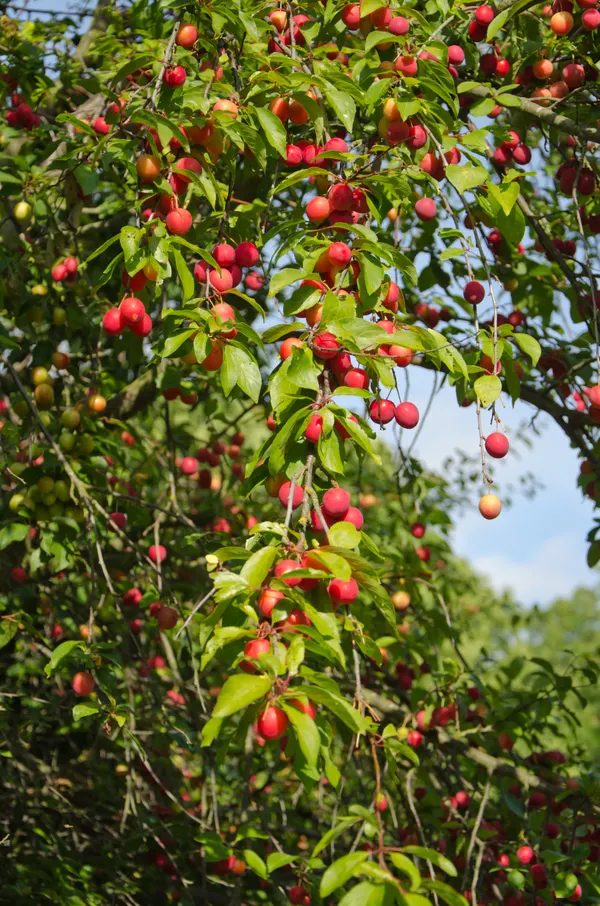
Cherry plum (tkemali)
Prunus cerasifera
Other names: Cherry plum (tkemali), ტყემალი (tkemali), Cherry plum / myrobalan plum
Edible plantPhoto credit: An-d
Safety information
Safety information
Toxicity: Fruit safe. Seeds/kernels contain amygdalin (cyanogenic) — do not eat the pits. | Fruit flesh: none known. Stones/kernels and leaves contain cyanogenic amygdalin — do not eat the kernels or large amounts of crushed seeds. Unripe fruit very sour/astringent.
Contraindications: None documented for fruit. | None well established for the fruit flesh.
Interactions: None documented. | None documented; high organic-acid sour fruit may bother reflux/ulcers in quantity.
Evidence level
Reported in folk medicine sources; not clinically validated. Folk and historical sources have not been validated by clinical research.
Preparations
fruit syrup / sharbat / fruit-leather poultice · fruit
Part used: fruit
Traditional use: cooling for liver and heart pain, thirst; dried fruit-leather applied externally over the liver region(Folk and historical sources have not been validated by clinical research.)
cooked · fruit
Part used: fruit
Traditional use: tkemali sour sauce (green from unripe, red from ripe; with herbs incl. ombalo); fruit leather; preserves(Folk and historical sources have not been validated by clinical research.)
edible-raw · ripe fruit
Part used: ripe fruit
Traditional use: eaten fresh and dried; folk digestive/appetite(Folk and historical sources have not been validated by clinical research.)
Associated conditions
Edibility
Edible parts: Fruit raw/cooked, basis of tkemali sauce and tklapi; pits/kernels not for eating. | fruit flesh raw (ripe) or cooked (the sour sauce); discard the stone
Toxic lookalike warning
Low (familiar fruit). | Cherry-plum fruit is a recognisable small plum (single stone), but never crack and eat the kernels (cyanogenic); avoid confusion with unknown stone fruits and inedible wild Prunus.
Nutritional notes
High vitamin C and organic acids (malic, citric), pectin, potassium and polyphenols; a low-sugar, vitamin-C-rich functional fruit and the souring base of the cuisine.
Healing traditions
Related plants
Sources (4)
- Bussmann et al., A comparative ethnobotany ... Republic of Georgia, J Ethnobiol Ethnomed 2016;12:43
- Mtsire Karabadini, Part II (Surmanidze, 1990) — Ramaz Surmanidze (1990)
- Karabadini (Khelaia ed., 2009) — Nani Khelaia (ed.) (2009)
- Bussmann et al., Unity in diversity — food plants of Sakartvelo, 2021
Sourcing & resources
Affiliate links — we may earn a small commission at no extra cost to you.