
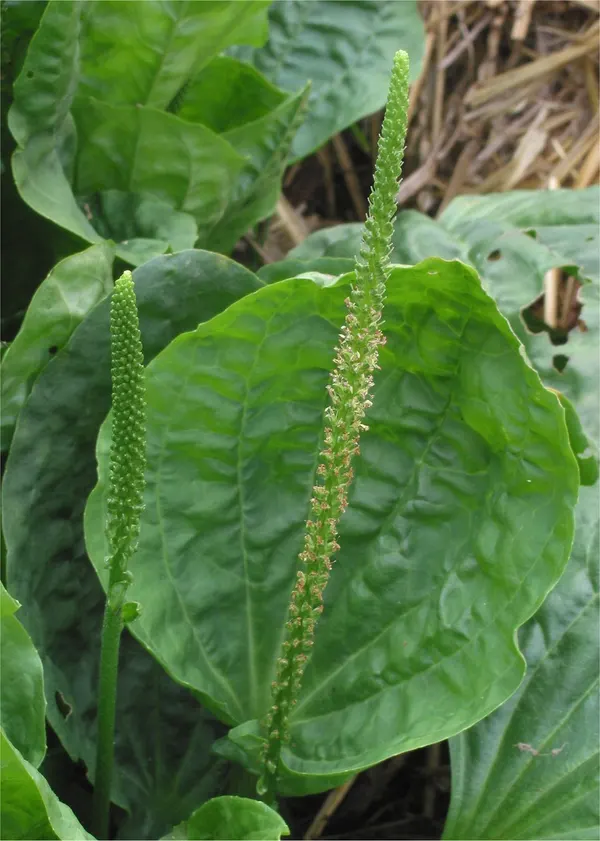
Plantain (broadleaf) / Greater Plantain
Plantago major
Other names: Plantain (broadleaf) / Greater Plantain, Common Plantain, Broadleaf/ribwort plantain, მრავალძარღვა, Broadleaf / Ribwort plantain, подорожник (podorozhnik), Broadleaf plantain
Edible plantPhoto credit: Rasbak
Safety information
Safety information
Toxicity: Generally well tolerated; rare allergy. As with any wild plant, contamination/pesticide exposure on harvested leaves is a practical concern. | None known; benign. Contains the glucoside aucubin. | None known. Topical use of clean leaves low-risk; rare contact allergy. | Low. | None known / mild for normal food and topical use. Rare allergy possible.
Contraindications: Hypersensitivity. Limited safety data for concentrated internal use; pregnancy data limited. | None specified by source. | None well established; theoretical caution with the mucilaginous Plantago seed/husk in bowel obstruction or stricture (take with adequate fluid). | None well established at food doses. | None well established. No specific pregnancy harm documented (medicinal dosing in pregnancy unstudied — not verified).
Interactions: None well documented; mucilage may delay absorption of co-administered oral drugs (general principle). | None specified by source. Modern: seed-husk mucilage may slow absorption of co-taken drugs. | Mucilage/fibre may slow absorption of co-taken oral drugs (separate dosing); possible additive effect with anticoagulants (vitamin K in leaf); seed fibre may aid glycaemic control (additive with antidiabetics in theory). | None well established. | Not well established. Seed-husk mucilage (as in P. ovata/psyllium) can slow absorption of co-administered oral drugs — general mucilage caution.
Pregnancy & breastfeeding: Pregnancy data limited. | No documented harm; culinary/topical use low-risk; medicinal dosing unstudied (not verified).
Evidence level
Supported by laboratory or animal studies; not yet confirmed in humans.
Preparations
infusion · leaf and aerial parts
Part used: leaf and aerial parts
Traditional use: Traditionally used as a gentle expectorant and demulcent for coughs and mild bronchitis, as an astringent for diarrhoea, haemorrhoids and cystitis with bleeding, and as a primary topical healing agent for cuts and bruises.
How to prepare (traditional): Infusion: pour 1 cup of boiling water over 2 teaspoons of dried herb and infuse 10 minutes. An ointment may be made for haemorrhoids and cuts; also applied as a lotion, compress or poultice.
Dosage note (descriptive only): Drunk three times a day. Commission E: 3-6 g of herb daily.
tincture · leaf and aerial parts
Part used: leaf and aerial parts
Traditional use: Vulnerary / demulcent.
How to prepare (traditional): Tincture at 1:5 in 40% alcohol.
Dosage note (descriptive only): 2-3 ml three times a day.
Associated conditions
Edibility
Edible parts: young leaves edible cooked (older leaves tough/stringy); seeds are a fibre source (a Plantago relative of psyllium) | young leaves a historical salad herb (best very young); seeds edible | young leaves cooked (older leaves fibrous/stringy) | Young leaves raw or cooked. | Young leaves raw as salad green; older leaves cooked; seeds ground into flour.
Toxic lookalike warning
Rosette leaves can be confused at a glance with toxic rosette plants such as young foxglove (Digitalis purpurea) - plantain has parallel-ribbed (not net-veined) leaves and a leafless flower spike; positively identify before eating. | Broadleaf plantain is unrelated to banana plantain; distinguish parallel-ribbed leaves and leafless flower-spike from toxic basal rosettes (foxglove, lily-of-the-valley) before eating. | Basal rosettes of plantain can resemble young rosettes of other roadside plants (and P. lanceolata superficially other lanceolate-leaved species); confirm the parallel-veined leaves and characteristic flower spike before eating; avoid unknown rosette plants. | Rosette plantain leaves confused with young foxglove (Digitalis purpurea) rosettes — foxglove contains lethal cardiac glycosides; plantain has parallel leaf veins and a leafless flower spike, foxglove leaves softly hairy with netted vein pattern and grey-green felted underside. Confirm parallel venation before eating. | Basal leaf rosettes can be confused with toxic foxglove (Digitalis) before flowering — Plantago has parallel/longitudinal leaf veins and a leafless flower spike; do not harvest rosette leaves unless positively identified.
Nutritional notes
Young leaves: vitamins A, C, K, minerals, fibre; minor wild-food use. | Edible green; mucilaginous seeds; modest nutritional value. | Vitamins A, C, K and minerals (calcium); mucilage and fibre; modest food value. | Leaves provide vitamin A, vitamin C, vitamin K, calcium; mucilage and soluble fibre. Functional fibre role (psyllium relative). | ~18 kcal/100 g fresh leaves; ~2.3 g protein, high fiber; allantoin, aucubin, ursolic acid, flavonoids.
Healing traditions
Related plants
Sources (9)
- Grieve M., A Modern Herbal (1931) — Maud Grieve (1931)
- Bussmann et al., A comparative ethnobotany ... Republic of Georgia, J Ethnobiol Ethnomed 2016;12:43
- EMA/HMPC Plantaginis lanceolatae folium monograph (closely related species rationale)
- standard Western ethnobotany/foraging references
- EMA/HMPC Plantaginis lanceolatae folium
- USDA/food-composition data for Plantago greens
- Plantago major — Wikipedia, 2026
- Samuelsen AB, J Ethnopharmacol (PMC7142308), 2000
- Plantain — Drugs.com professional monograph, 2020
Sourcing & resources
Affiliate links — we may earn a small commission at no extra cost to you.