
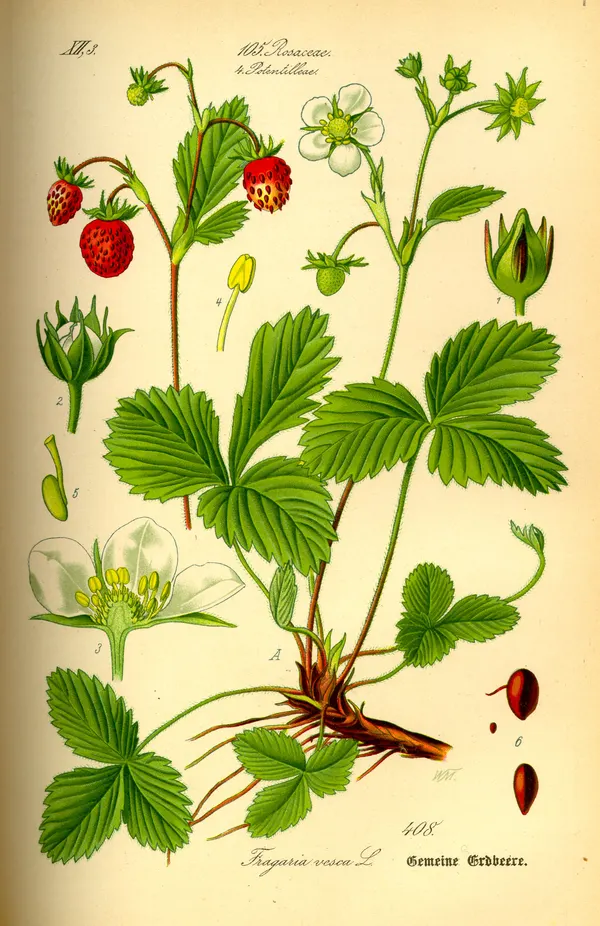
Wild strawberry
Fragaria vesca
Other names: Wild strawberry
Edible plantPhoto credit: Otto Wilhelm Thomé, Flora von Deutschland
Safety information
Safety information
Toxicity: None known as food. (Wilted leaves, like other Rosaceae, can transiently form trace cyanogenic compounds — use fresh or fully dried leaf for tea.)
Contraindications: None well established; rare strawberry allergy.
Interactions: None clinically significant; high-tannin leaf tea may reduce iron absorption in quantity.
Evidence level
Supported by laboratory or animal studies; not yet confirmed in humans.
Preparations
edible-raw · fruit
Part used: fruit
Traditional use: eaten fresh(Folk and historical sources have not been validated by clinical research.)
cooked · fruit
Part used: fruit
Traditional use: jam(Folk and historical sources have not been validated by clinical research.)
infusion · leaf
Part used: leaf
Traditional use: astringent folk tea for digestion, mild diuretic/'cleansing'
Proposed mechanism: leaf tannins/flavonoids
Dosage note (descriptive only): use fresh or fully dried leaf
Associated conditions
Edibility
Edible parts: ripe fruit raw/cooked; fresh or fully dried leaves for tea
Toxic lookalike warning
Wild strawberry is distinctive (white 5-petal flower, three-toothed leaflets, red aggregate fruit with surface seeds); the harmless 'mock/Indian strawberry' (Potentilla/Duchesnea indica) is tasteless but not toxic — confirm true Fragaria by aroma/flavour and avoid unknown red fruits.
Nutritional notes
High vitamin C, manganese, folate, ellagitannins and anthocyanins for its size; a fragrant functional berry.
Healing traditions
Related plants
Sources (2)
- Bussmann et al., A comparative ethnobotany ... Republic of Georgia, J Ethnobiol Ethnomed 2016;12:43
- Bussmann et al., Unity in diversity — food plants of Sakartvelo, 2021
Sourcing & resources
Affiliate links — we may earn a small commission at no extra cost to you.