
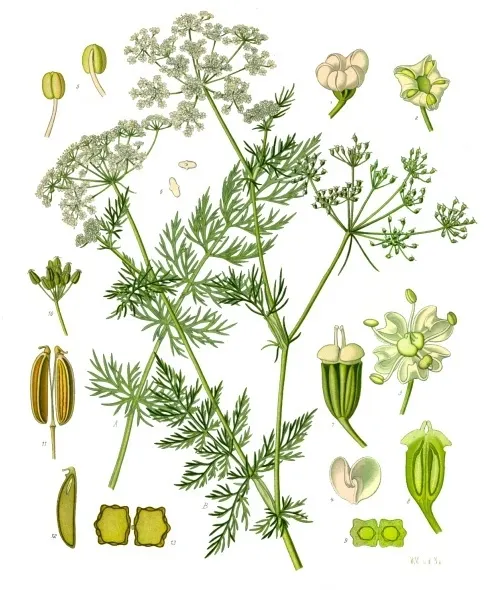
This plant carries serious safety risks. All information is for educational reference only.
Safety information
Toxicity: None known at culinary doses; concentrated oil used sparingly (drops). | Seed: none known as a spice. The danger is misidentification of the wild plant. Concentrated caraway oil is irritant.
Contraindications: None specified by source. | Concentrated caraway essential oil not for pregnancy/infants internally.
Interactions: None specified by source. | Minimal for culinary use; oil theoretical additive with antidiabetics.
Pregnancy & breastfeeding: Concentrated essential oil not for pregnancy internally.
Evidence level
Supported by laboratory or animal studies; not yet confirmed in humans.
Preparations
This plant carries serious safety risks. All information is for educational reference only.
infusion · seed
Part used: seed
Traditional use: Traditionally used as a carminative for flatulent dyspepsia and intestinal colic (especially in children), to stimulate appetite, for diarrhoea, and to increase milk flow.
How to prepare (traditional): Infusion: pour 1 cup of boiling water over 1 teaspoon of freshly crushed seeds and infuse, covered, 10-15 minutes.
Dosage note (descriptive only): Drunk three times a day.
Reference only — not a dosage instruction
tincture · seed
Part used: seed
Traditional use: Carminative.
How to prepare (traditional): Tincture at 1:5 in 40% alcohol.
Dosage note (descriptive only): 1-4 ml three times a day.
Reference only — not a dosage instruction
Associated conditions
Edibility
Edible parts: seeds (breads, cheese, comfits, liqueurs), young leaves (soup), roots (parsnip-like, eaten young) | seeds (spice); young leaves/roots only with expert identification
Toxic lookalike warning
Another finely-cut Apiaceae - wild collection risks confusion with poison hemlock (Conium maculatum) and hemlock water-dropwort. Use cultivated/clearly identified plants only. | CRITICAL (Caucasus): wild Apiaceae include deadly poison hemlock (Conium maculatum), hemlock water-dropwort (Oenanthe crocata/Oenanthe spp., the most lethal) and fool's parsley (Aethusa cynapium) that closely resemble edible umbellifers. NEVER gather wild Apiaceae roots/leaves without certain identification; a single misidentification can be fatal. Buy seed from known sources.
Nutritional notes
Seeds 4-7% volatile oil plus protein/fat; a flavouring spice. | Seed: aromatic oils, some minerals (iron, manganese); spice-level amounts.
Healing traditions
Related plants
Sources (2)
- Grieve M., A Modern Herbal (1931) — Maud Grieve (1931)
- Bussmann et al., A comparative ethnobotany ... Republic of Georgia, J Ethnobiol Ethnomed 2016;12:43