
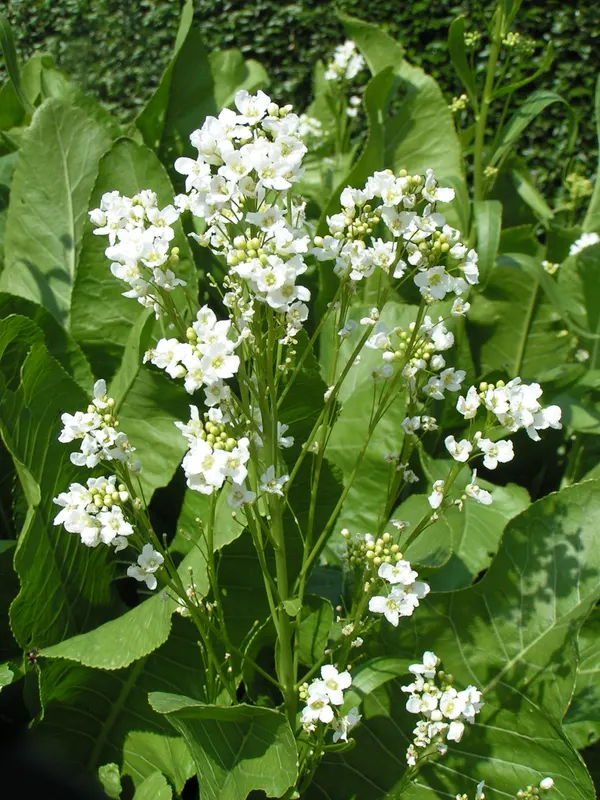
Horseradish
Armoracia rusticana
Other names: Red cole, mountain radish, Armoraciae rusticanae radix, Meerrettich
Edible plantPhoto credit: Pethan / Wikimedia Commons
Safety information
Safety information
Toxicity: Pungent isothiocyanates strongly irritate mucous membranes; large amounts cause GI upset, sweating, and mucosal/airway irritation; concentrated root/oil can blister skin. Culinary amounts well-tolerated.
Contraindications: Gastric/duodenal ulcers, gastritis, and kidney inflammation/disease; infants/young children (under ~4–12 per product labels); pregnancy/lactation (medicinal doses); thyroid caution (glucosinolate/goitrogen at very high intake).
Interactions: Theoretical additive mucosal irritation with NSAIDs and other mustard-oil herbs (nasturtium, mustard); high goitrogen intake may interfere with thyroid medication; levothyroxine caution at extreme intakes.
Pregnancy & breastfeeding: Avoid medicinal doses.
Evidence level
Supported by clinical trials in humans.
Preparations
edible · root
Part used: root
Traditional use: sharp condiment(Folk and historical sources have not been validated by clinical research.)
Proposed mechanism: isothiocyanates (allyl/2-phenylethyl) — mustard-oil
extract · root
Part used: root
Traditional use: respiratory catarrh / minor urinary-tract infections (often with nasturtium)
Proposed mechanism: isothiocyanates excreted via airways/urine — antibacterial
Dosage note (descriptive only): mucosal/ulcer/kidney caution
Associated conditions
Edibility
Edible parts: root grated raw as a sharp condiment (with beef/fish), in sauces
Toxic lookalike warning
Horseradish foliage/root can be confused at a distance with comfrey (Symphytum, hepatotoxic PAs) and with toxic Aconitum/other roots — identify by the unmistakable pungent smell when cut; never eat an unverified dug root
Nutritional notes
Root provides vitamin C, potassium, and glucosinolate-derived isothiocyanates (functional-food pungent phytochemicals); low calorie condiment
Healing traditions
Related plants
Sources (3)
- A Review on the Phytochemical Composition and Potential Medicinal Uses of Horseradish (Armoracia rusticana) Root
- Evaluation of an Aqueous Extract from Horseradish Root … against LPS-Induced Cellular Inflammation (PMC)
- Horseradish — vital.ly / Natural Medicines monograph (EN)
Sourcing & resources
Affiliate links — we may earn a small commission at no extra cost to you.