
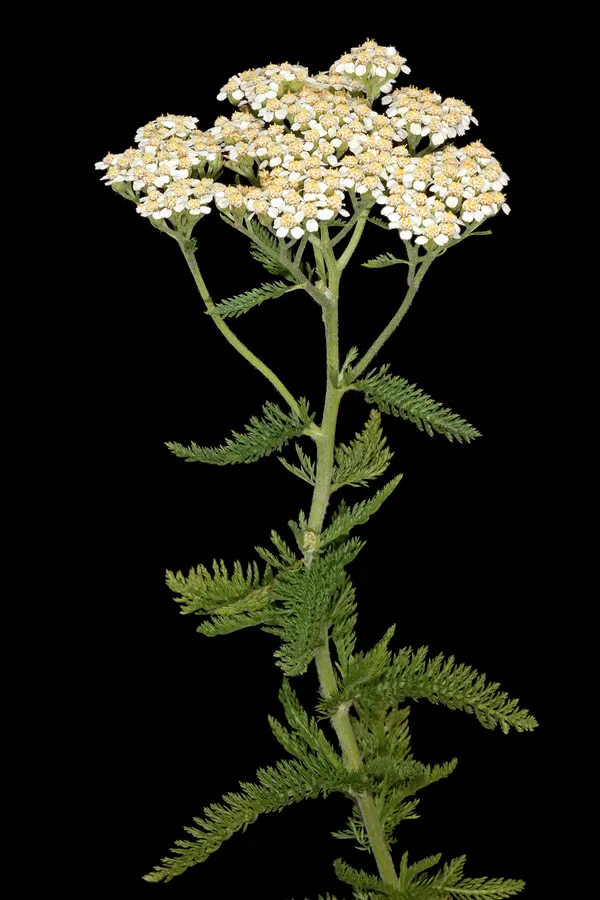
Yarrow
Achillea millefolium
Other names: Yarrow, ფურისულა / ათასფოთოლა ('thousand-leaf' type names), тысячелистник (tysyachelistnik)
Edible plantPhoto credit: SAplants
Safety information
Safety information
Toxicity: Generally mild; allergic skin reactions and photosensitivity reported (Asteraceae). Essential oil contains thujone (limit high-dose/oil use). | None notably described; generally mild. Modern: can cause skin photosensitivity/allergic dermatitis in sensitive people (Asteraceae family). | Mild — rare allergic/contact reactions (Asteraceae family). | Mild — hypersensitivity reported in people sensitive to Asteraceae. | Low; can cause allergic contact dermatitis in Asteraceae-sensitive people; thujone present in small amounts. | Low; can cause allergic contact dermatitis and photodermatitis (Asteraceae). Contains trace thujone in volatile oil — avoid high-dose/long-term concentrated preparations. | Mild. Skin hypersensitivity (allergic) reactions reported (frequency unknown).
Contraindications: Hypersensitivity to Asteraceae (Compositae). Avoid medicinal/high doses in pregnancy (traditional emmenagogue; uterine-stimulant concern). EMA: mostly adults. | None specified by source. Modern: Asteraceae allergy; emmenagogue reputation - caution in pregnancy. | Avoid in pregnancy. Essential oil only under professional supervision. | Some authorities caution against use in pregnancy. No restriction in lactation. | Pregnancy (emmenagogue/uterotonic folk reputation, thujone); Asteraceae allergy. | Pregnancy (traditional emmenagogue/uterine activity — avoid medicinal doses); Asteraceae allergy (ragweed/chamomile-sensitive); not for high-dose chronic use (thujone). | Hypersensitivity to yarrow or other Asteraceae/Compositae. Adults/adolescents >12 only.
Interactions: Theoretical additive effects with anticoagulants, sedatives, antihypertensives; possible interaction with lithium (diuresis) - consult provider. | None specified by source. | None specifically noted by the book. | None specifically reported. | Theoretical additive with anticoagulants (coumarins) and sedatives; may affect blood pressure. (Safety gate.) | Theoretical additive effect with anticoagulants/antiplatelets and with sedatives/antihypertensives; possible additive photosensitivity; bitter/choleretic action may affect biliary disease. | None established in EMA public summary. Theoretical additive effects with anticoagulants/antiplatelets and sedatives — not verified.
Pregnancy & breastfeeding: Avoid medicinal/high doses in pregnancy (uterine-stimulant/emmenagogue concern). | Caution (emmenagogue reputation) (modern). | Avoid in pregnancy. | Some authorities caution against use in pregnancy. | Avoid (uterotonic folk use). | Avoid medicinal doses (emmenagogue/uterine activity). | Traditional emmenagogue/abortifacient reputation — pregnancy caution (not verified in EMA summary).
Evidence level
Supported by laboratory or animal studies; not yet confirmed in humans.
Preparations
poultice · aerial parts
Part used: aerial parts
Traditional use: Applied to grazes, cuts, and bruises.
How to prepare (traditional): Made into a poultice from the herb.
infusion · aerial parts
Part used: aerial parts
Traditional use: Described for easing colds and flu.
How to prepare (traditional): For colds, mix equal parts yarrow, peppermint, and elderflower; infuse 1 tsp of the mix in about 3/4 cup (150 ml) water for 10 minutes and strain.
Dosage note (descriptive only): Take 3 times a day.
tincture · aerial parts
Part used: aerial parts
Traditional use: Same indications as the infusion; also the book cites pressed juice of fresh herb.
How to prepare (traditional): Tincture made at 1:5 in 25% alcohol.
Dosage note (descriptive only): 2-4 ml three times a day.
oil · flower
Part used: flower
Traditional use: Described for treating congestion; book says use the essential oil only under professional supervision.
How to prepare (traditional): Essential oil extracted from the flowers, used by herbalists.
Dosage note (descriptive only): professional use only — not provided
Associated conditions
Edibility
Edible parts: Young leaves edible in small amounts (bitter; used as a potherb/in salads historically). | young leaves used in 17th-century salads (bitter, pungent) and to flavour beer (Field Hop) | aerial parts used as a bitter flavouring/tea | Leaves used sparingly as a bitter pot-herb in some traditions; not a staple food. | young leaves used sparingly as a bitter pot-herb/flavoring; not a staple food | Leaves/flowers used in small amounts as a bitter culinary herb/tea — potent, not a bulk vegetable.
Toxic lookalike warning
Yarrow's finely divided leaves and white umbel-like flower clusters can be confused with deadly poison hemlock (Conium) and water hemlock (Cicuta); yarrow has a feathery leaf and characteristic aroma - positively identify before any consumption. | Finely divided feathery leaves resemble those of poisonous umbellifers - poison hemlock (Conium) and water hemlock (Cicuta), potentially fatal. Never eat foraged yarrow unless positively identified by its flat white flower-head and distinctive scent. | Several umbellifer-like meadow plants are poisonous (e.g. hemlock); confirm by finely divided feathery leaves and flat white flower-heads. | Finely-divided yarrow foliage can be confused by foragers with poisonous umbellifers (hemlock Conium, fool's parsley Aethusa); yarrow's leaves are feathery but its flower-head is a flat composite, not an umbel - confirm carefully. | Finely divided feathery leaves resemble other Apiaceae/Asteraceae; do not confuse with poison hemlock (Conium maculatum) or fool's parsley (Aethusa); confirm yarrow's flat-topped white (sometimes pink) flower heads, strong aroma and soft feathery leaves. | Feathery dissected leaves and white flat-topped flower clusters can be confused with highly toxic white-umbel Apiaceae (poison hemlock Conium, water hemlock Cicuta); yarrow is Asteraceae with feathery leaves and characteristic aroma — never forage white umbel-like plants without expert ID.
Nutritional notes
Minor wild-food/bitter use; negligible. | Volatile oil, achillein, achilleic acid, resin, tannin, mineral salts. | Bitter tonic; no notable food value. | Not a significant food source. | Not a nutritional food; bioactives include essential oil (chamazulene, sesquiterpene lactones), flavonoids.
Healing traditions
Related plants
Sources (9)
- EMA/HMPC Millefolii herba monograph & public summary
- Grieve M., A Modern Herbal (1931) — Maud Grieve (1931)
- Chevallier A., Encyclopedia of Herbal Medicine (2016) — Andrew Chevallier (2016)
- Hoffmann D., Medical Herbalism (2003) — David Hoffmann (2003)
- ნუნუ ღლიღვაშვილი-მარგიანი, "მედეადან დღემდე" (Nunu Ghlighvashvili-margiani, "From Medea to the present day")
- Martkoplishvili & Kvavadze, Some popular medicinal plants ... Upper Palaeolithic in Western Georgia, J Ethnopharmacol 2015
- Bussmann et al., A comparative ethnobotany ... Republic of Georgia, J Ethnobiol Ethnomed 2016;12:43
- Millefolii herba — HMPC summary, EMA/HMPC, 2020
- EU herbal monograph on Achillea millefolium L., herba (Rev.1), EMA/HMPC, 2020
Sourcing & resources
Affiliate links — we may earn a small commission at no extra cost to you.