
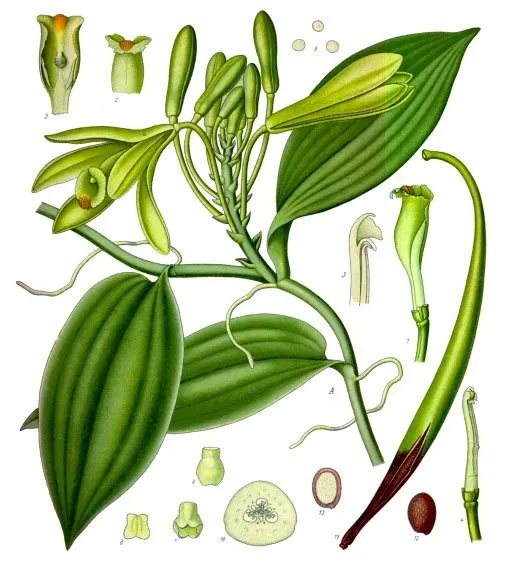
Safety information
Safety information
Toxicity: None known at culinary/flavor amounts; vanillin food-grade and generally recognized as safe. Most commercial vanilla extract contains alcohol (relevant for abstainers/very high intake). Can rarely cause contact dermatitis/allergy in handlers ('vanillism').
Contraindications: None at food use. Caution: alcohol content of extracts (recovering alcoholics, very young children in large amounts). Possible allergy in sensitized individuals/handlers.
Interactions: None established at culinary amounts.
Evidence level
Supported by laboratory or animal studies; not yet confirmed in humans.
Preparations
edible · fruit
Part used: fruit
Traditional use: flavoring(Folk and historical sources have not been validated by clinical research.)
Proposed mechanism: vanillin — antioxidant/antimicrobial in vitro
Dosage note (descriptive only): culinary/flavoring amounts
Associated conditions
Edibility
Edible parts: cured pod and seeds, and extract, in culinary amounts (flavoring)
Toxic lookalike warning
Synthetic vanillin and tonka bean (Dipteryx odorata, contains coumarin) are sometimes substituted — tonka is restricted/flagged due to coumarin; do not substitute tonka for vanilla
Nutritional notes
Used in trace flavoring amounts — not a meaningful nutrient source; provides vanillin and minor phenolics (antioxidant in vitro)
Healing traditions
Related plants
Sources (3)
- Antibacterial effects of vanilla ingredients — recent literature review (2022)
- How Effective Is Vanilla planifolia Beyond Flavor in Protecting Against Oxidative Stress? (review)
- Vanillin: a review on the therapeutic prospects of a popular flavouring molecule (Advances in Traditional Medicine, 2021)
Sourcing & resources
Affiliate links — we may earn a small commission at no extra cost to you.