
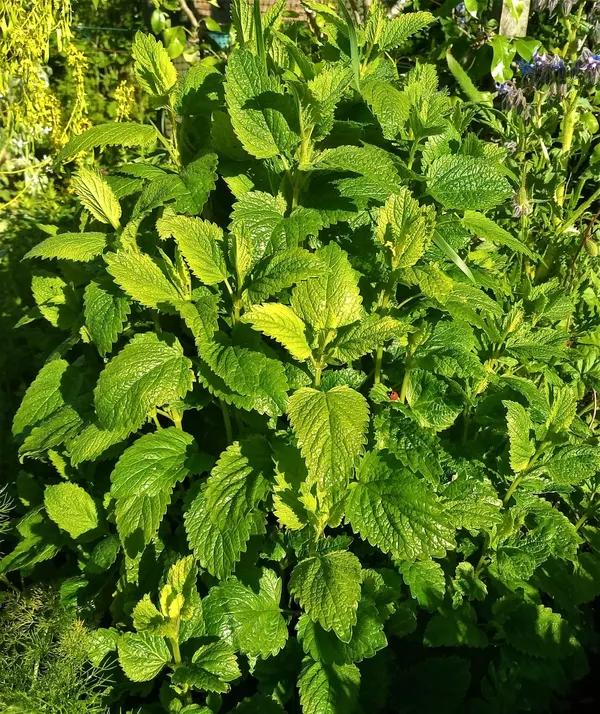
Lemon Balm
Melissa officinalis
Other names: Lemon Balm, Lemon Balm (Melissa)
Edible plantPhoto credit: Amitchell125
Safety information
Safety information
Toxicity: At assessment, no side effects reported. | Mild (essential oil not for unsupervised internal use).
Contraindications: EMA: adults/children >12; consult a doctor if symptoms persist beyond 2 weeks. Some sources caution in thyroid disease (not on EMA summary). | Caution with thyroid medication/conditions (thyroid-inhibiting).
Interactions: Not detailed on public summary; theoretical additive sedation with CNS depressants; theoretical thyroid-hormone interaction (preclinical). | Possible additive with sedatives/thyroid drugs.
Pregnancy & breastfeeding: Not specifically addressed.
Evidence level
Supported by laboratory or animal studies; not yet confirmed in humans.
Preparations
infusion · aerial parts
Part used: aerial parts
Traditional use: Traditionally used as a carminative and mild antidepressant nervine for flatulent dyspepsia with anxiety/depression, neuralgia, anxiety-induced palpitations, insomnia and tension-related migraine; topically for cold sores.
How to prepare (traditional): Infusion: pour 1 cup of boiling water over 2-3 teaspoons of dried herb (or 4-6 g fresh) and infuse, covered, 10-15 minutes. A lotion-based extract may be applied to herpes simplex lesions.
Dosage note (descriptive only): A cup morning and evening or when needed. Commission E: 1.5-4.5 g dried herb as infusion several times a day.
tincture · aerial parts
Part used: aerial parts
Traditional use: Carminative nervine.
How to prepare (traditional): Tincture at 1:5 in 40% alcohol.
Dosage note (descriptive only): 2-6 ml three times a day.
oil · aerial parts
Part used: aerial parts
Traditional use: Traditionally massaged onto the area for shingles.
How to prepare (traditional): Essential oil added to olive oil and massaged into the painful area.
Dosage note (descriptive only): For shingles, the book suggests 5 drops in 1 tsp olive oil massaged gently.
other · aerial parts
Part used: aerial parts
Traditional use: Traditionally applied for cold sores, cuts and scrapes, and insect stings.
How to prepare (traditional): Lotion made from an infusion, applied to the skin; juice applied to cuts and scrapes; ointment applied to insect stings.
Dosage note (descriptive only): Lotion applied regularly to cold sores; juice applied as needed.
Associated conditions
Edibility
Edible parts: leaves as a culinary herb/tea (lemon-scented), raw or cooked | lemon-scented leaves used in teas, salads and desserts
Toxic lookalike warning
Cultivated; unmistakable by aroma.
Nutritional notes
Culinary herb; negligible nutrition. | Culinary herb.
Healing traditions
Related plants
Sources (3)
- Chevallier A., Encyclopedia of Herbal Medicine (2016) — Andrew Chevallier (2016)
- EMA/HMPC Melissae folium monograph & public summary
- Priya 2025 rosmarinic acid review (PMID 40134762, DOI 10.2147/ndt.s501597)
Sourcing & resources
Affiliate links — we may earn a small commission at no extra cost to you.