
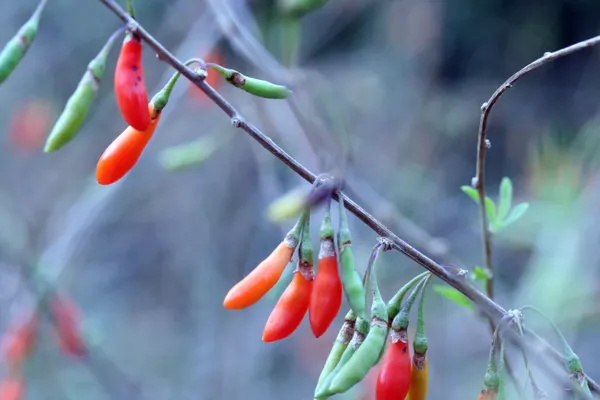
Goji Berry (Chinese Wolfberry)
Lycium chinense
Other names: Goji Berry (Chinese Wolfberry)
Edible plantPhoto credit: Sambuca
Safety information
Safety information
Toxicity: Mild.
Contraindications: Avoid in pregnancy; do not take with warfarin.
Interactions: Warfarin/anticoagulants (interaction).
Pregnancy & breastfeeding: Avoid in pregnancy.
Evidence level
Supported by clinical trials in humans.
Preparations
decoction · root
Part used: root
Traditional use: Traditionally taken for fevers.
How to prepare (traditional): Decoction of the root.
Dosage note (descriptive only): For fevers, the book suggests about 1/2 cup (100 ml) daily.
tincture · root
Part used: root
Traditional use: Traditionally taken for coughs and wheezing.
How to prepare (traditional): Tincture of the root diluted with water.
Dosage note (descriptive only): For coughs and wheezing, the book suggests 1/2 tsp diluted with water three times a day.
decoction · fruit
Part used: fruit
Traditional use: Traditionally taken to support eyesight; berries are also eaten raw or in cooking as a daily tonic.
How to prepare (traditional): Decoction made by chopping and simmering the dried berries.
Dosage note (descriptive only): For poor eyesight, the book suggests about 1/2 cup (100 ml) daily.
Associated conditions
Edibility
Edible parts: berries eaten raw, dried or cooked (traditional food-medicine)
Toxic lookalike warning
Berries are in the nightshade family; eat only the ripe fruit of the correct species.
Nutritional notes
High in zeaxanthin/carotenoids; vitamins B1, B12, C; antioxidant superfruit.
Healing traditions
Related plants
Sources (1)
- Chevallier A., Encyclopedia of Herbal Medicine (2016) — Andrew Chevallier (2016)
Sourcing & resources
Affiliate links — we may earn a small commission at no extra cost to you.