
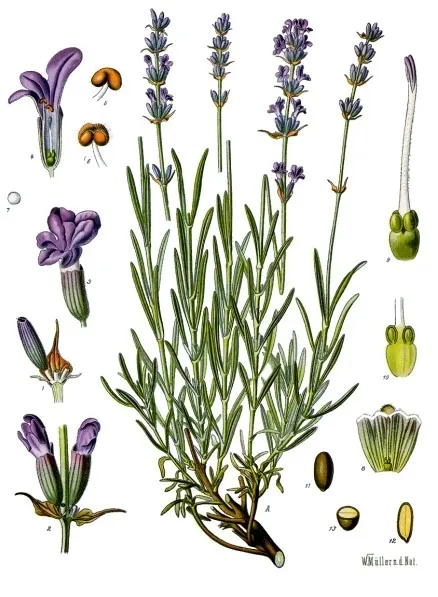
Lavender
Lavandula angustifolia
Other names: Lavender
Edible plantPhoto credit: Franz Eugen Köhler, Köhler's Medizinal-Pflanzen
Safety information
Safety information
Toxicity: Oral oil: eructation (lavender-scented burping), mild GI upset; generally well tolerated. Topical/aromatherapy: skin sensitisation possible. Some case reports associated topical lavender (and tea-tree) oil with prepubertal gynecomastia; evidence debated. | Mild (essential oil not for unsupervised internal use). | None known reported.
Contraindications: EMA traditional-use limits by preparation/age (oral standardized-oil products are adult). Limited pregnancy/breastfeeding data. | None notable for the flower; supervise essential-oil internal use. | Essential oil should not be taken internally.
Interactions: Theoretical additive sedation with CNS depressants/benzodiazepines; otherwise few documented at therapeutic oral doses. | Additive with sedatives (caution). | None reported.
Pregnancy & breastfeeding: Limited pregnancy/breastfeeding data.
Evidence level
Supported by clinical trials in humans.
Preparations
infusion · flower
Part used: flower
Traditional use: Traditionally used for stress-related headaches, depression, to promote sleep, and as a nervous-system tonic; the essential oil externally as a liniment for rheumatic aches.
How to prepare (traditional): Infusion (internal): pour 1 cup of boiling water over 1 teaspoon of dried herb and infuse, covered, 10 minutes. The essential oil is for external use - inhaled, rubbed on the skin or added to baths, not taken internally.
Dosage note (descriptive only): Infusion drunk three times a day. Commission E: 1-2 teaspoons herb per cup, or 1-4 drops (about 20-80 mg) of essential oil.
tincture · flower
Part used: flower
Traditional use: Traditionally taken for insomnia.
How to prepare (traditional): Tincture of the flowers taken with water.
Dosage note (descriptive only): For insomnia, the book suggests 1/2–1 tsp with water at night.
oil · flower
Part used: flower
Traditional use: Traditionally massaged onto temples for headaches.
How to prepare (traditional): Massage oil made by combining essential oil with carrier oil and applying.
Dosage note (descriptive only): For headaches, the book suggests combining 20 drops with 1 tbsp carrier oil and applying.
Associated conditions
Edibility
Edible parts: Culinary lavender (buds) used in small amounts as flavoring (herbes de Provence, baking). Concentrated essential oil is NOT a food. | Flowers used in small amounts as a culinary flavouring; not a staple | flowers used in small culinary amounts
Nutritional notes
Negligible (flavoring). | None notable. | Minor culinary use.
Healing traditions
Related plants
Sources (5)
- Chevallier A., Encyclopedia of Herbal Medicine (2016) — Andrew Chevallier (2016)
- Hoffmann D., Medical Herbalism (2003) — David Hoffmann (2003)
- EMA/HMPC Lavandulae flos / Lavandulae aetheroleum monograph & public summary
- Manzoor 2025 anxiolytic clinical review (PMID 40994458, DOI 10.1002/fsn3.70993)
- Nechepurenko 2026 Lavandula pharmacology review (PMID 42248216, DOI 10.1080/13880209.2026.2679806)
Sourcing & resources
Affiliate links — we may earn a small commission at no extra cost to you.