
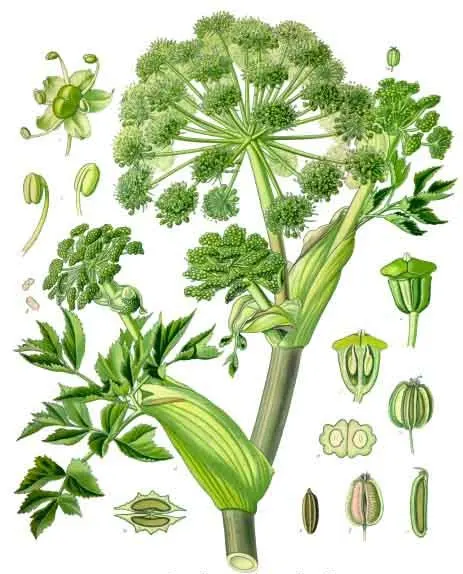
Angelica
Angelica archangelica
Other names: Angelica
Edible plantPhoto credit: Franz Eugen Köhler, Köhler's Medizinal-Pflanzen
Safety information
Safety information
Toxicity: Furanocoumarins may provoke photosensitivity reactions.
Contraindications: Avoid prolonged sun/UV exposure during use.
Interactions: Coumarin constituents — high doses may interfere with anticoagulant therapy.
Evidence level
Documented in systematic traditional medicine literature.
Preparations
decoction · root
Part used: root
Traditional use: Traditionally used as an expectorant for coughs, bronchitis and pleurisy (especially with fever/cold), as a carminative for intestinal colic and flatulence, as a digestive/appetite stimulant, and as a urinary antiseptic.
How to prepare (traditional): Decoction: place 1 teaspoon of cut root in 1 cup of water, bring to a boil and simmer 2 minutes, then remove from heat and let stand 15 minutes.
Dosage note (descriptive only): 1 cup three times a day.
tincture · root and leaf
Part used: root and leaf
Traditional use: Carminative and expectorant. (Stem and seed are used in confectionery.)
How to prepare (traditional): Tincture at 1:5 in 45% alcohol.
Dosage note (descriptive only): 2-5 ml three times a day.
Associated conditions
Edibility
Edible parts: candied stems; flavoring in liqueurs/gin/vermouth; leaves as garnish/salad
Toxic lookalike warning
Confusable with poisonous hemlock (Conium) and water hemlock (Cicuta) when foraging Apiaceae — positive ID essential.
Nutritional notes
Culinary/flavoring role.
Healing traditions
Related plants
Sources (1)
- Hoffmann D., Medical Herbalism (2003) — David Hoffmann (2003)
Sourcing & resources
Affiliate links — we may earn a small commission at no extra cost to you.