
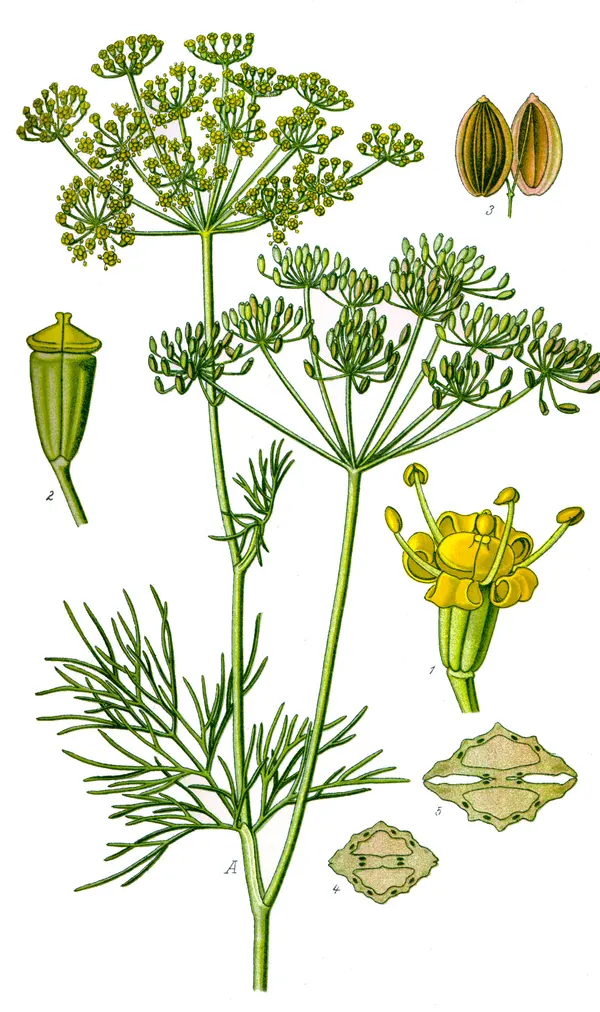
Dill
Anethum graveolens
Other names: Dill
Edible plantPhoto credit: Otto Wilhelm Thomé, Flora von Deutschland
Safety information
Safety information
Toxicity: None known at culinary doses. Indian/Japanese dill oil (contains dill apiol) differs from official European oil and should not be substituted (Grieve). | Mild — contact with fresh-plant juice may cause photodermatitis.
Contraindications: None specified by source. | None specifically reported.
Interactions: None specified by source. | None reported.
Evidence level
Documented in systematic traditional medicine literature.
Preparations
infusion · seed
Part used: seed
Traditional use: Traditionally used as a carminative for flatulence and colic (the herb of choice for children's colic) and to stimulate milk flow in nursing mothers; chewing the seeds for bad breath.
How to prepare (traditional): Infusion: pour 1 cup of boiling water over 1-2 teaspoons of gently crushed seeds and infuse, covered, for 10-15 minutes.
Dosage note (descriptive only): For flatulence, a cup of the infusion before meals. Commission E: about 3 g of seed daily.
tincture · seed
Part used: seed
Traditional use: Carminative.
How to prepare (traditional): Tincture at 1:5 in 25% alcohol.
Dosage note (descriptive only): 2-4 ml three times a day.
Associated conditions
Edibility
Edible parts: leaves (soups, fish, pickles), seeds (pickling, baking) | seed and leaf, culinary herb/spice
Toxic lookalike warning
As a feathery-leaved Apiaceae, wild collection risks confusion with poison hemlock (Conium) and hemlock water-dropwort (Oenanthe), which are fatal. Use only cultivated/clearly identified dill.
Nutritional notes
Seeds yield ~3.5% volatile oil (d-carvone, d-limonene); culinary, not a major nutrient source. | Culinary aromatic.
Healing traditions
Related plants
Sources (2)
- Grieve M., A Modern Herbal (1931) — Maud Grieve (1931)
- Hoffmann D., Medical Herbalism (2003) — David Hoffmann (2003)
Sourcing & resources
Affiliate links — we may earn a small commission at no extra cost to you.