
Safety information
Safety information
Toxicity: At assessment, no side effects reported. | None known. | None known; regarded as benign and even a food plant. | None known reported. | None known; very high mucilage.
Contraindications: None stated on public summary. EMA age limits: throat/dry cough >3 years; stomach/gut discomfort >12; ethanol extracts adults only. | Mucilage may slow absorption of other drugs (separate dosing). | None specified by source. Modern: mucilage may slow absorption of other oral drugs. | None specifically reported. | Mucilage can slow absorption of co-taken oral drugs — separate dosing by ~1-2 h; diabetics note syrup sugar content.
Interactions: Mucilage may delay absorption of other oral drugs taken at the same time - separate dosing. | May delay co-administered oral drug absorption (modern note). | None specified by source. | May delay absorption of other drugs taken at the same time (mucilage effect). | May delay/reduce absorption of other oral medicines taken simultaneously.
Pregnancy & breastfeeding: Not specifically addressed.
Evidence level
Supported by laboratory or animal studies; not yet confirmed in humans.
Preparations
infusion · root
Part used: root
Traditional use: Traditionally used as a soothing demulcent for inflamed mucous membranes - root mainly for the digestive tract (gastritis, ulceration, colitis), leaf for the urinary and respiratory systems.
How to prepare (traditional): Cold infusion of the root: steep 2-4 g of root in 1 cup of cold water overnight (cold maceration to preserve the mucilage).
Dosage note (descriptive only): BHC: 2-5 g as dried herb or cold infusion. Commission E: about 6 g root or 5 g leaf daily.
tincture · root and leaf
Part used: root and leaf
Traditional use: Demulcent.
How to prepare (traditional): Tincture at 1:5 in 25% alcohol.
Dosage note (descriptive only): 1-4 ml three times a day.
Associated conditions
Edibility
Edible parts: Root edible/used in foods historically (the original marshmallow confection); leaves edible cooked. | Root/leaf edible historically; mainly medicinal. | young tops/tender leaves raw in spring salads; roots boiled then fried | root historically used as food/confection base | root historically eaten/used in confectionery (origin of 'marshmallow'); minor food role
Toxic lookalike warning
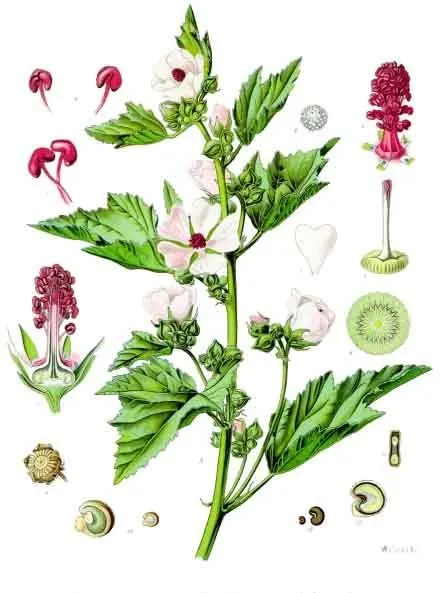
As a mallow (Malvaceae) generally low-risk, but any wild root harvesting requires positive identification before eating. | Identify by velvety stellate-hairy foliage and the 6-9-cleft outer calyx; distinguish from unrelated toxic plants of damp/marsh ground before eating. | Confirm Althaea (tall mallow, soft velvety grey-green downy leaves, pale pink flowers) and avoid confusion with other tall roadside plants before harvesting root.
Nutritional notes
Root starch/mucilage; minor food use. | Root mucilage, starch, asparagine. | Historically a famine/subsistence food (mucilage, starch, sugar). | High mucilage and pectin content. | Mucilage polysaccharides (soluble fibre); not a staple food.
Healing traditions
Related plants
Sources (6)
- Grieve M., A Modern Herbal (1931) — Maud Grieve (1931)
- Hoffmann D., Medical Herbalism (2003) — David Hoffmann (2003)
- Bussmann et al., A comparative ethnobotany ... Republic of Georgia, J Ethnobiol Ethnomed 2016;12:43
- Mtsire Karabadini, Part II (Surmanidze, 1990) — Ramaz Surmanidze (1990)
- Karabadini (Khelaia ed., 2009) — Nani Khelaia (ed.) (2009)
- EMA/HMPC Althaeae radix monograph & public summary
Sourcing & resources
Affiliate links — we may earn a small commission at no extra cost to you.