
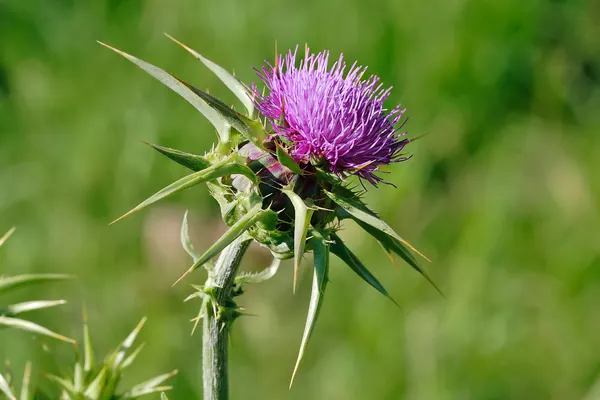
Milk Thistle
Silybum marianum
Other names: Milk Thistle, Milk thistle
Edible plantPhoto credit: fir0002 flagstaffotos [at] gmail.com Canon 20D + Sigma 150mm f/2.8
Safety information
Safety information
Toxicity: Well tolerated; mild GI symptoms (bloating, nausea, gas). Allergy in Asteraceae-sensitive individuals. Product-quality concern: variable silymarin content, pesticide/mycotoxin contamination (Fenclova 2019, PMID 31366891). | None known (rare allergy). | None known reported. | Seed extract: mild (GI, mild laxative effect). Asteraceae-allergy cross-reactivity.
Contraindications: Asteraceae allergy (ragweed, chrysanthemum, marigold, daisy). Limited pregnancy/breastfeeding data. | Seek guidance if combining with chemotherapy. | None specifically reported. | Asteraceae allergy; possible estrogenic effects (caution in hormone-sensitive conditions).
Interactions: Consult provider; theoretical CYP (CYP2C9, CYP3A4) and UGT effects, variably reported and usually modest in vivo. | Generally well tolerated; coordinate with oncology. | None reported (used protectively alongside hepatotoxic drugs). | Possible modest effects on CYP/UGT enzymes (theoretical drug interactions).
Pregnancy & breastfeeding: Limited pregnancy/breastfeeding data. | Safe during breastfeeding (galactagogue).
Evidence level
Supported by clinical trials in humans.
Preparations
other · seed
Part used: seed
Traditional use: Traditionally a liver tonic; clinically used to protect and treat the liver in conditions such as hepatitis and cirrhosis and against various hepatotoxins; also promotes milk secretion.
How to prepare (traditional): Modern use relies on a standardised seed extract (e.g. 30:1, standardised to about 80% silymarin) rather than a water infusion, because the active flavolignans are poorly water-soluble.
Dosage note (descriptive only): For daily liver protection, about 175 mg/day of 30:1 extract (80% silymarin); for therapeutic/restorative use up to 600 mg/day. Commission E: 12-15 g seed or 200-400 mg silymarin daily.
decoction · seed
Part used: seed
Traditional use: Traditionally taken for liver infections.
How to prepare (traditional): Seeds are made into a decoction.
Dosage note (descriptive only): For liver infections, about 1/3 cup (75 ml) a day.
capsule · seed
Part used: seed
Traditional use: Used for hangover and long-term liver support.
How to prepare (traditional): Seeds are made into capsules; tablets are also prescribed.
Dosage note (descriptive only): For a hangover, a 500 mg capsule; tablets for long-term liver-disorder treatment.
tincture · seed
Part used: seed
Traditional use: Taken to help hay fever.
How to prepare (traditional): A tincture is made from the seeds.
other · flower
Part used: flower
Traditional use: Traditional spring tonic; said to increase breast-milk and ease melancholia.
How to prepare (traditional): Flower heads were boiled and eaten like artichokes.
Associated conditions
Edibility
Edible parts: Young leaves/stalks historically eaten cooked (as a thistle vegetable), but not the medicinal use. | flower heads can be eaten like artichoke; young leaves/stalks edible (traditional spring tonic) | young parts of the plant are edible (traditional); seed is the medicinal part | Young de-spined leaves/stalks cooked (historical).
Toxic lookalike warning
Thistles are spiny and easily confused with other Asteraceae; positive ID required before any culinary use. | As a spiny thistle, confirm the distinctive white-marbled leaves before foraging. | Spiny, white-marbled leaves are distinctive, but rosettes can be confused with other thistles and with toxic spiny rosettes; confirm the white milk leaf-veining. As an Asteraceae forage, exclude intermixed ragwort.
Nutritional notes
Seeds not a notable food. | Minor food value. | Seed contains fixed oil and sterols. | Seed: silymarin flavonolignans, fixed oil; leaf/stalk: minor vegetable. Functional hepatoprotective interest (seed).
Healing traditions
Related plants
Sources (4)
- Chevallier A., Encyclopedia of Herbal Medicine (2016) — Andrew Chevallier (2016)
- Hoffmann D., Medical Herbalism (2003) — David Hoffmann (2003)
- NCCIH Milk Thistle fact sheet (Fried 2012 JAMA, PMID 22797645; Navarro 2019 PLoS ONE, PMID 31536511; Soleimani 2019, PMID 31069872; Fenclova 2019, PMID 31366891)
- NIH LiverTox Milk Thistle chapter
Sourcing & resources
Affiliate links — we may earn a small commission at no extra cost to you.