
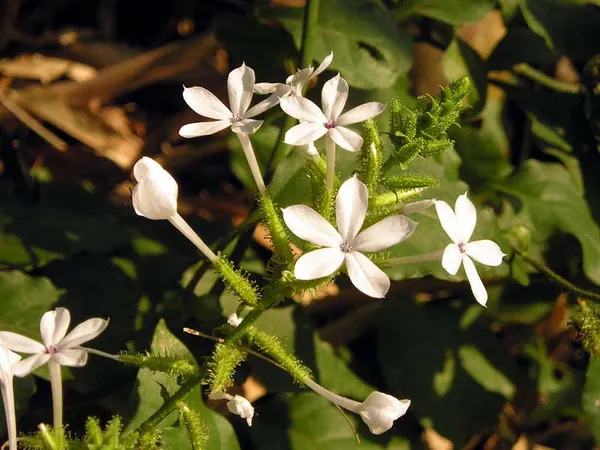
Chitrak (leadwort)
Plumbago zeylanica
Other names: Chitraka (चित्रक), Ceylon leadwort, doctorbush, Chitrak (leadwort)
Photo credit: Bernard Loison
This plant carries serious safety risks. All information is for educational reference only.
Safety information
Toxicity: SERIOUS / irritant. Plumbagin is a potent skin/mucosal irritant and toxic at higher doses; the root is an established abortifacient with anti-implantation activity (suppresses progesterone, FSH, LH in animal models).
Contraindications: Pregnancy — strictly contraindicated (abortifacient). Bleeding/GI ulceration, internal inflammation; not for unsupervised use.
Interactions: Insufficient human data; theoretical with hormonal agents; additive irritation with GI irritants.
Pregnancy & breastfeeding: Strictly contraindicated — abortifacient.
Evidence level
Supported by laboratory or animal studies; not yet confirmed in humans.
Preparations
This plant carries serious safety risks. All information is for educational reference only.
powder/decoction (after shodhana) · root
Part used: root
Traditional use: digestive stimulant ('agni deepana'), poor digestion, skin disorders, 'ama'; 'Chitrakadi' formulations
Proposed mechanism: Plumbagin (naphthoquinone) is redox-active/ROS-generating — anticancer/antimicrobial/pro-apoptotic in vitro; same reactivity drives irritancy; in animals anti-implantation/abortifacient via suppression of progesterone, FSH, LH
Dosage note (descriptive only): Requires processing ('shodhana') and only small amounts in compound formulations; abortifacient and irritant — no how-to dosing
Reference only — not a dosage instruction
Associated conditions
Nutritional notes
N/A; bioactive is plumbagin (naphthoquinone).
Healing traditions
Related plants
Sources (3)
- Padhye 2012, Med Res Rev (PMID 23059762)
- Thakor 2022, Curr Pharm Biotechnol (PMID 34967293)
- Sandeep 2011, Asian Pac J Trop Med (PMID 22118035)