
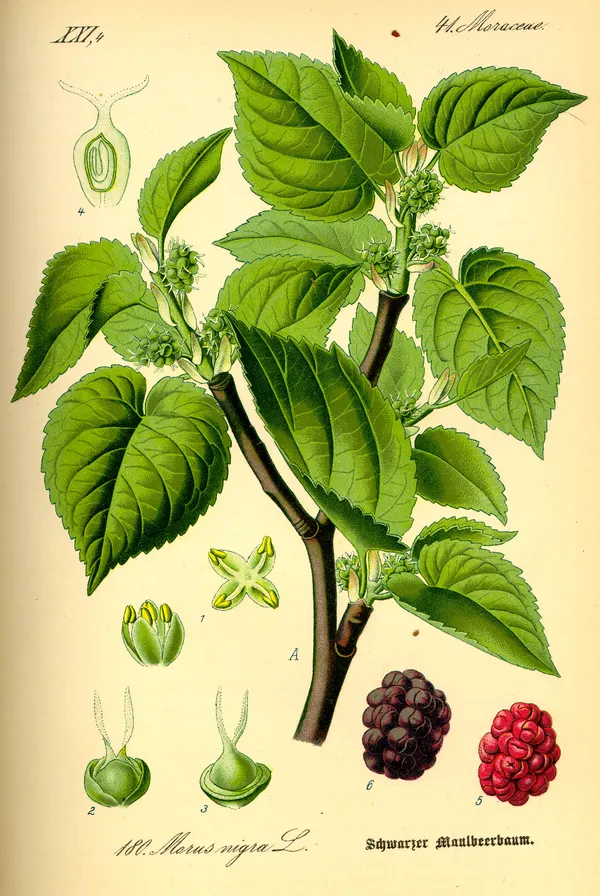
Black mulberry / white mulberry
Morus nigra(?)
Other names: Black mulberry / white mulberry
Edible plantSafety information
Safety information
Toxicity: Ripe fruit: none known. Unripe (white/green) fruit and the milky leaf/stem latex can cause GI upset/be mildly hallucinogenic in quantity — eat only ripe fruit. Leaf preparations 'for sugar' can cause hypoglycaemia if combined with diabetes drugs.
Contraindications: Diabetics using mulberry-leaf preparations should monitor for additive hypoglycaemia; unripe fruit/latex avoided.
Interactions: Leaf (DNJ) theoretical additive hypoglycaemic effect with antidiabetics (sulfonylureas, insulin) and with acarbose-type drugs (same mechanism).
Evidence level
Supported by clinical trials in humans.
Preparations
edible-raw · ripe fruit
Part used: ripe fruit
Traditional use: eaten fresh(Folk and historical sources have not been validated by clinical research.)
Dosage note (descriptive only): ripe only
cooked · fruit
Part used: fruit
Traditional use: jam, boiled syrup 'badagi', fruit leather, churchkhela dipping, vodka/chacha base(Folk and historical sources have not been validated by clinical research.)
infusion · leaf
Part used: leaf
Traditional use: folk 'for sugar'/diabetes
Proposed mechanism: 1-deoxynojirimycin alpha-glucosidase inhibitor (postprandial glucose)
Associated conditions
Edibility
Edible parts: ripe fruit raw or cooked (very staining)
Toxic lookalike warning
Ripe mulberries are distinctive aggregate fruits on a tree, but unripe white/red mulberries should not be eaten in quantity; avoid confusion with unrelated dark aggregate berries from shrubs.
Nutritional notes
Fruit rich in vitamin C, iron, anthocyanins (black mulberry) and resveratrol; the boiled syrup 'badagi' is an energy-dense traditional sweetener. A valued functional fruit.
Healing traditions
Related plants
Sources (2)
- Bussmann et al., A comparative ethnobotany ... Republic of Georgia, J Ethnobiol Ethnomed 2016;12:43
- Bussmann et al., Unity in diversity — food plants of Sakartvelo, 2021
Sourcing & resources
Affiliate links — we may earn a small commission at no extra cost to you.